A 'Swenglish' journey through family photos, notes and postcards
from the early 20th century.

2026-02-28

Visiting Versailles in the 1930s - Sepia Saturday 815

The theme for Sepia Saturday 815 shows a museum bedroom - which made me think of  some old postcards from Versailles, Paris, from my great-aunt Gerda's collection. 

This is a photo of Gerda visiting the gardens of Versailles in 1932. I have shown the same photo in an earlier post, from 2022-05-06, linked to Sepia Saturday 620. But that's nearly four years ago now... Some followers with good memories may remember bits and pieces from Gerda's story, but here's a short summary again:

Gerda Ekman, born 1881, was one of my grandmother Sally's older half-sisters. They shared the same father, but had different mothers. Gerda's mother died when she was six years old. In 1898, when she was 17, her father got remarried  to a younger window with one daughter (six years old at the time). 

In 1900, my grandmother Sally was born, and in 1902 also a baby boy. In those years of her father starting a new family, Gerda seems to have been staying with her oldest sister and her family much of the time. The sibling closest to Gerda's own age was her brother Gustaf, only two years older than herself. He was making plans to emigrate to America, and Gerda was no doubt inspired by him (but perhaps by other friends with the same plans as well). 

They both ended up emigrating in 1902 (for Gerda, when she turned 21). My impression is that they did not go on the same ship, though, but a few months apart. Anyway, while Gustaf ended up at a sawmill in Pennsylvania, Gerda went to Chicago; where she probably started out as simple kitchen maid, but kept working her way up to more respected positions in bigger households. Both siblings returned to Sweden around 1910/11. (Their father had then been dead for a few years - he died in 1907.) While Gustaf went back to farm work, Gerda continued her "career" as lady's maid and travel companion to wealthy ladies. 

When WWI broke out in 1914, Gerda happened to be in France - and got stuck there for the duration of the war. I've so far not been able to figure out who exactly she worked for during those years (and I probably never will) - but it was obviously for some fairly wealthy woman (or couple), as postcards show that in spite of the war going on, they went on holidays in the eastern parts of France, down to the riviera, and also over lake Geneva to Switzerland. After the war, Gerda returned to Sweden again - but continued to work as lady's maid/travel companion for various upper class women, also travelling abroad now and then.

In the autumn of 1928, she got employed as lady's maid to Estelle Manville-Bernadotte, daughter of a wealthy American, who in December that year married the Swedish count Folke Bernadotte (nephew of King Gustav V of Sweden). (The wedding took place in Pleasantville, N.Y.) The couple/family kept travelling a lot in the 1930s, both between Sweden and America, and within Europe; and Gerda travelled with them. 

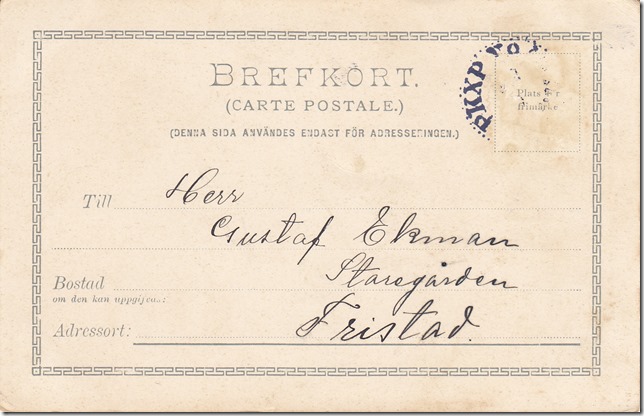
Years ago, a relative quoted (in an email to me) a document stating that in 1932, Gerda was employed at Square Lamartine no 3 in Paris, as "domestique au service du comte Bernadotte de Wisborg, neveu du Roi de Suède"  (Cf a post from 2022-05-06: Cairo and Paris, 1932 - Sepia Saturday 620) 

So I know for a fact that Gerda was in Paris in 1932, and visited Versailles that year. Possibly the postcards may have been bought even earlier though. (No dates printed on them, so I can't be sure.)

Anyway - what made me think of these cards for this week's Sepia Saturday was three bedroom photos:

Marie Antoinette's Bedroom

Lous XIV's bedroom

Napoleon's bedroom

I'll include the rest of the Versailles postcards as well, just to have them all gathered in one post:


Linking to: Sepia Saturday 815 (28 February 2026)


2025-11-08

"Hands Across the Sea" (Repost for Sepia Saturday 800)


Sepia Saturday, started in 2009 by Alan Burnett, is celebrating 800 weeks of photographic memories this week. I dare not guess how many old photos have been shared via that blog since then. I know I started my own first blog in 2009 as well, but I don't think I came across Sepia Saturday until several years later. The blog I've mostly been sharing from is this one, which I started in 2012, as a project of going through old postcards and photos inherited from my paternal grandparents. But when I got started on that, I had not yet discovered Sepia Saturday, so I have quite a few old posts that were never shared there. I'm choosing one of my earliest posts on this blog, from February 2012, to repost for this celebration.

Repost from 2012-02-09: 


R.M.S. CARONIA, (CUNARD LINE,) 20,000 TONS.

The postcard is an unwritten and undated one, found at the back of the postcard album.

R.M.S. Caronia was built in 1905, in service for the Cunard Line 1905-1932 (scrapped 1932)

Royal Mail Ship (sometimes Steam-ship or Steamer), usually seen in its abbreviated form RMS, a designation which dates back to 1840, is the ship prefix used for seagoing vessels that carry mail under contract by Royal Mail.  --- It was used by many shipping lines, but is often associated in particular with the Cunard Line,2 Royal Mail Lines and Union-Castle Line, which held a number of high-profile mail contracts, and which traditionally prefixed the names of many of their ships with the initials "RMS". 

 
http://en.wikipedia.org/wiki/Royal_Mail_Ship

Why Did They Emigrate? 

How is it that one never seems to think of the questions to ask until everyone who might be able to answer them is already gone? Is it because the right questions don’t arise until you’re old enough to begin to get a bit of perspective on your own life? Or even that there might be some questions that cannot be asked until you’re free to use your own imagination to fill in the details?

I do remember from my childhood, that my p.grandmother Sally used to talk about her big family and the farm where she grew up. But I never really got a time-perspective on it. All the names were a blur, and I never quite ‘got’ who was who among all the family portraits that sat on top of the cupboard in my grandparents’ living-room.

Family portraits are funny like that – frozen in time – some people forever old, others forever young, depending on when they happened to have their photo taken. A bunch of familiar faces (when you’ve been looking at those portraits all your life) but if you never knew them, there is really no clue who was the oldest or the youngest among them. Or even who is who!

I always knew that my grandma Sally had a bunch of older half-siblings, but I don’t think I ever quite got how much older most of them were. Like the fact that her oldest half-brother Carl, who also lived on the farm where she grew up, was in fact 30 years older than Sally; and only nine years younger than Sally’s mother! Or that she had nieces /nephews older than herself. Or that her father died when she was only seven. Or that she can’t really have had any early childhood memories of the two youngest half-siblings from her father’s first marriage – Gustaf and Gerda – because they went off to America when she was about 2½, and did not come back until she was 11.

And until I found the postcard albums that belonged to Gustaf and Gerda, even less has it ever occurred to me to think about things from their point of view. (Gustav I never met because he died before I was born. I’m not sure if I ever met Gerda either, even though she lived to be 92.)

When their mother Anna Sophia died (at the age of 57, and having given birth to nine children), Gustav was 16, Gerda 13.

When, four years later, in December 1898, their father Samuel (63) got remarried to Selma (a 37 year old widow with a young daughter), Gustaf was 20 and Gerda 17. My grandma Sally was born just over a year later, in February 1900. 1½ year later, in the summer of 1902, another baby was born, Sally’s brother Nils.

It seems to have been in the autumn/winter of 1902, that Gustaf and Gerda both went off to seek their fortune on the other side of the Atlantic. Gustaf was 24 and Gerda 21. Their father had started over with a new family (also including a step-sister, by then 10 years old); with their oldest brother to help. There were enough people living on the farm. The other older siblings had their own lives. Work opportunities in Sweden were hard to find.

At least part of 1901, Gerda was living or staying with her sister Emma (married with children) and Gustaf may have been staying with his older brother Oscar (also married).

I’m not sure if Gustaf and Gerda went to America together on the same boat, but it can’t have been far between. They did not go to live in the same place or even the same state, though.

At Christmas 1902, Gustaf was in Pennsylvania. It seems he stayed in Pennsylvania until he went back to Sweden in 1911.

At New Year 1903, Gerda was in Chicago; and still there in 1910.

Gustav came back to Sweden to live and work on the family farm in the summer of 1911. (Samuel, the father, had died in 1907.)

I’m not sure when Gerda came back, but I found evidence that in 1913 she was staying in Ronneby in Sweden (south-east coast).

The facts I’ve extracted partly from reading the addresses on random postcards, partly from dates of births and deaths collected by my father and one of his cousins (son of grandma Sally’s younger brother Nils).

Additional information from Wikipedia:

In the 19th and early 20th centuries, about 1.3 million Swedes left Sweden for the United States. The main "pull" was the availability of low cost, high quality farm land in the upper Midwest (the area from Illinois to Montana), and high paying jobs in mechanical industries and factories in Chicago, Minneapolis, Worcester and many smaller cities. The American environment also provided low taxes and no established state church or monarchy. Push factors inside Sweden included population growth and crop failures. Most migration was of the chain form, with early settlers giving reports and recommendations (and travel money) to relatives and friends in Sweden.

By 1890 the U.S. census reported a Swedish-American population of nearly 800,000. After a dip in the 1890s, emigration rose again, causing national alarm in Sweden. A broad-based parliamentary emigration commission was instituted in 1907. It recommended social and economic reform in order to reduce emigration. The effect of the measures taken is hard to assess, as World War I (1914-1918) also had its effect on migration. From the mid-1920s, there was no longer a Swedish mass emigration.


2025-10-31

The Three Cooks at Highgate, Mont. ~ 1904 (SS 799)

 Reposted from 2019-06-11


An unwritten, undated card from my great-uncle Gustaf's postcard album, with the text "The Three Cooks at Highgate, Mont." printed on the front. It sits in between other postcards from 1904 in the album. 

From the official website for the state of Montana, I learn that the discovery of gold brought many prospectors into that area in the 1860s; leading to boomtowns growing rapidly - and declining just as quickly when the gold ran out. Later, there was also silver and copper mining. And a lot of cattle and sheep ranches and wheat farming, as the gold-diggers and miners needed to eat... But the gold ran out (and perhaps silver and copper too); and post-WWI droughts and depression meant that a lot of farmers were forced to leave the state as well.

My best guess  is that the "Three Cooks" postcard may be from a boomtown restaurant; and perhaps sent with a letter to Gustaf from some friend working in that area for a while. Whether the sender was one of the three cooks himself, or someone eating their food, I don't suppose I'm ever likely to find out.

---

31 October 2025
When I saw the prompt photo for Sepia Saturday 799, the postcard above with the three cooks immediately came to mind for me, and I searched my blog for it. As the original post was not shared with Sepia Saturday (and I'm not sure anyone ever read it at all!), I decided to just do a repost.

Gustaf was an older brother of my grandmother Sally. He emigrated to America in 1902 and spent about eight years there; most of the time living in Galeton, Pennsylvania, working at a sawmill. In 1910 or 1911, he returned to Sweden - and as far as I know, he never went back to America again even to visit. 


2025-09-14

Washing Up - Sepia Saturday 792

For this week's Sepia theme, "washing up", I looked through some old photos in search of some that might show my grandparents'  kitchen sink, as I remember it from my early childhood (I was born in 1955). I found these two below - and on closer inspection, I even think they may have been taken on the same occasion, as my grandmother (Sally) is wearing the same clothes in both. 


Here she's feeding their collie Zepp a biscuit. She's standing next to a narrow cupboard next to the electric stove. To the right, next to the door (leading out into the entrance hall), is the kitchen sink with draining board.


Here she's sitting on the sofa by the window (one of two), drinking coffee, with the kitchen sink to the left. There's a small mirror on the wall above: They also often used the kitchen sink for washing hands and face, shaving etc. 

It occurred to me that if I put the two photos together edge to edge, they would show the whole small sink area. The scale is not 100% the same in both photos, but close enough...


Dishes were always washed up directly after a meal, dried with a towel and put away. In the photo the dish rack is turned up against the wall - when it was down, it covered the whole small draining board. There were no other workbench surfaces in the kitchen. The kitchen table was used for "everything".

In my childhood, they did also have WC and a bathtub installed down in the cellar, but there was no washbasin or mirror down there, and the walls and floor were raw cement... In summer they still mostly still used the old "outhouse" out in the yard. It was not until after my grandfather died (in 1969) that my dad arranged for a WC (+ washbasin) to be put in for my grandmother in what used to be a wardrobe next to the living room on the ground floor; and also a WC in a wardrobe upstairs (where there was already a washbasin in the adjoining bedroom). My grandmother pretty much only used the downstairs kitchen + living room (and slept in the kitchen) during the last years when she lived there alone, while we used the upstairs two rooms when visiting her.

After Sally moved to a retirement home in the village, and after her death, we kept the house as a holiday house. When dad retired from work (at 60), he and mum decided to move there permanently - but not until they had added a large new extension (more than doubling the living space), including a modern kitchen and bathroom + large new living room downstairs, and an enormous home office space upstairs for dad. The old living room became their bedroom; and what remained of the old kitchen (sink and stove and cupboards removed) became a sort of extra, doorless, room where some "antique" furniture and books were kept, as reminders of the past. 

Linking to Sepia Saturday 792


2025-09-06

Picnic - Sepia Saturday 791


My paternal grandparents loved to go on picnics ("coffee outings") in the summer. My grandmother Sally would pack a picnic basket with a coffee thermos, cups and saucers (porcelain, not plastic), and some buns and biscuits to eat. I'm not sure who the couple in the middle are, but it's Sally to the left, and her sister Hildur with husband Olle to the right; and I think it's probably from the mid/late 1950s. 

(Black & white photo re-cropped and turned sepia by me.)