A 'Swenglish' journey through family photos, notes and postcards
from the early 20th century.
Showing posts with label postcard. Show all posts

2025-11-08

"Hands Across the Sea" (Repost for Sepia Saturday 800)


Sepia Saturday, started in 2009 by Alan Burnett, is celebrating 800 weeks of photographic memories this week. I dare not guess how many old photos have been shared via that blog since then. I know I started my own first blog in 2009 as well, but I don't think I came across Sepia Saturday until several years later. The blog I've mostly been sharing from is this one, which I started in 2012, as a project of going through old postcards and photos inherited from my paternal grandparents. But when I got started on that, I had not yet discovered Sepia Saturday, so I have quite a few old posts that were never shared there. I'm choosing one of my earliest posts on this blog, from February 2012, to repost for this celebration.

Repost from 2012-02-09: 


R.M.S. CARONIA, (CUNARD LINE,) 20,000 TONS.

The postcard is an unwritten and undated one, found at the back of the postcard album.

R.M.S. Caronia was built in 1905, in service for the Cunard Line 1905-1932 (scrapped 1932)

Royal Mail Ship (sometimes Steam-ship or Steamer), usually seen in its abbreviated form RMS, a designation which dates back to 1840, is the ship prefix used for seagoing vessels that carry mail under contract by Royal Mail.  --- It was used by many shipping lines, but is often associated in particular with the Cunard Line,2 Royal Mail Lines and Union-Castle Line, which held a number of high-profile mail contracts, and which traditionally prefixed the names of many of their ships with the initials "RMS". 

 
http://en.wikipedia.org/wiki/Royal_Mail_Ship

Why Did They Emigrate? 

How is it that one never seems to think of the questions to ask until everyone who might be able to answer them is already gone? Is it because the right questions don’t arise until you’re old enough to begin to get a bit of perspective on your own life? Or even that there might be some questions that cannot be asked until you’re free to use your own imagination to fill in the details?

I do remember from my childhood, that my p.grandmother Sally used to talk about her big family and the farm where she grew up. But I never really got a time-perspective on it. All the names were a blur, and I never quite ‘got’ who was who among all the family portraits that sat on top of the cupboard in my grandparents’ living-room.

Family portraits are funny like that – frozen in time – some people forever old, others forever young, depending on when they happened to have their photo taken. A bunch of familiar faces (when you’ve been looking at those portraits all your life) but if you never knew them, there is really no clue who was the oldest or the youngest among them. Or even who is who!

I always knew that my grandma Sally had a bunch of older half-siblings, but I don’t think I ever quite got how much older most of them were. Like the fact that her oldest half-brother Carl, who also lived on the farm where she grew up, was in fact 30 years older than Sally; and only nine years younger than Sally’s mother! Or that she had nieces /nephews older than herself. Or that her father died when she was only seven. Or that she can’t really have had any early childhood memories of the two youngest half-siblings from her father’s first marriage – Gustaf and Gerda – because they went off to America when she was about 2½, and did not come back until she was 11.

And until I found the postcard albums that belonged to Gustaf and Gerda, even less has it ever occurred to me to think about things from their point of view. (Gustav I never met because he died before I was born. I’m not sure if I ever met Gerda either, even though she lived to be 92.)

When their mother Anna Sophia died (at the age of 57, and having given birth to nine children), Gustav was 16, Gerda 13.

When, four years later, in December 1898, their father Samuel (63) got remarried to Selma (a 37 year old widow with a young daughter), Gustaf was 20 and Gerda 17. My grandma Sally was born just over a year later, in February 1900. 1½ year later, in the summer of 1902, another baby was born, Sally’s brother Nils.

It seems to have been in the autumn/winter of 1902, that Gustaf and Gerda both went off to seek their fortune on the other side of the Atlantic. Gustaf was 24 and Gerda 21. Their father had started over with a new family (also including a step-sister, by then 10 years old); with their oldest brother to help. There were enough people living on the farm. The other older siblings had their own lives. Work opportunities in Sweden were hard to find.

At least part of 1901, Gerda was living or staying with her sister Emma (married with children) and Gustaf may have been staying with his older brother Oscar (also married).

I’m not sure if Gustaf and Gerda went to America together on the same boat, but it can’t have been far between. They did not go to live in the same place or even the same state, though.

At Christmas 1902, Gustaf was in Pennsylvania. It seems he stayed in Pennsylvania until he went back to Sweden in 1911.

At New Year 1903, Gerda was in Chicago; and still there in 1910.

Gustav came back to Sweden to live and work on the family farm in the summer of 1911. (Samuel, the father, had died in 1907.)

I’m not sure when Gerda came back, but I found evidence that in 1913 she was staying in Ronneby in Sweden (south-east coast).

The facts I’ve extracted partly from reading the addresses on random postcards, partly from dates of births and deaths collected by my father and one of his cousins (son of grandma Sally’s younger brother Nils).

Additional information from Wikipedia:

In the 19th and early 20th centuries, about 1.3 million Swedes left Sweden for the United States. The main "pull" was the availability of low cost, high quality farm land in the upper Midwest (the area from Illinois to Montana), and high paying jobs in mechanical industries and factories in Chicago, Minneapolis, Worcester and many smaller cities. The American environment also provided low taxes and no established state church or monarchy. Push factors inside Sweden included population growth and crop failures. Most migration was of the chain form, with early settlers giving reports and recommendations (and travel money) to relatives and friends in Sweden.

By 1890 the U.S. census reported a Swedish-American population of nearly 800,000. After a dip in the 1890s, emigration rose again, causing national alarm in Sweden. A broad-based parliamentary emigration commission was instituted in 1907. It recommended social and economic reform in order to reduce emigration. The effect of the measures taken is hard to assess, as World War I (1914-1918) also had its effect on migration. From the mid-1920s, there was no longer a Swedish mass emigration.


2025-10-31

The Three Cooks at Highgate, Mont. ~ 1904 (SS 799)

 Reposted from 2019-06-11


An unwritten, undated card from my great-uncle Gustaf's postcard album, with the text "The Three Cooks at Highgate, Mont." printed on the front. It sits in between other postcards from 1904 in the album. 

From the official website for the state of Montana, I learn that the discovery of gold brought many prospectors into that area in the 1860s; leading to boomtowns growing rapidly - and declining just as quickly when the gold ran out. Later, there was also silver and copper mining. And a lot of cattle and sheep ranches and wheat farming, as the gold-diggers and miners needed to eat... But the gold ran out (and perhaps silver and copper too); and post-WWI droughts and depression meant that a lot of farmers were forced to leave the state as well.

My best guess  is that the "Three Cooks" postcard may be from a boomtown restaurant; and perhaps sent with a letter to Gustaf from some friend working in that area for a while. Whether the sender was one of the three cooks himself, or someone eating their food, I don't suppose I'm ever likely to find out.

---

31 October 2025
When I saw the prompt photo for Sepia Saturday 799, the postcard above with the three cooks immediately came to mind for me, and I searched my blog for it. As the original post was not shared with Sepia Saturday (and I'm not sure anyone ever read it at all!), I decided to just do a repost.

Gustaf was an older brother of my grandmother Sally. He emigrated to America in 1902 and spent about eight years there; most of the time living in Galeton, Pennsylvania, working at a sawmill. In 1910 or 1911, he returned to Sweden - and as far as I know, he never went back to America again even to visit. 


2024-08-18

Greetings from Ulriksdal, Stockholm (Sepia Saturday 737)

 (Reposted card; first shared on this blog in February 2013.)

 
Stockholm - Ulriksdals slott
No 1378, Ferdinand Hey’l, Stockholm.

A. Blomberg, Photo


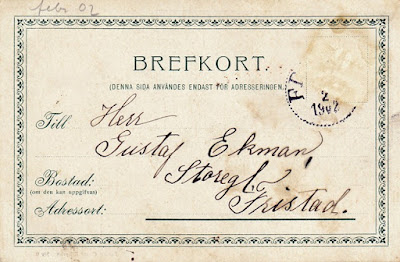
To: Mr Gustaf Ekman, Storegården, Fristad (1902)

The postcard was sent to my great-uncle Gustaf in 1902 (before he emigrated to America), from friends visiting Stockholm. I have still not managed to decipher all the words in the message, but it starts with "We are now in Stockholm", and seems to also include greetings from some mutual friend that they happened to run into there.  

(Edited colours) 

A comment on my original post back in 2013 points out how back then they liked to make photo postcards look like paintings. (I suppose the colours were added to a b&w photo.)

Photo from Wikipedia (2011)

Ulriksdal Palace was originally built for Count Jacob De la Gardie in 1645 and then called Jakobsdal. About 25 years later it was bought by Queen Hedwig Eleonora for her grandson Ulrik and renamed Ulriksdal after him. The little prince however died at the age of one. After the death of Hedwig Eleonora in 1715, the palace was transferred to the Crown.

In 1902 (when this postcard was sent), the King of Sweden was Oscar II. I’m not sure how Ulriksdal Palace was used in his day. Later on in the 20th century, it came to be much used by his grandson, crown prince Gustav Adolf (later king Gustav VI Adolf of Sweden, 1950-1973). Since 1986 it has been open to the public. Parts of the former living quarters are nowadays used to exhibit items from king Gustaf V's silver collection, and king Gustaf VI Adolf's art and crafts collection. (Wikipedia)


2023-10-07

Mysterious Girl with Moustache - Sepia Saturday 693

The Sepia Saturday October theme of Portraits gives me an opportunity to repeat another early post from this blog, with an old postcard that I still find very intriguing.

G.001-3 – Girl with Moustache 
Previously posted on this blog 2012-02-17


A postcard sent to Gustaf at Odensberg in 1901, while he was staying with his brother Oscar. (Cf. my post for SS 690. Before he emigrated to America in 1902, Gustaf seems to have alternated between staying with his father at his farm, vs with his brother who was running a country store at Odensberg.)

The postmark PKXP indicates a railway line and a locality along that line. In the early days, post was sorted aboard the trains.
 
The second printed line on the back of the card (Bostad - om den kan uppgifvas)  indicates that this space is set aside for the recipient's residential address – “if it can be given". Most people probably had to collect their post at the nearest post office, railway station or village shop.


The message is rather mysterious. Besides the moustache and beard added to the image, the message is written in incomplete sentences and using abbreviations ("text message" style of 100 years ago?). The last sentence is also written upside-down; and the sender is anonymous. But this is how I read it:

"Undrar hur Ni befinner Er. Hoppas inte som - hjärtligt tack därför i alla fall - i för. vk. [= i förra veckan] Jag har f.n. tandvärk o är mycket retlig."

“I wonder how you are. Hope not like  - many thanks for that anyway -  last week. I am currently having a toothache, and am very irritable.”  

My guess is that sender and receiver had been "up to something" together the week before, which probably made the message easier to interpret for Gustaf than it is for us, 120+ years later.

The sender has also given the young lady in the picture an ink moustache and beard - in the same way one sometimes sees it done to Da Vinci’s Mona Lisa. 

The remarkable thing is that when I checked, I found that the most famous parody of Mona Lisa with moustache and beard (L.H.O.O.Q by Marcel Duchamp) was not made until 1919. But this postcard was sent in 1901... 

I also noticed one more thing on "my" postcard: An ink line drawn across one of the girl's fingers, which makes it look like she's wearing a ring. (It's on her right hand, while an engagement ring would normally be worn on the left hand - but still...) 

If anyone has come across similar parody images from before 1919, I'd be interested to learn about it!

Linking to Sepia Saturday 693 - Portraits


2023-09-23

Warrior Kings and Salvation Army - Sepia Saturday 691

 G.005.1 - Postcard previously posted on this blog 2012-04-20


005.1A-1
Karl XII:s staty. Stockholm. - Förlag Oscar Ellqvist, Nr 9.
(Statue of King Charles XII of Sweden.)

005.1A-003

Tack för kortet! Skrif Snart! 
Många Hälsningar från en vän - ALARIK

Thanks for the card! Write soon!
Many Greetings from a friend – ALARIK

005.1B-1 
 8.2.1902
To: Herr Gustaf Ekman, Storegd, Fristad

Some of Gustaf's friends back in the early 1900s seem to have enjoyed sending him anonymous and/or cryptic postcard messages. (I suppose he probably did the same to them.) This postcard from Stockholm is signed using the old runic alphabet: 


Runes are very old letters which Germanic people used before they started using Latin letters in the Middle Ages. In its broadest sense, the word runes can mean any cryptic letters, but it usually means the alphabets used by Scandinavian people from about the year 150 AD to the Middle Ages. The oldest of these is called the Elder Fuþark, used from about 150 to 800 AD.

Interest in runes and Old Norse mythology etc had a sort of renaissance here for a while back in the so-called "Romantic Nationalism" of the 19th and early 20th century.

So the name of the friend who sent the card seems to be Alarik. It is an old masculine Germanic name meaning "ruler of all" Whether this was his real name or not, I don't know. But the name Alarik was added to (i.e. given a "name day" in) the Swedish almanac in 1901. (It is still included - 5 August - but I don't think there are a lot of Alariks around in our time. Names do tend to "come and go", though...) 

One famous Alarik in history was Alaric I, king of the Visigoths from 395 to 410 - said to be the first Barbarian ruler to invade Italy. He was a professed Christian and was also seen by some Christians as God's wrath upon a still pagan Rome.

005.1A-002 

The statue on this postcard is of the Swedish king Karl XII (1682-1718), in Swedish history often called the Warrior King. The statue in Stockholm shown on the postcard was made by Johan Peter Molin (1814-73). It's cast in bronze and weighs 2½ tons.

Modern photo from Wikipedia

005.1A-004

The young women in the foreground on the old postcard are female Salvation Army soldiers, dressed in typical hats, and carrying guitars and and leaflets. 

It's one of those street views which may seem ordinary at first glance - just a statue and some random people - but which could just as well be used to convey a hidden message... To me there seems to be a certain irony in the fact that the women soldiers here are turning their back on the old warrior king, and are walking in the opposite direction to where he is pointing!

The Salvation Army, founded 1865 in London, was introduced in Sweden in 1882 by Hanna Ouchterlony. (Wikipedia) She was born in Värnamo, Sweden, in 1838. From 1857 to 1864 she served as housekeeper with relatives in Stockholm; then opened a book shop in Värnamo. In the 1870s, she had a religious crisis, and became active within Christian social work. In 1878, she got acquainted with Bramwell Booth (son of William Booth, the founder of the Salvation Army) who was visiting Värnamo for recreation. She became identified with the values of the Salvation Army, and Booth considered her suitable to introduce the movement to Sweden. Between 1878 and 1881, she took correspondence courses from the Salvation Army; and in 1881, she visited London, staying in the home of Catherine and William Booth. She became an officer of the Salvation Army in London 28 November 1882; and upon her return to Sweden, introduced the movement here. 

Hanna served as chief of the Swedish Salvation Army from 1882 until 1892. In 1887–1888, she also founded the Norwegian Salvation Army. She travelled for the Salvation Army in the United States in 1892 and was the territorial leader of the movement between 1894 and 1900. She retired in 1904 and died in Stockholm in 1924.

Linking to Sepia Saturday 691 - On the Street


2023-09-16

Falköping, Storgatan (1901) - Sepia Saturday 690

 (G.003.3 - Postcard previously posted on this blog 2012-02-29)

It struck me recently that there must be postcards in my inherited collection which, although I've posted them on the blog before, I did not link to Sepia Saturday. So I decided to go back and look among those for some image to repost for the current Sepia theme. (Actually interesting for myself as well, as I've both learned and forgotten a lot since I started this blog nearly 12 years ago...)

Falköping. Storgatan. (Main Street)


Lindgrens Bok- & Pappershandel (John Swedmark) Falköping.
Sommar-filial vid Mössebergs Badanstalt.
Lindgren's Books & Stationary - Summer Branch at Mösseberg Spa *


The sign on the building to the left says "Coats Shop"

Falköping (with surroundings) is widely known for its ancient remains of Stone Age, Bronze Age and Iron Age. The town is located between the two plateaus Mösseberg* and Ålleberg. The location has been inhabited since the end of the ice age and cultivated by people for 6000 years. (Wikipedia)

* There has been a spa at Mösseberg since 1865. The air up on the hill was considered healthy, there was a spring, and with the railway between Gothenburg and Stockholm passing Falköping (since 1862), the location was easily accessible. In 1885, a sanatorium for patients with tuberculosis was added. (There is still a spa there, but it has of course gone through a lot of changes since the start.)

To: Gustaf Ekman, Storegården, Fristad
From: Oscar Ekman, Odensberg

Obg. 5/10 -01
K.B.! [Käre Broder!] Tack för brefvet! Äfven tack för alla besvär, samt det jag kan få hjälp till erhållande af sågspån. Skall vidare släpas --- [?]. Gerda är som Ni kanske kanske redan vet nu åter uppe o kry, roligt nog! Hälsningar! Oscar

Odensberg 5/10 –01
Dear Brother, Thanks for the letter! Also thanks for all the trouble and for what help I can get to acquire sawdust. Must also be [transported...?] - As you may already know, Gerda is up and well again, I'm happy to report. Regards, Oscar

A postcard from October 1901, about a year before Gustaf and Gerda (brother and sister) both emigrated to America. Oscar was their older brother, manager of a country store in Odensberg, owned by his brother-in-law Brynolf (married to their sister Emma, and running another store in the village Floby, where they also lived). 

Falköping is the nearest bigger town to both Odensberg and Floby.


Oscar’s handwriting is not all easy to decipher, but comparing the information on this card with another card written the same month, it seems that he was doing some kind of work that required sawdust as "filling"(?), and is asking his brother (and perhaps also their father) for help with that. At the time, Gustaf was staying with their father Samuel and his new family (baby Sally - my grandmother - not yet two years old). At the end of the message Oscar adds that Gerda is up and well again – as they might already have heard. (She was probably staying with Emma and her husband in Floby.) 

Both Gustaf (23) and Gerda (20) were probably feeling rootless at this point in time - sometimes staying at their father's farm and sometimes with their older siblings, depending on where their help was best needed. No doubt this contributed to both of them deciding to seek their fortune in America instead. 


Linking to Sepia Saturday 690 - On the Street


2022-05-27

Chicago and New York (1933) - Sepia Saturday 623

The Chicago World's Fair 1933 - 'A Century of Progress'

In 1933, my great-aunt Gerda's employer, Count Folke Bernadotte, represented Sweden at the Century of Progress International Exposition in  Chicago. (The links go to Wikipedia articles.) The theme of the fair was technological innovation, and its motto "Science Finds, Industry Applies, Man Adapts".

Image of poster, from Wikimedia Commons

Back in 2012 (early days on this blog) I wrote another post about The 1933 Chicago World's Fair. Among prominent citizens of Chicago who where involved in organizing it was a former employer of Gerda's, a doctor Otto L. Schmidt. (Both links go to blog posts of mine from 2012.) In the US census of 1910 (shortly before she returned to Sweden), Gerda was registred as working in his household (and from postcards, I know she had been employed there for a few years by then).


The Manvilles' estate Hi-Esmaro in Pleasantville N.Y. 

Whether Gerda also got to revisit Chicago in 1933, I don't know. What I do know from her photo album is that aside from Folke's participation in the great exposition in Chicago, the Bernadotte family (and Gerda) spent that summer with Estelle's parents (the American industrialist Hiram Edward Manville, and his wife Henrietta Estelle Romaine) at their estate Hi-Esmaro in Pleasantville, New York. 

One photo of Gerda has "Pleasantville 1933" written on the back. In another, she is in the company of two little boys, who must be Folke's and Estelle's two oldest sons, Gustaf and Folke Jr (3½ and 2½ years old that summer). These photos have been shown on this blog before (first in September 2012), and with unexpected help from readers in Pleasantville, the location of both was confirmed to be the garden of the Manvilles' estate Hi-Esmaro.  


More recently, I noticed yet another photo in Gerda's album that could be from Hi-Esmaro, and seems to include one of the Bernadotte brothers at a young age. The woman in uniform is obviously a nurse/nanny, and I think the one to the left may be Estelle. 


My first guess was that this photo too was from 1933 - in which case the boy had to be the younger of the two. After enlarging photos and comparing faces and size, I'm having second thoughts, though. Maybe it's the older brother, Gustaf, but from the summer of 1931? (He was born 30 January 1930, but sadly only lived to be six years old - he died in February 1936.)  


As for the house in the background on this photo being Hi-Esmaro, I decided to try a new web-search - which brought up some more photos of the house taken by Keith Walsh, published in a Facebook group "You know you're from Pleasantville, N.Y., if...", in October 2018 - in memory of it then being 40 years since the house was torn down (1978). As Keith sent me other photos of the house in the past, I hope he won't mind if I borrow another one of his here. The photo in Gerda's album may not be from the exact same corner of the house, but the windows do look very similar in style, and the stonework too.  (If you click on the link and look at more of Keith's photos, you'll see that it was a huge and rather quirky building - with every side looking different.)

From 1931, the only postcard by Gerda that I have is the one from Örgården in Sweden in September that year (used for Sepia Saturday 622, April 2022). However, Folke Jr was born in Pleasantville in February 1931, and it seems likely to me that the family would have stayed on there into the summer that year, before returning to Sweden.

From 1933 I also only have one postcard - but it confirms that Gerda and the Bernadottes had spent that summer in the US, and also tells us exactly when they returned to Sweden, and by which ship:

Postcard: Wall Street, New York City (M.005.01) 

Bank of the Manhattan Co.
Wall Street, New York City


MANHATTAN COMPANY BUILDING, New York City,
located on the North side of Wall Street. The building rises 
to a height of 70 stories, and is one of the outstanding
commercial structures in the world. It is 925 feet high.

"The 71-story, 927-foot-tall Manhattan Company Building or 40 Wall Street was built from May 1929 to May 1930. It was the tallest building in the world for about two months, when it was surpassed by Chrysler Building. The building is crowned by a pyramidal roof capped by a spire.
  In 1955, the Bank of the Manhattan Company merged with Chase National Bank to form Chase Manhattan Bank. In 1995, Donald Trump took over 40 Wall Street." [Geographic Guide New York Historic Buildings]


To: Herr Gustaf Samuelson, Storegården, Fristad, Sweden
From: Gerda (New York, Aug 18, 1933)

K. bror! Tack för brev, såg att du varit ute och cyklat, det var ju trevligt, det har ju varit skön sommar hemma. Här har det varit ganska hett ibland, men nu är det lagom. Vi lemnar [=lämnar] med Gripsholm d. 6 sept, är väl hemma omkring d. 14. Får se om jag kan komma hemåt något, skulle vara roligt. K. hälsningar, Gerda.

Dear brother, Thanks for your letter. I saw that you've been out cycling, that sounds nice. I understand you've had a pleasant summer at home. Here it's been rather hot sometimes, but now it's better. We're leaving with Gripsholm on Sept 6th, should be home around the 14th. I'll see if I'll be able to come home for a visit some time, that would be fun. Love, Gerda

- - -

MS Gripsholm was an ocean liner, built in 1924 by Armstrong Whitworth in Newcastle-upon-Tyne, England, for the Swedish American Line for use in the Gothenburg-New York City run. She was of great historical importance as the first ship built for transatlantic express service as a diesel-powered motor vessel, rather than as a steamship. [Wikipedia/MS Gripsholm (1924)]

- - -


Linking to Sepia Saturday 623

For Sepia Saturday 623, the theme 
is either telephones, bows,
cushions, or anything else
you can find in this silly photograph.

Alexander Graham Bell was awarded the first U.S. patent for the invention of the telephone in 1876. Surely this must have been included somewhere in the 1833-1933 "Century of Progress" exposition! 


SVENSKA

År 1933 representerade greve Folke Bernadotte Sverige vid Världsutställningen i Chicago – 'The Century of Progress'  International Exposition  (1833-1933) . Temat för utställningen var tekniska innovationer, med mottot ”Vetenskapen uppfinner, industrin tillämpar, människan anpassar sig”. 

[ Affisch för utställningen - bild från Wikimedia Commons ]

I september 2012 (samma år som jag startade den här bloggen) skrev jag ett annat inlägg om världsutställningen i Chicago 1933, där också en av Gerdas tidigare arbetsgivare i Chicago, Otto L. Schmidt, var involverad. 

(För nytillkomna läsare: Gerda var min farmors äldre halvsyster. Hon bodde i Chicago mellan 1902-1910, och i den amerikanska folkräkningen 1910 är hon registrerad som anställd i hushållet hos familjen Schmidt. Från ca 1928 och framåt arbetade hon för Estelle och Folke Bernadotte.)
 
Om även Gerda fick tillfälle att återse Chicago 1933 vet jag inte, men däremot att hon tillsammans med familjen Bernadotte tillbringade sommaren hos Estelles föräldrar i Pleasantville, New York. Detta  på grund av att det finns foton på henne tagna på Manvilles egendom Hi-Esmaro det året. 

På ett foto står ”Pleasantville 1933” antecknat på baksidan, och på det andra syns Gerda i sällskap med två små pojkar, som måste vara Folkes och Estelles två äldsta söner, Gustaf och Folke Jr, 3½ respektive 2½ år gamla den sommaren. Dessa foton har visats på den här bloggen tidigare (september 2012, och även senare), och jag fick då oväntad hjälp från två olika läsare med lokalkännedom om Pleasantville, att identifiera platsen som Hi-Esmaro. Huset är sedan länge rivet men vissa spår av murar etc finns fortfarande i den igenvuxna trädgården.
  
Mer nyligen lade jag märke till ett annat foto i Gerdas fotoalbum, med två okända kvinnor på ömse sidor om liten pojke, som det nu slog mig också skulle kunna vara från Hi-Esmaro – och i så fall borde den pojken också vara en av bröderna Bernadotte i mycket ung ålder. Kvinnan till höger i uniform är väl en barnsköterska, och jag tror att kvinnan till vänster kan vara Estelle. (Hon ser för ung ut för att det ska kunna vara Gerda.) 

Min första gissning var att även detta foto var från 1933, och i så fall måste pojken vara den yngre av de två, dvs Folke Jr. Men det skulle också kunna vara den äldre brodern, Gustaf – men i så fall 1931? (Gustaf var född 30 januari 1930. Sorgligt nog blev han bara sex år – han dog i frebruari 1936.)

Vad gäller att bakgrunden på fotot skulle vara Hi-Esmaro, så var det en känsla jag fick av stenväggen som syns i bakgrunden. Jag kunde inte påminna mig att jag sett någon liknande glasdörr på andra foton av huset; men jag har förstått att huset var mycket stort och såg olika ut från olika sidor. Jag testade en ny web-sökning och hittade fler foton tagna av Keith Walsh, publicerade i oktober 2018 i en Facebook-grupp (”Du vet att du är från Pleasantville, New York, om...”) - till minne av att det då var 40 år sedan huset revs (1978). Eftersom Keith är en av dem som skickat foton till mig tidigare, så hoppas jag han inte misstycker om jag ”lånar” ännu ett här, för jämförelses skull. Det visar kanske inte exakt samma plats som fotot i Gerdas album, men fönstren ser onekligen ut att vara i samma stil, och även stenväggen.

Det enda vykort skrivet av Gerda som jag har från 1931 är det från Prins Eugens Örgården i Vadstena i september det året (se Sepia Saturday 619, april 2022). Folke Jr föddes i Pleasantville i februari 1931, och det verkar högst troligt att familjen då blev kvar där till frampå sensommaren det året innan de återvände till Sverige.

Från 1933 har jag också bara ett enda vykort  – men sänt från New York, och förutom att det bekräftar att Gerda och familjen Bernadotte tillbringat den sommaren i USA, så ger det till och med information om datum för deras återvändande till Sverige, och även vilket fartyg de reste med.

Vykort: M.005.01 - Wall Street, New York City
Byggnaden på bilden är ”Bank of the Manhattan Co., Wall Street, New York City” - 70 våningar och 925 fot hög. Den uppfördes mellan maj 1929 och maj 1930 – men förblev världens högsta bara i två månader (innan Chrysler-byggnaden tog över den positonen). Senare i historien, 1995, togs byggnaden över av Donald Trump.

Till: Herr Gustaf Samuelson, Storegården, Fristad, Sweden
Från: Gerda (New York, Aug 18, 1933)

K. bror! Tack för brev, såg att du varit ute och cyklat, det var ju trevligt, det har ju varit skön sommar hemma. Här har det varit ganska hett ibland, men nu är det lagom. Vi lemnar [=lämnar] med Gripsholm d. 6 sept, är väl hemma omkring d. 14. Får se om jag kan komma hemåt något, skulle vara roligt. K. hälsningar, Gerda.

M/S Gripsholm var Sveriges och världens första dieseldrivna passagerarfartyg i atlanttrafik --- Hon tog 1 643 passagerare och hade 301 mans besättning. Jungfruresan påbörjades den 21 november 1925. Hon var inte bara svenska handelsflottans största fartyg, utan även internationellt ett av de modernaste fartygen på Atlanten. [Wikipedia/MS Gripsholm

 - - - 

Sepia Saturday 623: ”telefoner, rosetter, kuddar, eller vad helst du kan hitta i detta fotografi”

Alexander Graham Bell tilldelades 1876 det första patentet i USA för att ha uppfunnit telefonen. Säkert fanns denna apparat med och hyllades bland alla andra innovationer i världsutställningen ”Century of Progess” i Chicago 1933!


2022-04-28

Prince Eugen's Örgården (1931) - Sepia Saturday 619

 M.003.01 - Orgården / Örgården


To: Herr Gustav Samuelson*, Storegården, Fristad
From: Gerda (9.9.1931, sent from ?-köping)

* Re Gustav's change of surname to Samuelson:
   Cf. my post for Sepia Saturday 616

Käre bror! Nu är vi resfärdiga, i morgon reser vi till Stockholm. Det är skönt här nu, fast det är ej så varmt. Adress i Sthlm blir Banérgatan 53. Kära hälsningar, Gerda.
Hoppas du är kry. Ester är i Linköping nu, träffar nog henne i morgon, reser igenom då. 
Kommer du kanske till henne någon gång i höst.

Dear Brother, We are ready to leave now, tomorrow we travel to Stockholm. It's nice here now, but not very warm. The address in Stockholm will be Banérgatan 53. Love, Gerda.
I hope you are well. Ester is in Linköping now, I'll probably see her tomorrow when passing through there. Perhaps you will visit her some time this autumn?

Finding out where this card was from turned out quite a challenge. I spent a lot of time searching for Orgården (the name as printed on the postcard), without finding any clues at all. I was beginning to think it must be some place that no longer extisted. But then I had a stroke of inspiration, and tried Örgården (with umlaut dots over the o) ... And that made all the difference! A Swedish blogpost turned up with several photos of Örgården from 2016, when the place celebrated 100 years - and it was clearly the same place as on my old postcard. 

Örgården is an estate near Vadstena (small charming old town on the east shore of Lake Vättern). It was built in 1916 as summer residence for Prince Eugen (1865-1947) -  a Swedish painter, art collector, and patron of artists. Prince Eugen  and Folke Bernadotte's father, Prince Oscar, were brothers - so Eugen was Folke's uncle. And as followers of this blog know by now, in the 1930s (and onward), my great-aunt Gerda, who wrote the postcard, was working for Count Folke Bernadotte and his wife Estelle, and frequently travelled with them, both in Sweden and abroad. 


I also found this photo of Prince Eugen himself at Örgården in 1934.
Photo: Karl Johan Stenhardt (1894-1983). Östergötlands Museum

The location of Örgården/Vadstena also fits with the information on the postcard, that Gerda is about travel to Stockholm, with a stop in Linköping on the way. (What little remains of the postmark [köping] also suggests that the card was probably posted in Linköping.)

(Vadstena - Linköping - Stockholm are underlined with purple on the map.)

Ester was Gerda's and Gustav's sister (five years older than Gerda). At this time in life, I think she was living in Mullsjö on the other side of Lake Vättern. Why she was in Linköping in September 1931, I don't know. There is a big hospital in Linköping, though, which makes me wonder if perhaps there was some problem with her health - as Gerda is also suggesting to Gustaf to visit her.

"The address in Stockholm will be Banérgatan 53." I put the address into Google Street view to get an idea of the surroundings. Clearly, the Bernadottes had not yet moved into Dragongården in Stockholm (a large villa which was to be their family home in years to come). 


Gerda was born 25 October, 1881 - which means that in 1931, she celebrated her 50th birthday. From my childhood I remember this coloured portrait of her (I think originally black-and-white), sitting in a frame among other family portraits on top of a cupboard in my grandparents' living room. I also seem to recall having been told that the photo was from her 50th birthday. Thinking about it now though, I realise that if the photo was taken on her actual birthday in late October, she must have celebrated the day in a warmer climate than in Sweden! On the other hand, I suppose the photo may have been taken in the summer that year, but could still have been used to send to family and friends with a thankyou note for remembering her on the "big day" in the autumn.  

As mentioned in last week's post, the Bernadottes' second son, Folke Jr, was born in Pleasantville, N.Y. on Feb 8, 1931. I have no information about how long into the spring or summer the family stayed on in Pleasantville after his birth, but I imagine it would have been at least a few months. So it's possible that the photo of Gerda may be from Pleasantville - even if the background doesn't really remind me of other photos from the garden at the Hi-Esmaro estate.

Another little boy was born to other parents in late August that year: My dad. Besides also being named after his father (Gustaf) and one of his uncles (Nils), he was given the name Bertil. This, I suspect, may have been inspired by a Swedish prince by that name, Prince Bertil (born 1912). My grandmother was a great admirer of the royal family - and proud of her sister Gerda working for members thereof.

The first photo of my dad is from Christmas that year, sitting on his mother's lap by the tree:


Linking to: Sepia Saturday 619


"Welcome to Sepia Saturday 619. Take a seat.
Take any seat. Take a photograph of a seat.
Take an old photograph of a seat
and share it with the world."


M.003.01 - Orgården / Örgården  - Sepia Saturday 619

Till: Herr Gustav Samuelson*, Storegården, Fristad
Frän: Gerda (9.9.1931, från ?-köping)

Käre bror! Nu är vi resfärdiga, i morgon reser vi till Stockholm. Det är skönt här nu, fast det är ej så varmt. Adress i Sthlm blir Banérgatan 53. Kära hälsningar, Gerda.
Hoppas du är kry. Ester är i Linköping nu, träffar nog henne i morgon, reser igenom då.
Kommer du kanske till henne någon gång i höst.

* Ang. Gustavs byte av efternamn, se mitt inlägg för Sepia Saturday 616. 

Att lista ut varifrån Gerda skickade det här kortet var en utmaning. Jag spenderade mycket tid på att söka efter ”Orgården”, utan att få några träffar alls. Sedan fick jag plötsligt en ingivelse att prova med ”Örgården” (Ö istället för O). Bingo! Ett inlägg på en svensk blogg dök upp, med foton från Örgården nära Vadstena, som firat 100-årsjubileum 2016. Inget tvivel om att det är samma byggnad. 

https://marianneanderson.blogg.se/2016/august/orgarden-100-ar.html

Örgården byggdes 1916 för 'målarprinsen' Prins Eugen (1865-1947) – känd svensk målare, konstsamlare och konstmecenat. Eugen och Folke Bernadottes far, prins Oscar, var bröder – så Eugen (liksom kung Gustav V) var alltså Folkes farbror. Och som följare av denna blogg vet vid det här laget, så arbetade min farmors syster Gerda vid den här tiden för Folke och Estelle Bernadotte, och åtföljde dem ofta på resor både inom Sverige och utomlands.

https://digitaltmuseum.se/021017313156/prins-eugen-orgarden

Örgårdens läge nära Vadstena stämmer också med texten på kortet, som meddelar att Gerda är på väg att resa till Stockholm, med ett stopp i Linköping på vägen. I vad som syns av poststämpeln kan också utläsas köping, så säkert postades också vykortet i Linköping.

Ester var syster till Gerda och Gustaf (fem år äldre än Gerda). Vid den här tiden tror jag hon bodde i Mullsjö på andra sidan Vättern. Vad hon gjorde i Linköping i september 1931 vet jag inte. Det slår mig dock att i Linköping finns ett stort sjukhus, så kanske kan det ha varit av hälsoskäl – eftersom Gerda också verkar vilja uppmana brodern att hälsa på Ester under hösten. 

”Adress i Sthlm blir Banérgatan 53.”
Tydligen har familjen Bernadotte ännu inte flyttat in på Dragongården.

Gerda var född 25 oktober 1881, vilket betyder att hon 1931 fyllde 50. I min barndom stod det här kolorerade porträttet av henne bland andra familjefoton ovanpå ett skåp i mina farföräldrars storarum. Jag tycker mig också minnas ha hört att det var från Gerdas 50-årsdag. Om fotot togs på själva födelsedagen måste hon ju dock i så fall ha firat den dagen i ett varmare klimat än i Sverige. Å andra sidan kan ju fotot ha tagits på sommaren, och ändå ha använts som tackkort för uppvakning på 50-årsdagen – och det är kanske det troligaste.

Som nämndes i förra veckans inlägg, så föddes paret Bernadottes andre son, Folke Jr, i Pleasantville, New York (där Estelles föräldrar bodde) den 8 februari 1931. Hur långt in på våren/sommaren därefter som familjen stannade kvar  i USA vet jag inte, men jag tänker mig att det väl bör ha varit åtminstone några månader. Så eventuellt kan '50-årsfotot' på Gerda vara taget i Pleasantville, även om bakgrunden inte direkt påminner mig om andra foton i Gerdas album som jag säkert fått bekräftat är därifrån. 

En annan liten pojke föddes sent i augusti 1931: Min pappa. Förutom att han också fick namn efter sin far (Gustaf) och sin morbror (Nils), så fick han tilltalsnamet Bertil. Detta gissar jag kan vara inspirerat av en annan medlem av den kungliga familjen: Prins Bertil (född 1912). Min farmor var stor beundrarinna av 'de kungliga' – och stolt över att ha syster som arbetade för dem. 

Det första fotot som finns av min pappa är från julen 1931, sittande i sin mors knä vid julgranen i deras hem.