A 'Swenglish' journey through family photos, notes and postcards
from the early 20th century.
Showing posts with label SepiaSaturday. Show all posts

2026-06-20

Midsummer at Mösseberg - Repost for Sepia Saturday 831


G.017.1_0001

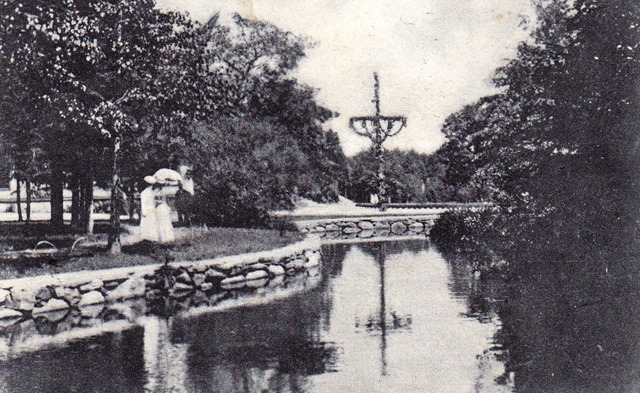
Mösseberg, Ankdammen. 52737
Imp. G.W. Lundins Bokhandel (Hjalmar Lundin) Falköping

G.017.1_0002 

(G.017.01)

G.017.1_0001-002

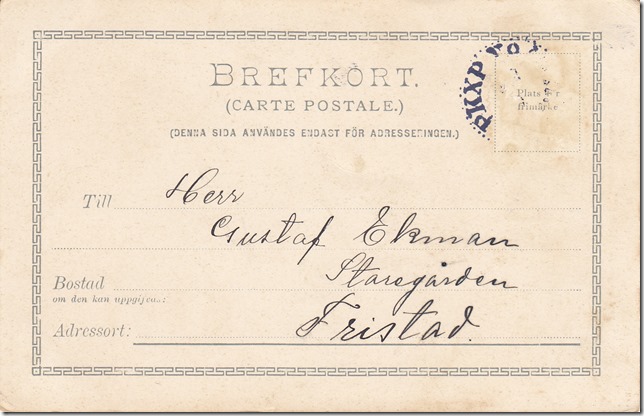
Date: Unknown, but most likely 23.6.1902 (Midsummer Eve)
Sent from: Mösseberg, Falköping (spa resort)
To: Herr Gustaf Ekman, Storegården, Fristad
From: Gerda

Jag är nu på Mösseberg och har mycke roligt. Här skulle du varit med. Jag kommer nog hem på tisdag e.m. på halv 7 tåget tänker jag, eljest på sista tåget, möt mig då.
Tack för brefvet, det kom oförväntat. 
Hälsningar från Gerda
Hälsningar från Anna E—? o E—r o Edith.

I am now at Mösseberg and am having a very good time. You should have been here. I think I'll be home on Tuesday by the 6:30 train, or else the last train - meet me then. Thanks for the letter, I did not expect that.
Greetings from Gerda
(and Anna E-, E-r and Edith)

G.017.1_0001-001

Mösseberg is (still) a spa resort up on the hill Mösseberg at Falköping, founded in 1865. There was a spring there, and the location high up was also considered to be good for people with lung diseases. (The hill is ~100 m high.) A railway nearby made it easy for people to get there. In 1885, there was a sanatorium for people with tuberculosis. In the early 1900s, it became more of a spa for "anyone", including healthy and wealthy upper class people. The park and bath were restored and more guest rooms added, to be able to have guests there all year round. (Source: Swedish Wikipedia article.)

The postmark on the card shows vague traces that the date may have been 23, but not which month or year. My guess is June 1902, though. Later that year, Gustaf (the recipient of the card) and his sister Gerda (the sender) would both be emigrating to America. The image on the card shows a Midsummer pole. Midsummer Eve back then was always celebrated on June 23. In 1902 that was a Monday, and Gerda writes that she'll be going back home on Tuesday evening. E-r might refer for Ester (their sister), and Edith could be their niece - their older sister Emma's daughter. I also seem to recall having heard that Ester at some point did spend some time at Mösseberg for her own health - but I don't know when.

You'll find my original post about this card here (2013-06-18). 

Back then, I had not yet starting linking this blog to Sepia Saturday.

Linking now to Sepia Saturday 831 -  "Celebration time"


2026-05-16

Sepia Saturday 826: Stormy Weather at Varberg (Repost)

This is a modified repost of an early post on this blog, from 2012-02-21 .


Varberg: Hamnpiren i storm. / Varberg: The Pier in storm.
Publisher: Vilén & Johanson, Borås 


Varberg 6/8 (1903). Heartfelt thanks for the postcard. Yesterday there was quite a storm here. Rather beautiful to behold. Mother does not have to be anxious about us going out on the sea, because that is impossible. Otherwise we are quite well. Greetings G.J.

This is a card that seems to fall outside my own family history. My great-uncle Gustaf (in whose postcard album the card is found) probably got it second-hand later in life, from some friend who knew he collected postcards. In August 1903, Gustaf was living in America; but he returned to Sweden in 1910. This card was written by a  G.J. to an J.A. Johanson. My guess is that J.A. was the sender's mother, as it was common in Sweden back then to address your parents “in the third person” rather than using “you”. 

The card shows quite a magnificent picture of stormy weather at the pier in Varberg, a town on the west coast in the county of Halland. Varberg and all of Halland are well known for their "typical west coast" sandy beaches. In Varberg the coast changes from wide sandy beaches to rocky terrain that continues north into the Bohuslän archipelago.

Varberg is still a popular summer and spa resort for  people living further inland. Its reputation as a spa resort was founded in the early/mid 19th century. The railway line between Varberg and Borås was established in 1880. The town has an old fortress from around 1280-1300; now museum + hostel.

Below are my own photos from a visit there in 2001 - in not so stormy weather...

1. The Fort
2. The Pier
3. A beach beneath the fort, with an old wooden bathhouse


2025-11-08

"Hands Across the Sea" (Repost for Sepia Saturday 800)


Sepia Saturday, started in 2009 by Alan Burnett, is celebrating 800 weeks of photographic memories this week. I dare not guess how many old photos have been shared via that blog since then. I know I started my own first blog in 2009 as well, but I don't think I came across Sepia Saturday until several years later. The blog I've mostly been sharing from is this one, which I started in 2012, as a project of going through old postcards and photos inherited from my paternal grandparents. But when I got started on that, I had not yet discovered Sepia Saturday, so I have quite a few old posts that were never shared there. I'm choosing one of my earliest posts on this blog, from February 2012, to repost for this celebration.

Repost from 2012-02-09: 


R.M.S. CARONIA, (CUNARD LINE,) 20,000 TONS.

The postcard is an unwritten and undated one, found at the back of the postcard album.

R.M.S. Caronia was built in 1905, in service for the Cunard Line 1905-1932 (scrapped 1932)

Royal Mail Ship (sometimes Steam-ship or Steamer), usually seen in its abbreviated form RMS, a designation which dates back to 1840, is the ship prefix used for seagoing vessels that carry mail under contract by Royal Mail.  --- It was used by many shipping lines, but is often associated in particular with the Cunard Line,2 Royal Mail Lines and Union-Castle Line, which held a number of high-profile mail contracts, and which traditionally prefixed the names of many of their ships with the initials "RMS". 

 
http://en.wikipedia.org/wiki/Royal_Mail_Ship

Why Did They Emigrate? 

How is it that one never seems to think of the questions to ask until everyone who might be able to answer them is already gone? Is it because the right questions don’t arise until you’re old enough to begin to get a bit of perspective on your own life? Or even that there might be some questions that cannot be asked until you’re free to use your own imagination to fill in the details?

I do remember from my childhood, that my p.grandmother Sally used to talk about her big family and the farm where she grew up. But I never really got a time-perspective on it. All the names were a blur, and I never quite ‘got’ who was who among all the family portraits that sat on top of the cupboard in my grandparents’ living-room.

Family portraits are funny like that – frozen in time – some people forever old, others forever young, depending on when they happened to have their photo taken. A bunch of familiar faces (when you’ve been looking at those portraits all your life) but if you never knew them, there is really no clue who was the oldest or the youngest among them. Or even who is who!

I always knew that my grandma Sally had a bunch of older half-siblings, but I don’t think I ever quite got how much older most of them were. Like the fact that her oldest half-brother Carl, who also lived on the farm where she grew up, was in fact 30 years older than Sally; and only nine years younger than Sally’s mother! Or that she had nieces /nephews older than herself. Or that her father died when she was only seven. Or that she can’t really have had any early childhood memories of the two youngest half-siblings from her father’s first marriage – Gustaf and Gerda – because they went off to America when she was about 2½, and did not come back until she was 11.

And until I found the postcard albums that belonged to Gustaf and Gerda, even less has it ever occurred to me to think about things from their point of view. (Gustav I never met because he died before I was born. I’m not sure if I ever met Gerda either, even though she lived to be 92.)

When their mother Anna Sophia died (at the age of 57, and having given birth to nine children), Gustav was 16, Gerda 13.

When, four years later, in December 1898, their father Samuel (63) got remarried to Selma (a 37 year old widow with a young daughter), Gustaf was 20 and Gerda 17. My grandma Sally was born just over a year later, in February 1900. 1½ year later, in the summer of 1902, another baby was born, Sally’s brother Nils.

It seems to have been in the autumn/winter of 1902, that Gustaf and Gerda both went off to seek their fortune on the other side of the Atlantic. Gustaf was 24 and Gerda 21. Their father had started over with a new family (also including a step-sister, by then 10 years old); with their oldest brother to help. There were enough people living on the farm. The other older siblings had their own lives. Work opportunities in Sweden were hard to find.

At least part of 1901, Gerda was living or staying with her sister Emma (married with children) and Gustaf may have been staying with his older brother Oscar (also married).

I’m not sure if Gustaf and Gerda went to America together on the same boat, but it can’t have been far between. They did not go to live in the same place or even the same state, though.

At Christmas 1902, Gustaf was in Pennsylvania. It seems he stayed in Pennsylvania until he went back to Sweden in 1911.

At New Year 1903, Gerda was in Chicago; and still there in 1910.

Gustav came back to Sweden to live and work on the family farm in the summer of 1911. (Samuel, the father, had died in 1907.)

I’m not sure when Gerda came back, but I found evidence that in 1913 she was staying in Ronneby in Sweden (south-east coast).

The facts I’ve extracted partly from reading the addresses on random postcards, partly from dates of births and deaths collected by my father and one of his cousins (son of grandma Sally’s younger brother Nils).

Additional information from Wikipedia:

In the 19th and early 20th centuries, about 1.3 million Swedes left Sweden for the United States. The main "pull" was the availability of low cost, high quality farm land in the upper Midwest (the area from Illinois to Montana), and high paying jobs in mechanical industries and factories in Chicago, Minneapolis, Worcester and many smaller cities. The American environment also provided low taxes and no established state church or monarchy. Push factors inside Sweden included population growth and crop failures. Most migration was of the chain form, with early settlers giving reports and recommendations (and travel money) to relatives and friends in Sweden.

By 1890 the U.S. census reported a Swedish-American population of nearly 800,000. After a dip in the 1890s, emigration rose again, causing national alarm in Sweden. A broad-based parliamentary emigration commission was instituted in 1907. It recommended social and economic reform in order to reduce emigration. The effect of the measures taken is hard to assess, as World War I (1914-1918) also had its effect on migration. From the mid-1920s, there was no longer a Swedish mass emigration.

2025-09-14

Washing Up - Sepia Saturday 792

For this week's Sepia theme, "washing up", I looked through some old photos in search of some that might show my grandparents'  kitchen sink, as I remember it from my early childhood (I was born in 1955). I found these two below - and on closer inspection, I even think they may have been taken on the same occasion, as my grandmother (Sally) is wearing the same clothes in both. 


Here she's feeding their collie Zepp a biscuit. She's standing next to a narrow cupboard next to the electric stove. To the right, next to the door (leading out into the entrance hall), is the kitchen sink with draining board.


Here she's sitting on the sofa by the window (one of two), drinking coffee, with the kitchen sink to the left. There's a small mirror on the wall above: They also often used the kitchen sink for washing hands and face, shaving etc. 

It occurred to me that if I put the two photos together edge to edge, they would show the whole small sink area. The scale is not 100% the same in both photos, but close enough...


Dishes were always washed up directly after a meal, dried with a towel and put away. In the photo the dish rack is turned up against the wall - when it was down, it covered the whole small draining board. There were no other workbench surfaces in the kitchen. The kitchen table was used for "everything".

In my childhood, they did also have WC and a bathtub installed down in the cellar, but there was no washbasin or mirror down there, and the walls and floor were raw cement... In summer they still mostly still used the old "outhouse" out in the yard. It was not until after my grandfather died (in 1969) that my dad arranged for a WC (+ washbasin) to be put in for my grandmother in what used to be a wardrobe next to the living room on the ground floor; and also a WC in a wardrobe upstairs (where there was already a washbasin in the adjoining bedroom). My grandmother pretty much only used the downstairs kitchen + living room (and slept in the kitchen) during the last years when she lived there alone, while we used the upstairs two rooms when visiting her.

After Sally moved to a retirement home in the village, and after her death, we kept the house as a holiday house. When dad retired from work (at 60), he and mum decided to move there permanently - but not until they had added a large new extension (more than doubling the living space), including a modern kitchen and bathroom + large new living room downstairs, and an enormous home office space upstairs for dad. The old living room became their bedroom; and what remained of the old kitchen (sink and stove and cupboards removed) became a sort of extra, doorless, room where some "antique" furniture and books were kept, as reminders of the past. 

Linking to Sepia Saturday 792


2025-06-28

Old Friends - Sepia Saturday 781


Gamle Andersson, Tvärred
Old Man Andersson, Tvärred

If not for a note scribbled on the back of this photo (probably by my dad, when sorting old photos left behind from his dad), I wouldn't have had a clue. I also found it in the envelope marked "Tvärred", though (a place name) - where most of the photos involve the brothers Anders and Evert Andersson (who have appeared in other recent Sepia posts on this blog). So I suppose I might have made a bold guess anyway, that this was probably their father. 


"Sometimes all you need is a name. You can be sorting through a pile of old family photographs, desperately trying to work out if the subject is your Great Uncle Joe or Cousin Mabel's young nephew, when you suddenly find a name pencilled on the reverse of the photograph..."
(Alan Burnett, Sepia Saturday 781)


This photo does not have names scribbled on the back, but (even more unusual) a date: 10.08.64 (10 August 1964), which pins it down in time. And in this case, I can add the names, and even the place, myself. The man to the right is my grandfather Gustaf (at age 60); and the one behind him his brother-in-law Olle. The man to the left is Edvin Kornelius - as I remember it, usually just referred to by his last name. And the place is the small farm Källeberg, where he lived together with his sisters Annie and Ellen. (From another source, I know that the three of them inherited the place in 1937.)

Olle's wife Hildur and Edvin's sister Annie both died in 1964. I don't have the exact date of death for either of them; but I guess that this visit to Källeberg was probably after both those women died. 

In my own early childhood photo album there is an earlier photo that includes them both, from the summer of 1957:


Standing: Olle & Hildur (my grandmother's sister with husband), my grandmother Sally with me (barely 2 years old) on her arm, Annie and Edvin Kornelius. Sitting: Ellen Kornelius, my mum and dad, and my grandparents' dog Zepp. (My grandfather no doubt behind the camera.)

My grandparents, Hildur & Olle, and the siblings Kornelius were all old friends; and the middle photo of the three men brought Simon & Garfunkel's song "Old Friends" to mind for me...

♫ Old friends
Memory brushes the same years
Silently sharing the same fears ♫


2025-06-14

The Veranda - Sepia Saturday 779

I searched in vain in my old albums for a photo of someone standing next to a chair (as in the Sepia prompt photo.) In my inherited photos, if there is a chair, there is usually someone sitting on it, though! 

However, in one of the envelopes I've been going  through recently, I found a photo of my grandfather Gustaf as a young man, sitting alone on a chair on/in the "glass veranda" at the farm Storegården, which belonged to my grandmother Sally's family. Gustaf was friends with Sally's younger brother Nils; and in the mid 1920s, when Gustaf was trying to change his career from a shoemaker's apprentice to becoming a journalist, Nils' family let him rent a room with them (probably in a small cottage on the grounds rather than in the main house). (Cf. my post for SS 773 - The Desk.) I would date the photo below to around that time (mid 1920s) - after Gustaf had recently moved to the farm to live, but before he and Sally became romantically involved.

It was not an open veranda, but more like an extra room with many windows - and probably  no heating, so primarily used in summer. 

In one of the albums, there is this photo of Sally and Gustaf. They seem to be sitting in the same corner of the veranda as in the first photo, but now with plants behind them. My guess is that this is from their engagement (Sept 7, 1929). 

This photo shows what the veranda looked like from the outside. (The entrance door is to the right, I know from other photos.) Two of the women are unknown to me. Standing at the back are Gustaf, one of the guests, and Sally. Sitting down are another guest, Hildur (Sally's older half-sister), Selma (mother of Hildur, Sally and Nils), and Hildur's fiancé Olle. 

To finish off, a photo of Gustaf some 25-30 years later than in the first photo; sitting and looking contemplative. Possibly on the sofa in his own kitchen (that door behind him could be to the larder). But I'm not sure. It might also be somewhere unknown to me.

Linking to Sepia Saturday 779  


2025-05-31

Sepia Saturday 777 - The Radio


The prompt for this week's Sepia Saturday immediately reminded me of a photo I recently noticed in one of my grandmother Sally's old "anonymous" photo albums (totally without written notes). Can't say I've ever really noticed it before - but I did now, because after recently having studied various photos in an envelope marked 'Tvärred' (the name of a place), I'm now pretty sure I recognise the two men as my grandmother's friends Evert and Anders - who have also figured in a number of recent Sepia posts on this blog. 

It's obviously the Radio that is in focus in this photo, though; and my guess is therefore that it was taken when this device was still a novelty. Swedish Radio started broadcasting on 1st January, 1925, at 10:55 am. The very first program on the air was a church service live from a church in Stockholm, which could be heard by around 40.000 receivers. In the beginning, on weekdays, they only broadcasted like half an hour at noon + half an hour in the evening. However, in May 1925, a Radio Choir was also established to give radio concerts; and in September a children's program was started that came to last until 1972. (I remember it from my own childhood!) They also got started with broadcasting certain big sports events; and radio theatre (written especially for the radio). 

In 1928, they started broadcasting "school radio" (educational programs); and introducing new music from gramophone records. In 1930, daily short "morning devotions". (Still going on! but I'm never up at 5:45 myself...) In 1932, the first political debate before an election could be heard on the radio. In 1933, they were broadcasting 8 hours per day. In April 1937, the number of radio licenses issued passed 1 million. (The total number of citizens in Sweden back then was around 6.2 million.)

I doubt that my grandparents' friends Evert and Anders were among the 40.000 to listen to the first radio broadcasts ever. But I guess they may have been among the first million to have one. (?) Just based on its very existence, I'd date this photo to the mid 1930s or so - i.e. while a radio was still not something you saw in each and every home. (The photographer is likely to be my grandfather Gustaf; and even if I can't swear to it, I can't recall having seen a radio in any early 1930s photo from my grandparents' own house.)

2025-05-03

Sepia Saturday 773 - The Desk

If this post seems familiar to some readers, that will be because it's basically the same as my post for Sepia Saturday 713 ("Going to Work"), about a year ago...   

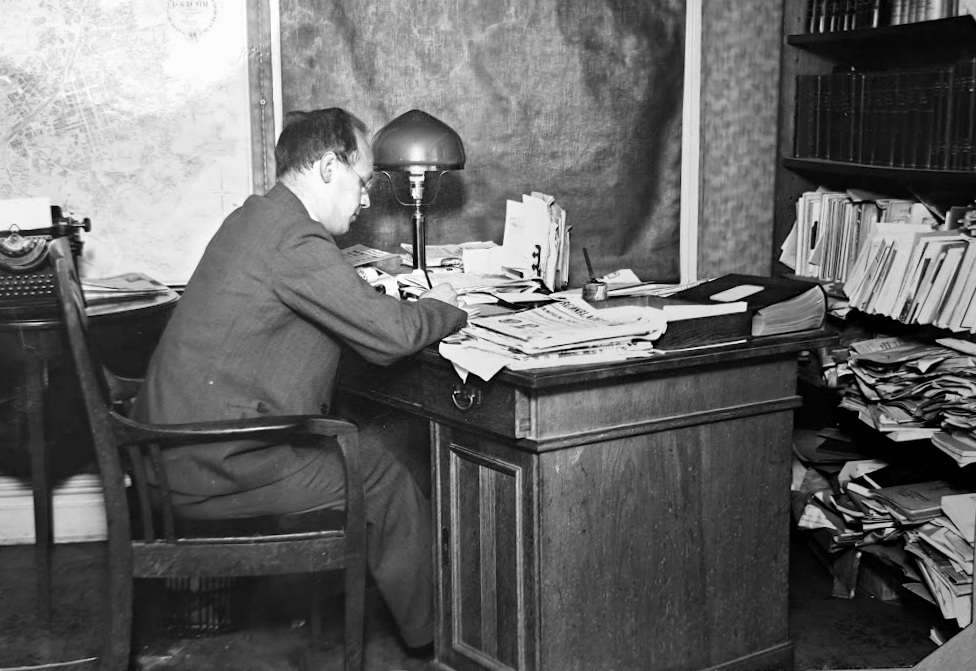
My grandfather Gustaf (born 1904) started out as a shoemaker's apprentice in his early teens, but what he really wanted to do was write. He gradually managed to shift to a career as journalist, by taking a few correspondence courses (cf. SS 675 - "Book-keeping, Stenography and Typewriting") + freelancing for a local newspaper, until eventually he got employed there full time as journalist in 1926. He also usually took his own photos when he was out and about on various jobs. 

Young Gustaf at his desk in his room at the farm

While being a shoemaker's apprentice, Gustaf lived with the shoemaker and his family; but later on, he  was offered a room at the farm where his childhood friend Nils lived (with his mother, two sisters and one or two older half-brothers). One of Nils' sisters, Sally, was to be his future wife - but from what I've gathered from letters, when Gustaf first moved to the farm to live, there was not yet any romantic relationship between them. My impression is also that Gustaf's room must have been in a separate small cottage rather than in the main farm house with the family.

This photo shows one of Gustaf's colleagues at the newspaper where he worked between 1926-1938. (In 1938 he was recruited to another newspaper in the same town.)

In this photo Gustaf is obviously older, and I think it's probably from his office at the other newspaper, where later on in his career he also advanced to be editor. But I think his main passion was always to write his own articles about local history and people. 

Linking to Sepia Saturday 773 - The Desk


2025-04-27

On the Beach Again - Sepia Saturday 772


The original size of this photo is only 5.5 x 8 cm, and I had no idea who the people were. Having scanned and enlarged it, I think the woman and the man to the left are probably my grandmother's sister Hildur and her  husband Olle - the same couple that we also saw on a beach in my post for Sepia Saturday 770 - but then in swimsuits! I'm not sure about the identity of the man to the right, but because of other photos in the same envelope, I think it may be their friend Evert (cf my post for SS 768). From the background scenery, it looks to me like the lake could be the one close to where Hildur and Olle, and my grandparents Sally and Gustaf, lived after they got married (1930-). (But there may of course be other lakes offering similar scenery that I'm not familiar with.) 


Svenska: 
Orginal-fotot är endast 5,5 x 8 cm, och i det formatet kunde jag inte känna igen personerna. Efter att ha skannat och förstorat fotot, tror jag att kvinnan och mannen till vänster är min farmors syster Hildur och hennes man Olle - samma par som också ses på stranden i mitt inlägg till Sepia Saturday 770, men då iförda baddräkter. Mannen till höger tror jag kan vara deras vän Evert (från Tvärred), som kan ses i gruppfoton i inlägget för SS 768. Från bakgrunden här tror jag att sjön kan vara Öresjö i Fristad. Som gifta (1930-) bodde Hildur och Olle, liksom mina farföräldrar Sally och Gustaf, på nära gångavstånd till en strand där.


2025-04-12

On the Beach - Sepia Saturday 770


"You can't beat a picture that gives you more questions than answers."
(Alan Burnett) 


The prompt for this week's Sepia Saturday made me think of this photo, which I have so far hesitated to publish - not because I don't know who the couple are, but because I do, and therefore still have a hard time imagining them ever willingly having posed for a photo dressed only in swimsuits - and yet they both look fairly comfortable doing so here! 

The couple are my grandmother's older half-sister Hildur, and her husband Olle. They were both born 1892. I am pretty sure that the beach is the one by the lake only a few minutes walk from the house that my grandparents Sally and Gustaf built in 1930. Sally and Gustaf got married in September that year, Hildur and Olle at New Year, and they then moved into the upstairs flat in the same house. (Later on they built a house of their own very close by.) 

I would date this photo to the summer of 1931 - simply because I can even less imagine "Aunt Hildur" agreeing to pose in a swimsuit before they got married... In my own childhood, late 50s/early 60s, I never saw neither Hildur nor my grandmother on the beach, or ever dressed in anything else than skirts that went well below their knees! 

And I've never seen a photo of my grandmother wearing a swimsuit either. The closest to that is the one below, also from the lakeside, with her wearing her long hair down, but dressed in what to me seems to be a long bathrobe. As I know from an old letter that she had her hair cut short in October 1929, I would date this photo to the summer of 1929. She later let her hair grow out again, though - and didn't cut it really short again until she was in her 70s. (Even in my childhood when she let her hair out at night, it was as long as in this photo. She wore it rolled up at the back in the daytime, and in a long braid at night. And I remember her telling me once that my grandfather liked her to keep her hair long.)


But... I think it is probably also Sally you see in the background of of the first beach photo, fully dressed in hat and all. And it strikes me now, that if that photo is from 1931, she would that summer have been rather heavily be pregnant with my dad (born towards the end of August). So probably even less willing to pose in a swimsuit for that reason... 

No doubt it was my grandfather Gustaf behind the camera with both photos, whenever they were taken.


2025-04-05

People Wearing Hats - Sepia Saturday 769

From an envelope marked Tvärred (the name of a place where friends of my grandparents lived; cf my previous post for SS 768), I pick this photo as the closest match for today's Sepia prompt:


The photo is rather blurry, which may be one reason why it never ended up in one of the albums. I imagine they took it because they themselves found it rather funny that they were all wearing hats! I would date the photo to around 1927-28, as it includes (I think) my grandmother's older brother Carl, who died in September 1928 (which makes the preceding summer the latest possible time for it).

No 3 from the left (the man with the biggest hat!) + the man furthest to the right, must be the brothers Evert and Anders Andersson (also featuring in last week's post).

  
No 1 from the left must be my grandmother's brother Nils (born 1902), and I think the woman next to him may be his future wife Carin. Just like my grandparents, they did not get married until 1930, but had been "dating" for a few years before that (I'm not sure exactly for how long). 

As all seven people are holding on to one another here, the relationships between them are not all easy to sort out just from this photo, though!


No 4 is my grandmother Sally, No 5 (I think) her older half-brother Carl, No 6 her sister Hildur, and No 7 I think is their friend Anders. And behind the camera was most likely my grandfather Gustaf. (I know from at least one other photo that he and Sally were officially a "couple" before Carl died, even if they did not get formally engaged until 1929, and married in 1930.)


2025-03-29

Uncertainty - Sepia Saturday 768

 In his introduction to Sepia Saturday 768, Alan Burnett writes: 

"Just as a good novel guarantees that you are never sure where the plot is going to take you next, a good collection of old photographs means that you are likely to be taken to the most unexpected places and unexpected times. It is this pleasure, this uncertainty, that we celebrate here on Sepia Saturday."

So I'm grabbing the opportunity to share four photos that still involve quite a bit of uncertainty.

The original photo prints are no larger than 6x8 cm. I  scanned them to enlarge them on my computer screen, which does help a little bit, though. One thing they have in common is that they probably include some people from the parish where my great-grandmother Selma came from (Tvärred). Whether these people were related to her or "just friends" is something I've never been sure of, though. 

In the first photo all but one of the six people are familiar to me, though. The boy at the front is my dad. He was born 1931 and I suppose he must be around 10-12 here (?)  Behind him to the left are his parents (my grandparents) Gustaf and Sally; and to the right his uncle and aunt - Sally's sister Hildur with husband Olle. The one I'm not certain about is the man in the middle. From somewhere at the back of my memory I seem to recall that there were two brothers (?) named Anders and Evert, living at Tvärred, whom I even met a few times in my own early childhood. Who of them is who in old photos, I no longer know, though. And if I ever knew their surname, I've forgotten.

This photo is from earlier in my dad's early childhood. (Does he look 3 or 4 years old to you?) The old woman to the left is my great-grandmother Selma. (She died long before I was born, but I recognise her from many photos.) To the right of the boy who became my dad (Bertil) is my grandmother. The woman with curly hair behind him is her sister Hildur; and behind her, her husband Olle. I suppose the two men to the left must be be the afore-mentioned brothers. As for the third man and the other two women, I have no idea, though. 

 
Judging by their clothes, I'd say this photo must be from the same occasion.


And this photo must be even earlier. 1932 or possibly 33, but no later (my grandmother in the middle, holding a very young version of my dad). Again I'm not sure about where the photo was taken, but it strikes me that this one might be from the farm where my grandmother was born and grew up (and remained living until she got married in 1930). 

I know that besides the farm house (the "big" house), there was also a smaller cottage on the grounds there, which remained my great-grandmother Selma's property until she died. Although the farm was sold after 1930, and Selma too moved in with her daughters and their husbands in the new house that my grandfather built, I recall having been told that the small cottage was still hers, and she liked to spend the summers there. (It was not very far from the new house that my grandfather built.)

It was a common arrangement in old times that when an old farmer retired and let his oldest son take over the running of it, a small cottage + a small piece of land was set aside for the parents, and remained theirs for life. My great grandfather Samuel did let his oldest son (Carl) take over the running of the farm a few years before he died; but remained living on the property with his 2nd wife and three young children. Samuel died in 1907 (when my grandmother was 7, and her younger brother Nils 5).  Carl was a bachelor and never married and had no children himself; and my impression is that he and his step-mum Selma joined forces best they could to make the best of the situation. They probably even all lived together in the main house (or if anyone lived in the small cottage, it was probably Carl). Later on, periodically, Carl's younger brother Gustav (who emigrated to America in 1902, but later returned) also lived on the farm and helped out. 

Carl died in 1928. I've not seen the estate inventory, but I suspect that as he did not have any children of his own, the estate was then inherited by all seven of his siblings and half-siblings still living; and that this led to the farm (except the small cottage belonging to Selma) being sold in 1930/31 - after all three of Selma's children (Nils, Sally and Hildur) had got married and moved out during 1930. 

PS.  /2025-03-31/ A comment from La Nightingale below made me remember where I might find the answer to who's who of the two brothers in the photos above. Some years before my dad died, I sat down with him and went through an envelope of photos that had belonged to Hildur and Olle, my grandmother's sister and brother-in-law. I then put those photos in a special album, with some notes added. And among those is another photo including both brothers from Tvärred. Their surname was Andersson, and from my dad I got the impression they were "friends" rather than relations. The man in the middle in the top photo here is Anders; and second from the left in the 2nd photo is Evert.


(I may be adding a Swedish version of all this below later.)


2025-03-15

Sisters Reunited - Sepia Saturday 766


Yesterday, opening another envelope of miscellaneous old photos taken by my grandfather, I found two of my grandmother Sally (in the middle above) with her sisters (+ brother-in-law) that I can't recall  having seen before. But they were obviously taken on the same occasion as the portraits below of my great-aunt Gerda proudly wearing a medal - previously posted on this blog in a post entitled Gerda's Medal, for Sepia Saturday 634, in August 2022.

That post was about my research to try and establish when and why Gerda was presented with that medal; and my conclusion was that it was probably after 30 years of service to the countess Estelle Bernadotte. Estelle was American (born Estelle Romaine Manville, 1904). She got married to the Swedish count Folke Bernadotte in December 1928; and  Gerda - by then 47 years old and an experienced lady's maid who had worked as such not only among nobility in Sweden, but had also lived in both America and France, and was well used to travelling - got  employed as lady's maid to Estelle from shortly before their wedding; and ended up staying with that family the rest of her life.

If Gerda got the medal after 30 years of service, that dates this photo to 1958. An alternative might be if she received it in connection with her 75th birthday, in 1956. (She was born in 1881, and lived to be nearly 92 years old.) Either way, it seems that shortly after Gerda was presented with this medal, not only did she visit my grandparents Sally and Gustaf, but they also managed a reunion with all four sisters still alive. 

The woman next to Gerda here must be her sister Ester, who was born 1876 (five years older than Gerda), and died in 1959. (So this may even be the last time they got together.) The one standing in the middle behind Ester is Hildur (born 1892) - older half-sister to Sally on their mother's side, and step-sister to Gerda and Ester. The man to the left is Hildur's husband Olle. (They lived only a few minutes walk away from my grandparents.) And to the right, my grandmother Sally (born 1900). 

Below to the right is a double portrait of Ester and Gerda together from their youth (some time before Gerda emigrated to America in 1902); and to the left, one of Ester on her own (obviously some years later, but I don't know the year). 

Linking to Sepia Saturday 766


I ett kuvert med foton märkt "efter 1930" fann jag två foton som jag inte kan påminna mig att jag sett förut, men som uppenbarligen måste vara från samma tillfälle som andra foton av min farmor Sallys halvsyster Gerda Ekman med samma medalj, sittande i mina farföräldrars vardagsrum. Jag har tidigare spekulerat kring dessa och årtalet för och anledningen till medaljen, i ett inlägg från augusti 2022, Gerda's Medal. (Text där på både engelska och svenska.) 

De nytillkomna fotona ovan visar att även Gerdas och Sallys äldre syster Ester Ekman, (1876-1959), var med vid den här syskon-träffen. Detta bekräftar väl också min teori att Gerda troligen fick medaljen antingen år 1958 efter 30 år i tjänst hos familjen Bernadotte; eller möjligen i samband med sin 75-årsdag två år tidigare.

Med på gruppfotona här är också min farmor Sallys halvsyster Hildur (1892-1964) och hennes man Olle Hellsten, som bodde bara ett par minuters gångväg ifrån mina farföräldrar. (Hildur var dotter till Sallys mor Selma från hennes första äktenskap; medan Gerda och Ester var döttrar till Sallys far Samuel Emanuelsson från hans första äktenskap.)