A 'Swenglish' journey through family photos, notes and postcards
from the early 20th century.
Showing posts with label Stockholm. Show all posts

2024-08-18

Greetings from Ulriksdal, Stockholm (Sepia Saturday 737)

 (Reposted card; first shared on this blog in February 2013.)

 
Stockholm - Ulriksdals slott
No 1378, Ferdinand Hey’l, Stockholm.

A. Blomberg, Photo


To: Mr Gustaf Ekman, Storegården, Fristad (1902)

The postcard was sent to my great-uncle Gustaf in 1902 (before he emigrated to America), from friends visiting Stockholm. I have still not managed to decipher all the words in the message, but it starts with "We are now in Stockholm", and seems to also include greetings from some mutual friend that they happened to run into there.  

(Edited colours) 

A comment on my original post back in 2013 points out how back then they liked to make photo postcards look like paintings. (I suppose the colours were added to a b&w photo.)

Photo from Wikipedia (2011)

Ulriksdal Palace was originally built for Count Jacob De la Gardie in 1645 and then called Jakobsdal. About 25 years later it was bought by Queen Hedwig Eleonora for her grandson Ulrik and renamed Ulriksdal after him. The little prince however died at the age of one. After the death of Hedwig Eleonora in 1715, the palace was transferred to the Crown.

In 1902 (when this postcard was sent), the King of Sweden was Oscar II. I’m not sure how Ulriksdal Palace was used in his day. Later on in the 20th century, it came to be much used by his grandson, crown prince Gustav Adolf (later king Gustav VI Adolf of Sweden, 1950-1973). Since 1986 it has been open to the public. Parts of the former living quarters are nowadays used to exhibit items from king Gustaf V's silver collection, and king Gustaf VI Adolf's art and crafts collection. (Wikipedia)


2023-09-23

Warrior Kings and Salvation Army - Sepia Saturday 691

 G.005.1 - Postcard previously posted on this blog 2012-04-20


005.1A-1
Karl XII:s staty. Stockholm. - Förlag Oscar Ellqvist, Nr 9.
(Statue of King Charles XII of Sweden.)

005.1A-003

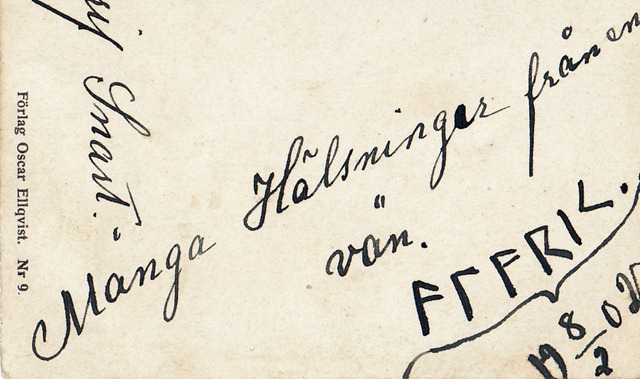
Tack för kortet! Skrif Snart! 
Många Hälsningar från en vän - ALARIK

Thanks for the card! Write soon!
Many Greetings from a friend – ALARIK

005.1B-1 
 8.2.1902
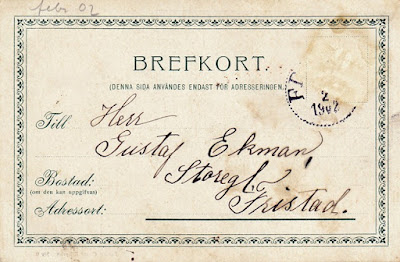
To: Herr Gustaf Ekman, Storegd, Fristad

Some of Gustaf's friends back in the early 1900s seem to have enjoyed sending him anonymous and/or cryptic postcard messages. (I suppose he probably did the same to them.) This postcard from Stockholm is signed using the old runic alphabet: 


Runes are very old letters which Germanic people used before they started using Latin letters in the Middle Ages. In its broadest sense, the word runes can mean any cryptic letters, but it usually means the alphabets used by Scandinavian people from about the year 150 AD to the Middle Ages. The oldest of these is called the Elder Fuþark, used from about 150 to 800 AD.

Interest in runes and Old Norse mythology etc had a sort of renaissance here for a while back in the so-called "Romantic Nationalism" of the 19th and early 20th century.

So the name of the friend who sent the card seems to be Alarik. It is an old masculine Germanic name meaning "ruler of all".  Whether this was his real name or not, I don't know. But the name Alarik was added to (i.e. given a "name day" in) the Swedish almanac in 1901. (It is still included - 5 August - but I don't think there are a lot of Alariks around in our time. Names do tend to "come and go", though...) 

One famous Alarik in history was Alaric I, king of the Visigoths from 395 to 410 - said to be the first Barbarian ruler to invade Italy. He was a professed Christian and was also seen by some Christians as God's wrath upon a still pagan Rome.

005.1A-002 

The statue on this postcard is of the Swedish king Karl XII (1682-1718), in Swedish history often called the Warrior King. The statue in Stockholm shown on the postcard was made by Johan Peter Molin (1814-73). It's cast in bronze and weighs 2½ tons.

Modern photo from Wikipedia

005.1A-004

The young women in the foreground on the old postcard are female Salvation Army soldiers, dressed in typical hats, and carrying guitars and and leaflets. 

It's one of those street views which may seem ordinary at first glance - just a statue and some random people - but which could just as well be used to convey a hidden message... To me there seems to be a certain irony in the fact that the women soldiers here are turning their back on the old warrior king, and are walking in the opposite direction to where he is pointing!

The Salvation Army, founded 1865 in London, was introduced in Sweden in 1882 by Hanna Ouchterlony. (Wikipedia) She was born in Värnamo, Sweden, in 1838. From 1857 to 1864 she served as housekeeper with relatives in Stockholm; then opened a book shop in Värnamo. In the 1870s, she had a religious crisis, and became active within Christian social work. In 1878, she got acquainted with Bramwell Booth (son of William Booth, the founder of the Salvation Army) who was visiting Värnamo for recreation. She became identified with the values of the Salvation Army, and Booth considered her suitable to introduce the movement to Sweden. Between 1878 and 1881, she took correspondence courses from the Salvation Army; and in 1881, she visited London, staying in the home of Catherine and William Booth. She became an officer of the Salvation Army in London 28 November 1882; and upon her return to Sweden, introduced the movement here. 

Hanna served as chief of the Swedish Salvation Army from 1882 until 1892. In 1887–1888, she also founded the Norwegian Salvation Army. She travelled for the Salvation Army in the United States in 1892 and was the territorial leader of the movement between 1894 and 1900. She retired in 1904 and died in Stockholm in 1924.

Linking to Sepia Saturday 691 - On the Street


2022-05-13

A Place to Sit Down, and the Swedish Census of 1930 - Sepia Saturday 621

 M.004.01 - Stockholm, Karlaplan, 1932

Stockholm, Karlaplan  -  Fotografi 5760, Axel Eliassons Konstförlag, Stockholm


To: Herr Gustaf Samuelson, Storegården, Fristad
From: Gerda (Stockholm, 24.8.1932)

d. 24-8-32
Käre bror! Tack för brev vari jag såg att Emma är hos dig. Jag skulle gerna velat kommit hem, men jag får ej tid nu. Lydia är i Sthlm nu. Skulle varit roligt om du kunde kommit också. Du kan se på andra sidan var jag bor. Kära hälsningar till dig och Emma. / Gerda

Dear brother, Thanks for your letter, wherein I saw that Emma is visiting you. I would have liked to come home, but I can't make time for it now. Lydia is in Stockholm now. It would have been nice if you had been able to come here as well. You can see on the front of the card where I live. Love to you and Emma. / Gerda

In last week's post for Sepia Saturday 620, Gerda was with the Bernadottes in Paris in the spring of 1932; and from there also made a trip to Cairo. In August the same year, they're back in Stockholm, but evidently  have not yet moved into Dragongården (which was to be their home in years to come), but are living somewhere in the neighbourhood of Karlaplan, in central Stockholm. 

Karlaplan
Below are two 21st century photos, borrowed from the Swedish Wikipedia article, to illustrate how a place can change in 80 years, just by letting the trees grow...

Aerial view from 2014
(I think taken in the opposite direction from the old postcard)


Panorama view from 2011

Both then and now, this seems to be a good place to "sit down and do nothing in particular", though - which happens to be the theme for this week's Sepia Saturday.  (You'll find the prompt picutre at the bottom of the post.) 

Comments on the message
I don't know know who Lydia is, but she seems to be a mutual friend of Gerda's and Gustaf's, as Gerda would have liked to see them both in Stockholm at the same time. Emma is Gerda's and Gustaf's oldest sister. 66 years old in 1932; married and with grown-up children. (Perhaps even grandchildren by now  - I haven't got that branch of the family tree complete.) 

As far as I know, in 1932 Gustaf was living alone at the farm Storegården. His younger siblings all got married and moved away, one after the other, during the autumn of 1930. I suppose he must have hired help with some of the farm work. But maybe 'Big Sister' Emma was a bit worried about how he was coping with everything on his own?  (I'm a big sister myself...)

Gustaf and his sisters


These three photos of people in front of the main house at Storegården are found pages apart in Gerda's photo album, but clearly belong together.

It looks like late summer or early autumn. The man is Gustaf. The hatless woman to the right in the first photo is Gerda. The one sitting on the ground in the last photo is Hildur, their younger step-sister. As for the two on the left, with hats pulled down over their eyes, I think they must be Ester and Emma (and probably in that order).

The facts that Hildur was present, but that there is no similar photo including Sally (my grandmother), makes me think that it could be 1930 - because that year, Sally got married (on 7 September), but Hildur remained living at the farm until the end of December (when she too got married). 

Taking that thought one step further, it strikes me that the reason for them all to be visiting at the same time may even have been Sally's wedding.

I'm not sure, though. For one thing, if someone attending the wedding had a camera, why aren't there any photos of the bride and groom apart from the one official studio photo?  (Cf. Sepia Saturday 618.)  (A question that will probably never have an answer.)

Swedish Census of 1930
I recently discovered a Swedish national digital archive of old census records and have started to explore that a bit. The last one available online happens to be from 1930, and  must have been done in December, because the household at Storegården is recorded there as consisting of only Gustaf, his step-mother Selma, and Hildur; while my grandparents are registered at their new house (Nysäter); and Nils (the youngest brother) and his wife (who got married 30 November) at another address. 

Gustaf is listed as farmer, but it is also noted that he had an additional job as churchwarden. This reminds me of a card in Gustaf's postcard collection with an invitation sent to him from the vicar to come and have afternoon coffee at the vicarage on Lucia day (13 Dec) 1929 - "and please bring the keys to the cupboard in the tower if you have them". 


In my grandmother Sally's album there are also some photos of Gustaf acting as coachman for the vicar and curates. Here is one of those photos, with the church in the background (year unknown).


Linking to  Sepia Saturday 621

"Our theme this week is all about sitting 
down and doing nothing in particular."

M.004.01 - Stockholm, Karlaplan, 1932

d. 24-8-32
Käre bror! Tack för brev vari jag såg att Emma är hos dig. Jag skulle gerna velat kommit hem, men jag får ej tid nu. Lydia är i Sthlm nu. Skulle varit roligt om du kunde kommit också. Du kan se på andra sidan var jag bor. Kära hälsningar till dig och Emma. / Gerda

I förra veckans inlägg var Gerda våren 1932 tillsammans med familjen Bernadotte i Paris, och därifrån också på en resa till Kairo. I augusti samma år är de tillbaka i Stockholm, men har uppenbarligen fortfarande inte flyttat in på Dragongården (som skulle bli deras framtida hem under många år framåt), utan bor någonstans i närheten av Karlaplan.

Från den svenska Wikipedia-artikeln om Karlaplan har jag lånat två foton från vårt eget århundrade, som visar hur mycket en plats kan förändras på 80 år bara genom låta träden växa. Både då och nu verkar det dock vara en bra plats för att bara "sitta ner ett slag och göra inget särskilt" – vilket råkar vara temat för den här veckans Sepia Saturday.

Kommentarer till vykortstexten:
Vem Lydia var vet jag inte, men hon verkar ha varit vän till både Gerda och Gustaf, eftersom Gerda skulle ha velat se dem båda i Stockholm samtidigt.
Emma var Gerdas och Gustafs äldsta syster, 66 år gammal år 1932, gift och med vuxna barn. (Kanske även barnbarn vid det laget – jag har inte den grenen av släktträdet komplett.)

Så vitt jag vet, så bodde Gustaf år 1932 ensam på Storegården. Hans yngre syskon gifte sig alla och flyttade därifrån under hösten 1930. (Jmf Sepia Saturday 618.) Jag antar att han måste haft inhyrd hjälp med delar av lantbruksarbetet. Men kanske var storasyster Emma lite orolig för hur han klarade sig på egen hand??
 
Gustaf och hans systrar
Alla foton i Gerdas album verkar ha blivit insatta huller om buller utan försök att ordna dem vare sig kronologiskt eller tematiskt. Detta tillsammans med det faktum att de flesta dem är av mycket litet format, och de flesta ansiktena okänd för mig, gör det till en utmaning att datera, identifiera och relatera dem till varandra så här 80-100 år senare. De tre fotona från Storegården ovan måste dock vara tagna på samma dag, även om de är hämtade från olika sidor i fotoalbumet. Och jag tror att de måste vara från ett sällsynt tillfälle då Gustaf hade besök av alla tre systrarna i den äldre generationen i syskonskaran (Emma, Ester och Gerda) på samma gång.

Det ser ut att vara sommar eller tidig höst, och de sitter utanför Storegården. Mannen är Gustaf. Kvinnan utan hatt till höger på första fotot är Gerda. Sittande på marken på sista fotot ser vi deras yngre styvsyster Hildur. När det gäller de två damerna till vänster, med hattar nerdragna över ögonen, kan jag bara gissa – men jag tror det måste vara Ester och Emma.

Det faktum att Hildur är med på ett av fotona, men att det inte finns något motsvarande foto där min farmor Sally är med, göra att jag tror att det kan vara 1930 – det år då Sally gifte sig (7 september) och flyttade till eget hushåll, men Hildur och Selma bodde kvar på Storegården till slutet av december (då Hildur också gifte sig och flyttade därifrån. Tar jag den tanken ett steg vidare, så slår det mig att anledningen till att Sallys äldre syskon var samlade så här, utan henne, kanske faktiskt skulle kunna vara hennes bröllop. 

Jag är dock inte säker. En fråga jag ställer mig är: Om någon som var med på bröllpet hade en kamera, varför finns inte också foton av brudparet? Det enda bröllopsfoto som finns är det officiella som är taget i studio. (Jmf Sepia Saturday 618)

Den svenska folkräkningen 1930
Sedan förra veckan har jag också börjat titta lite i Folkräkningar på Riksarkivets hemsida. Den sista som finns tillgänglig där är just från 1930, och måste ha gjorts i december månad. Hushållet på Storegården bestod då av Gustaf, hans styvmor Selma, och Hildur, medan mina farföräldrar är registrerade på sin nya bostad (Nysäter), och Nils och Carin (som gifte sig 30 nov) på annan adress (Öreberg). 

Gustaf står i denna folkräkning som jordbrukare, med ”kyrkvakt” som bisyssla. I hans vykorts-samling finns några enstaka kort adresserade till honom på Prästgården, eller Prostgården. Det finns också en inbjudan från kyrkoherden att komma och dricka "lussekaffe" i prästgården på eftermiddagen den 13 december 1929 - och "medtag då nycklarna till skåpet i tornet, om Samuelsson har dem".
 I farmors fotoalbum finns också foton på honom där han skjutsar prost eller pastorsadjunkter med häst och vagn. På fotot som syns här är det (enligt min farmors anteckning i albumet) "adj. Särndahl" som skjutsas. 

2021-04-05

G.029.03 - Come Fly With Me


En Stockholmsutflykt - Skeppsholmen
Axel Eliassons Konstförlag, Stockholm. 3591


To: Mr Gustaf Ekman, Galeton Box 113, Potter Co, Pa
From: Gerda (Chicago) (8 nov 1905)

Så glada är de i Stockholm så de flyger!

Kära bror! Hjärtligt tack för kortet, det ser utmärkt fint ut där du bor, jag önskade jag vore där till sommaren [?] Kära hälsningar och skrift snart. Syster Gerda

In Stockholm they are so happy that they fly!

Dear brother, my heartfelt thanks for the card [or photo?], it looks excellent where you live, I wish I were there in the summer [?] Best wishes, and write soon. Your sister, Gerda.


Kommentarer

1/ Bilden på vykortet får mig att tänka på Mary Poppins! (Notera att kvinnan t.o.m. har tvilling-bebisar i väskan!) Men det här vykortet skickades 1905, och om Gerda hade det med sig från Sverige, så är det ännu några år äldre. (Första boken om Mary Poppins gavs inte ut förrän 1934.) Det retar min nyfikenhet och jag skulle gärna vilja veta vad som inspirerade bilden!

2/ Axel Eliassons Konstförlag (AE) var ett förlag som 1890 började sälja egna vykort genom sin grundare Axel Eliasson. Företaget var under 1900-talets första hälft Sveriges ledande producent av vykort. [Wikipedia]

3/ "Tack för kortet" kan syfta på antingen ett vykort eller ett foto. Hur som helst så bör det enligt Gerdas kommentar ("det ser utmärkt fint ut där du bor") ha varit en bild som visade hur det såg ut i Galeton. Det jag då kommer att tänka på är ett foto jag bloggat om tidigare, som visar huset där Gustaf bodde i Galeton  (inneboende hos en familj med efternamnet Near, enligt den amerikanska folkräkningen 1910). Om detta är vad Gerda syftar på, så betyder det att det fotot kan dateras till 1905. (Det verkar också troligt att Gustaf lät beställa flera kopior av det fotot för att skicka till både Gerda och till syskonen hemma i Sverige.)


Comments 

1/ The image on the postcard makes me think of Mary Poppins! (Please note that the woman is even carrying baby twins in her bag!) But this card was sent in 1905 (and if Gerda had brought it from Sweden, it was even printed 1902 or earlier). And the first book about Mary Poppins was not published until 1934... I would really like to know what inspired the card!

2/ Axel Eliassons konstförlag started producing its own postcards in 1890 and remained the leading producer of postcards in Sweden during the fist half of the 20th century. [According to Swedish Wikipedia]

3/ Kort in Swedish can mean either "postcard" or "photo". Either way, Gerda must be referring to an image showing what it looked like in Galeton, where Gustaf lived. What comes to mind for me is a photo I have blogged about before, showing the house where Gustaf was staying in Galeton. (Boarding with a family by name of Near, according to the 1910 US Population Census.) If that is what Gerda is referring to here, it means we can date that photo to 1905. (It also seems likely that Gustaf would have sent prints of that photo both to Gerda and to the family back in Sweden.)

The house in Galeton; Gustaf standing furthest to the left.

Come fly with me (Frank Sinatra, Youtube) 

2013-02-27

G.010.2 Ulriksdals slott, Stockholm (1902)

Ulriksdal Palace, Stockholm

G.011.2A

No 1378 Ferdinand Hey’l, Stockholm.
A. Blomberg, Photo

G.011.2A-001

G.011.2B

Postmark: --1902
To: Här (Herr) Gustaf Ekman, Storegården, Fristad
From: Karl / Hj.A (?)

G.011.2A-002

Vi är nu i Stockholm och vi äro Mycket --- efter resan
--- så träffade vi --- från din vän Karl och hans --- Hj.A
[Kan inte utläsa alla ord]

In English

Postcard to Gustaf from friends visiting Stockholm.
I have not managed to decipher all the words in this message.

Ulriksdals slott. Foto: Norberg Design AB/Dick Norberg.

The building is Ulriksdal Palace from the 17th century.

The palace was originally built for Count Jacob De la Gardie in 1645 and then called Jakobsdal. About 25 years later it was bought by Queen Dowager Hedwig Eleonora for her grandson Ulrik and renamed after him. The little prince however died at the age of one. After the queen’s death in 1715 the palace was transferred to the Crown.

In 1902 (when the postcard was sent), the King of Sweden was Oscar II. I’m not sure how Ulriksdal Palace was used in his day. Later on in the 20th century it was residence to his grandson Gustav VI Adolf (king of Sweden 1950-1973). Since 1986 it has been open to the public. Parts of the former living quarters are used to exhibit items from Gustaf VI Adolf's art and crafts collection.

2012-04-20

G.005-1 Salvation Army, Stockholm (1902)

G.005-1 Krigarkonungen och Frälsningsarmén
      The Warrior King and the Salvation Army


005.1A-1

Karl XII:s staty. Stockholm.
Förlag Oscar Ellqvist. Nr 9

005.1B-1

005.1A-003

005.1A-002

005.1A-004

Datum/date: 8.2.1902
Till/to: Herr Gustaf Ekman, Storeg, Fristad

Tack för kortet! Skrif Snart!
Många Hälsningar från en vän.
ALARIK

Gustafs vänner tycks verkligen ha haft en förkärlek för att skicka anonyma och kryptiska vykortshälsningar. Det här vykortet från Stockholm är signerat med runskrift!1 Jag tyder namnet till Alarik – men hade han verkligen en vän som hette så, eller var det i sin tur ett smeknamn eller kodnamn??

Alarik är ett gammalt nordiskt namn med betydelsen 'allhärskare, den som härskar över allt'.

Namnet fick en viss popularitet när det infördes i almanackan 1901.

Alarik I (alternativt Alarik goten eller i latinska källor Alaricus), (cirka 370 - 410), var en gotisk kung och den förste barbarhärskaren som intog Rom.

Motivet på vykortet är Karl XII:s staty i Stockholm.2 
I förgrunden t.v. en grupp unga kvinnor. När man tittar närmare, så är det inte vilka kvinnor som helst – de bär på gitarrer och papper, och har hattar typiska för Frälsningsarmén!

Frälsningsarmén grundades 1865 i London och kom till Sverige 1882 under ledning av Hanna Ouchterlony.

image
1882; Hanna Ouchterlony, som hört William Booths son Bramwell predika i väntsalen i stationshuset i Värnamo, och snabbutbildats till frälsningsofficer i England kommer till Stockholm i december 1882 i spetsen för en liten grupp på fem personer. Den 28 december hålls Frälsningsarméns första möte på dåvarande Ladugårdslandsteatern (sedermera Folkan) vid Östermalmstorg och Frälsningsarmén hade därmed ”öppnat eld” i Sverige.

Statyn som föreställer Karl XII är modellerad av Johan Peter Molin (1814-73) och göts på Kungliga Myntet på Kungsholmen av Heroldt från Nürnberg i två omgångar. Bronsen väger två och ett halvt ton.

Karl XII (1682-1718) har kallats krigarkonung och hjältekonung. Det förefaller mig som det ligger en viss ironi i fotografiet av de kvinnliga frälsningssoldaterna som vänder ryggen åt den gamle krigarkonungen (representant för den världsliga makten) och går i en annan riktning än den som statyn pekar ut.

Ännu en vykortsbild som vid första anblicken inte verkar alls märkvärdig – en staty och lite folk – men i själva verket är en mycket skickligt fångad bild; och möjligen också ett mycket medvetet val av bild från avsändarens sida.


…


In English

Thanks for the card! Write soon!
Many Greetings from a friend – ALARIK

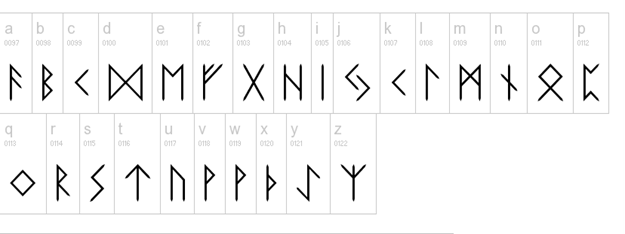
Gustaf’s friends certainly seemed to enjoy sending him anonymous and cryptic messages. This postcard from Stockholm is signed using runes! 1

image

1 Runes are very old letters which Germanic people used before they started using Latin letters in the Middle Ages. In its broadest sense, the word runes can mean any cryptic letters, but it usually means the alphabets used by Scandinavian people from about the year 150 AD to the Middle Ages. The oldest of these is called the Elder Fuþark, used from about 150 to 800 AD.
The runes used here seem to be from the Elder Fuþark and would read ALARIK.
Alaric is an old Nordic/German name meaning Ruler of all. Alaric I was the Gothic king of the Visigoths who plundered Rome in AD 410.

It is/was not a very common name but I found a note that it was introduced in the Swedish namesday calendar in 1901 (i.e. the year before this postcard was sent) and in connection with that gained a certain popularity.


So did Gustaf really have a friend by the name of Alarik? Or was it a nickname, or a code name?

Looking closer at the picture on the card, in the background there is a famous statue of the Swedish king Charles XII of Sweden (1682-1718), who was often referred to as warrior king and hero. 2 


image

Part of the Monument to Charles XII
in Stockholm, pointing towards Russia
(from Wikipedia)

In the foreground of the picture, there is a group of women. When you look closer, you can see they are carrying guitars and books or papers, and wearing hats typical of the Salvation Army!

The Salvation Army was founded in London in 1865 by William Booth and his wife Catherine. In 1878, their son Bramwell Booth, age 22, was visiting a family in Värnamo, Sweden. He took the opportunity to preach at the railway station there. One of those who heard him was a woman named Hanna Ouchterlony, a 40 year old bookshop assistant. She ended up going to London a few years later to study the work of the Salvation Army there; and returned to Sweden in 1882 with a group of four people, founding the first branch of the Salvation Army in Stockholm.

When looking close at this postcard, it seems to me to hold a wonderful irony, in that the Salvation Army women are turning their backs on the old warrior king, representing worldly wars and power, and walking in the opposite direction.

All in all, this to me turns out another example of a picture postcard that at first sight seemed rather ordinary – a statue and some people – but which on analysis turns out to be a really clever photo; and possibly also very consciously chosen by Gustav’s friend “Alarik”.

2012-02-24

A New Estelle Bernadotte (23-02-2012)

Here is some contemporary news, which happen to be loosely related to the life story of my grandmother’s half-sister Gerda. I’ve posted about this elsewhere but I’m putting it in here too.

The Associated Press
Date: Thursday Feb. 23, 2012 10:52 AM ET

STOCKHOLM — Sweden's Crown Princess Victoria gave birth to her first child Thursday, a baby girl who will one day become queen, prompting banner headlines and 21-gun salutes across the country.

The girl, who is second in line to the Swedish throne, was born at 4:26 a.m. (0326 GMT), said Victoria's husband, Prince Daniel. She was 20 inches (51 cms) long and weighed 7.23 pounds (3.28 kg).

---

Victoria, 34, is next in line to the throne held by her father since 1973. Sweden changed the constitution in 1980, three years after Victoria was born, to allow the eldest heir to inherit the throne regardless of gender. Before that female heirs were excluded. Sweden's last female monarch was Queen Ulrika Eleonora, who ruled for just one year until 1720.

Victoria married Daniel, 38, a commoner and her former personal trainer, in June 2010.

As is custom when an heir to the throne is born, the Swedish Armed Forces celebrated the news with two 21-gun salutes at noon in Stockholm and other cities.

Read more: http://www.ctv.ca/CTVNews/Entertainment/20120223/sweden-princess-has-baby-girl-120223/#ixzz1nELzQsvJ

image

This is the only picture made pucblic so far of Princess Estelle Silvia Ewa Mary, Duchess of Östergötland. With her parents Crown Princess Victoria and Prince Daniel. (Photo from the Royal Family’s Facebook page.)

As soon as the birth was announced yesterday, name speculations started. Today the name was officially announced, and the TV hosts were obviously a bit surprised and bewildered at first about the choice of Estelle. It took them a while to get their bearings and find the background for it. I wonder if I was the only one reacting with an “Of course!”  and wishing I’d actually thought of making a serious guess of it…

In the introduction page to this blog (see tab at the top of the page) I mention that my p.grandmother’s half-sister Gerda was employed as chamber maid or similar to Estelle Manville-Bernadotte, American wife of the well-known Swedish diplomat Folke Bernadotte, related to/member of our royal family.

Folke Bernadotte (2 January 1895 – 17 September 1948) was grandson to King Oscar II of Sweden, who was King of Sweden 1872-1907 (and of Norway 1872-1905).

Folke Bernadotte also earned his own place in history as a Swedish diplomat noted for among other things his negotiation of the release of about 31,000 prisoners from German concentration camps during World War II. After the war, Bernadotte was unanimously chosen to be the United Nations Security Council mediator in the Arab–Israeli conflict of 1947–1948. He was assassinated on Friday 17 September 1948 by members of the Jewish nationalist Zionist group Lehi (commonly known as the Stern Gang or Stern Group).

On 1 December 1928 in New York City, Folke Bernadotte married Estelle Romaine Manville (born in Pleasantville, New York, 26 September 1904; died in Stockholm, 28 May 1984), whose family had founded part of the Johns-Manville Corporation. They had four sons, two of whom died in childhood, and seven grandchildren, all born after Bernadotte's death.

(Source: Wikipedia)

…

I have not yet found out at what point in history my great-aunt Gerda came to work for them. I’m hoping to maybe find some clue among the old postcards as I continue to examine these. If I don’t, I may try and think of some other way to find out, because I’m really getting very curious!

Anyway, my immediate reaction to the royal announcement today was that the name could hardly have been more perfectly chosen. It’s a stylish old name not worn out by recent popularity but not sounding too odd either. It’s got a French ring to it that goes well with the name Bernadotte. It’s got royal connection as pointed out above, but at the same time Estelle Manville was not born royal - just as the new little princess Estelle’s father Daniel was not! And it indirectly commemorates a member of the royal family whose life’s work really deserves to be honoured.

I’m sure my grandmother Sally would have loved it. She was a big fan of the royal family – partly, I suspect, because of her sister working for them! When I was visiting my grandparents in childhood, I used to read old weekly magazines from the 1940’s and early 50’s that my grandmother had saved. They had lots of articles and photos of the royal family then living at Haga Palace (which Crown Princess Victoria and Prince Daniel have now taken over as their residence).

image
Our present King Carl XVI Gustaf (in the middle), with his four older sisters, at Haga in 1948 (from Wikipedia). Back then, the Swedish constitution did not allow girls to inherit the throne – so the nation kept waiting and waiting for that little prince…!