A 'Swenglish' journey through family photos, notes and postcards
from the early 20th century.

2013-06-18

G.017.1 Mösseberg, Midsommar

G.017.1_0001

Mösseberg, Ankdammen. 52737
Imp. G.W. Lundins Bokhandel (Hjalmar Lundin) Falköping
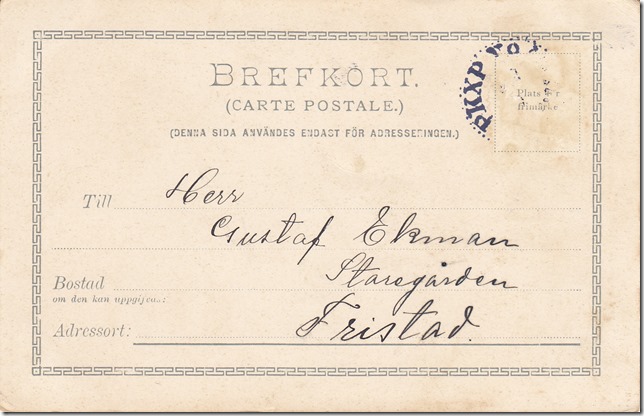
G.017.1_0002

G.017.1_0001-002

Date: Unknown, possibly 23.6.1902 (Midsummer Eve)
Sent from: Mösseberg, Falköping (spa resort)
To: Herr Gustaf Ekman, Storegården, Fristad
From: Gerda

Jag är nu på Mösseberg och har mycke roligt. Här skulle du varit med. Jag kommer nog hem på tisdag e.m. på halv 7 tåget tänker jag, eljest på sista tåget, möt mig då.

Hälsningar från Gerda

Hälsningar från Anna E—? o E—r o Edith.

Tack för brefvet, det kom oförväntat.
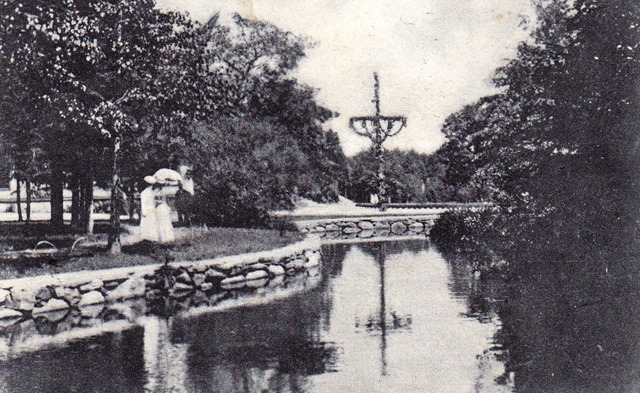
G.017.1_0001-001

Mösseberg, Kurort nära Falköping, grundad 1864.
Jmf mina kommentarer till vykort G.003.1 - Kanske hade Mösseberg trots allt redan vid sekelskiftet börjat bli mer av semesterort än kurort för lungsjuka?

Av poststämpeln syns vaga spår av att datumet kan ha varit 23 men inte vilken månad eller år. Troligen 1902 eftersom det sitter sorterat så i albumet. Midsommarafton firades på den tiden den 23 juni oavsett veckodag, och inföll 1901 på en söndag och 1902 på en måndag. Gerda skriver att hon tänker resa hem (till Fristad) tisdag em/kväll. Kanske var hon på Mösseberg för midsommarfirande? (Det som väcker tanken är midsommarstången på bilden…) E—r kan stå för Ester (Gerdas ogifta syster) och Edith deras syster Emmas äldsta dotter.

In English

Postcard sent to Gustaf from Gerda from Mösseberg, a spa resort near Falköping. In the picture you see a Swedish midsommarstång = midsummer pole (similar to maypole), reflected in the duck-pond in the park. There is not enough of the postmark to see the whole date but it could have been 23.6.1902, i.e. Midsummer Eve, which that year fell on a Monday. Gerda writes that she expects to go home on the train on Tuesday afternoon or evening, and wants her brother to meet her. She includes greetings from Anna (unknown to me), E—r (probably her sister) and Edith (probably her oldest niece, daughter to Emma). She also thanks her brother for an unexpected letter.


2013-06-17

G.016.3 Borgholms Slottsruin/ Borgholm Castle

G.016.3_0001

Oskrivet och odaterat vykort, troligen ca 1902.
Förlag: Hjalmar Appeltoffts Bokhandel.

G.016.3_0002

Enligt en uppgift jag fann vid sökning på internet grundades Hjalmar Appeltoffts Bokhandel år 1885 i Kalmar.

In English

Unwritten and undated postcard, probably ~ 1902.
Published by Hjalmar Appeltoffts Bokhandel (bookshop), Kalmar (founded in 1885).

Borgholm is the main city of Öland [island off the east coast of Sweden], but one of the smallest cities in Sweden. The city received its charter in 1816 and emerged as a spa-town in the shadow of the ruins of the once mighty Borgholm Castle, which burned down in 1806.

File:Borgholm .JPG

Borgholm Castle, 2006 (image from Wikimedia Commons)

2013-06-16

G.016.2 Brahehus + Diversehandel, Gränna

G.016.2_0001

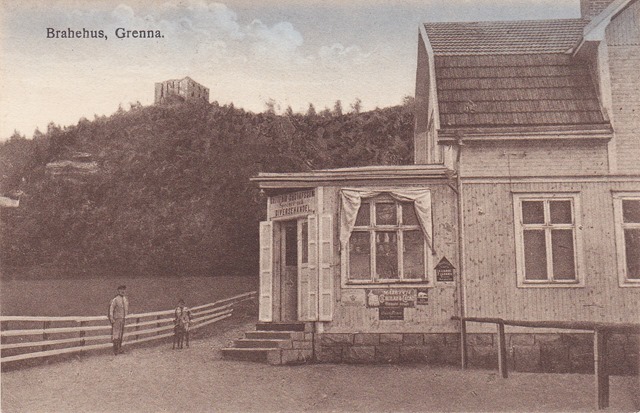
Brahehus, Grenna [Gränna]  (oskrivet vykort/unwritten card)

Förlag: Gottfrid Gustafsson, Grenna
Import: Gust. Lundgren & C:o, Norrköping
100 P (?)
Okänt tryckår, men troligen från ca 1902

Brahehus är ruinen uppe på kullen i bakgrunden.
I förgrunden ser vi (enligt skylten ovanför dörren)

GOTTFRID GUSTAFSSON
Speceri och
DIVERSEHANDEL.

Antagligen är det väl Gottfrid Gustafsson själv som står vid staketet t.v. (?)

Den största skylten på väggen under fönstret är reklam för
Mazettis Choklad & Cacao

G.016.2_0001-002

Mazetti chokladfabrik startades 1888 av Emil Mazetti Nissen och firman hette ursprungligen Malmö Choklad och konfektfabriks AB. Firmamärket var från början en dalkulla med en stor chokladbit. På 1890-talet bytte man namn till Mazetti. 


Jag hittade denna bild (via Google Image Search) på Brobygubbens Bildblogg, 24 september 2006
http://blogg.aftonbladet.se/45?page=29&pageSize=25


In English

http://upload.wikimedia.org/wikipedia/commons/5/56/Brahehus_2010.JPG

Brahehus, Gränna, Sweden, 2010 (Wikimedia Commons)

Brahehus Castle was built for Count Per Brahe the Younger in the 1640s. The ruins are situated at Gränna in Jönköping County in the province of Småland, Sweden. From the ruins you have a view of lake Vättern and the island of Visingsö.

Brahehus is the ruin on top of the hill in the background in the old postcard. The building in front is a country store owned by Gottfrid Gustafsson. (My guess is that Gottfrid is the man standing by the fence to the left.) There is no year printed on this unwritten card but it’s probably from around 1902 (as it has been placed together with other cards from that period in the album).

On the wall by the window there are some advertising signs. The biggest of these is for Mazetti Chocolates and Cocoa. The Mazetti chocolate factory in Malmö, Sweden, was founded in 1888 by Emil Mazetti Nissen. There is still a chocolate factory in the original premises, but now under a different name.

G.016.1 Skokloster (ca 1902)

G.016.1_0001

No. 17. Skokloster

G.016.1_0002

Date: Unknown (probably 1902)
To: Herr Gustaf Ekman, Storeg, Fristad
From: A. B—n

Mycket tacksam för vänliga hågkomsten, om ursäkt för jag dröjt så länge med besvarandet. Hoppas emotse!
Hälsningar! A. B—n

In English

Many thanks for remembering me, sorry for not writing back sooner. Hope to [be hearing from you again soon]
Greetings! A. B—n

(Sender unknown to me.)

Skokloster Castle is located on Lake Mälaren between Stockholm and Uppsala. It was built in the Baroque style between 1654 and 1676.
http://en.wikipedia.org/wiki/Skokloster_Castle

Skokloster slott, fasad mot väst i maj 2013

Skokloster Castle 2013 (Wikimedia Commons)

2013-06-08

Sepia Saturday: First World War

The Sepia Saturday inspiration photo this week shows “the kitchen of the hospital train of Kaiserin Augusta Victoria and dates from the early years of the First World War”.

It brought to mind for me another photo from my great-aunt Gerda’s photo album:

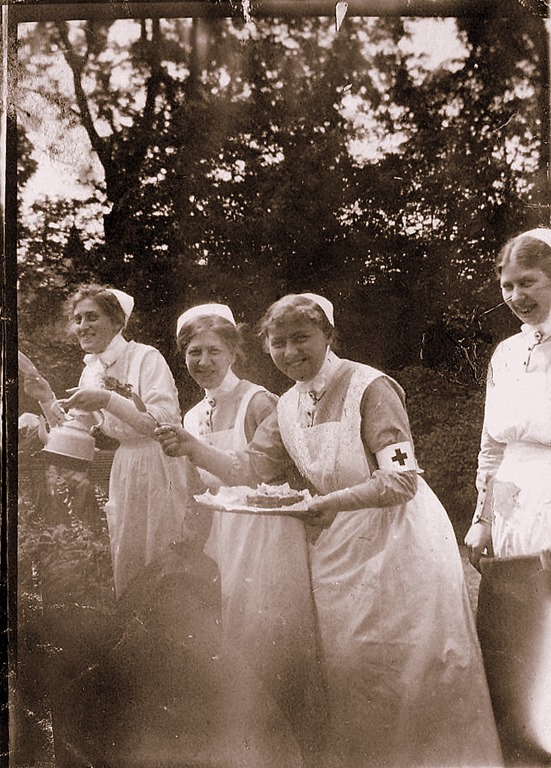
Gerda 48-003

Unfortunately this photo like most of the others in the album does not come with any notes to explain when and where it was taken, or who the people are. The original photo is small, 6x8 cm. Again it was not until I got it scanned and enlarged on my computer screen that I realized that the woman in the middle, holding the plate and spoon, must be Gerda herself. (I say “again”, because it’s been like that with several photos in her album.)

Gerda 48-004

Compare it to the portrait of her in the sidebar of this blog, which she sent to her little sister, my grandmother, from Lyon in France in 1915 :

Gerda

There are several postcards in her brother Gustaf’s postcard album that were sent by Gerda from France in 1914-18. I will get to them in due time as I continue to blog my way through the album. But here is a foretaste for Sepia Saturday:

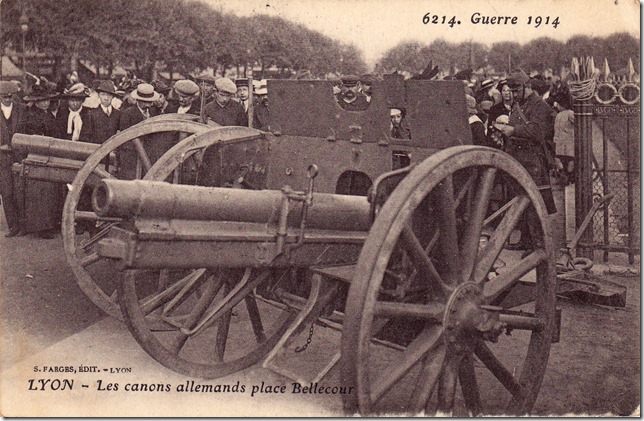
6214 Guerre 1914 canons _0002-001

6214. Guerre 1914.
E. FARGES, ÉDIT. – LYON
LYON – Les canons allemands place Bellecour

The Place Bellecour is a large square in the center of Lyon, France --- it is the largest clear square (i.e., without any patches of greenery, trees or any other kind of obstacles) in Europe /Wikipedia/

6214 baksida-001

Franked: Lyon Brotteaux 11.16, 12-12-14 Rhone

Lyon 11 Dec 1914
Dear brother,
I wish you a merry and happy Christmas! Did you get my letter, I haven’t had any news from home for a month. I hope I’ll hear from you soon. Lots of love from your sister Gerda. / These are cannons that the French have taken from the Germans, they are on display here.

Some six or seven months ago I got an email from a distant cousin of mine (grandson of one of Gerda’s older sisters). He tells me that after Gerda came back to Europe after her stay in Chicago (where she lived from 1902 and at least through 1910) she worked as lady’s maid/travel companion for (various) English ladies travelling in the British Commonwealth and to the US. When World War I broke out, Gerda was in France. The English lady she was working for at the time managed to get back home to England, but Gerda got stuck in France and remained there for years; judging by postcards sent to her brother it seems throughout the war.

Comparing Gerda’s portrait from 1915 with the photo of her in nurse’s uniform … It seems likely to me that it was at some point during the war in France that she also served as nurse. They seem very happy in that picture though… Were they celebrating victory? or just a private birthday party or something? I suppose that’s the kind of detail I’m not likely to be able to find out!