A 'Swenglish' journey through family photos, notes and postcards
from the early 20th century.
Showing posts with label France. Show all posts

2026-02-28

Visiting Versailles in the 1930s - Sepia Saturday 815

The theme for Sepia Saturday 815 shows a museum bedroom - which made me think of  some old postcards from Versailles, Paris, from my great-aunt Gerda's collection. 

This is a photo of Gerda visiting the gardens of Versailles in 1932. I have shown the same photo in an earlier post, from 2022-05-06, linked to Sepia Saturday 620. But that's nearly four years ago now... Some followers with good memories may remember bits and pieces from Gerda's story, but here's a short summary again:

Gerda Ekman, born 1881, was one of my grandmother Sally's older half-sisters. They shared the same father, but had different mothers. Gerda's mother died when she was six years old. In 1898, when she was 17, her father got remarried  to a younger window with one daughter (six years old at the time). 

In 1900, my grandmother Sally was born, and in 1902 also a baby boy. In those years of her father starting a new family, Gerda seems to have been staying with her oldest sister and her family much of the time. The sibling closest to Gerda's own age was her brother Gustaf, only two years older than herself. He was making plans to emigrate to America, and Gerda was no doubt inspired by him (but perhaps by other friends with the same plans as well). 

They both ended up emigrating in 1902 (for Gerda, when she turned 21). My impression is that they did not go on the same ship, though, but a few months apart. Anyway, while Gustaf ended up at a sawmill in Pennsylvania, Gerda went to Chicago; where she probably started out as simple kitchen maid, but kept working her way up to more respected positions in bigger households. Both siblings returned to Sweden around 1910/11. (Their father had then been dead for a few years - he died in 1907.) While Gustaf went back to farm work, Gerda continued her "career" as lady's maid and travel companion to wealthy ladies. 

When WWI broke out in 1914, Gerda happened to be in France - and got stuck there for the duration of the war. I've so far not been able to figure out who exactly she worked for during those years (and I probably never will) - but it was obviously for some fairly wealthy woman (or couple), as postcards show that in spite of the war going on, they went on holidays in the eastern parts of France, down to the riviera, and also over lake Geneva to Switzerland. After the war, Gerda returned to Sweden again - but continued to work as lady's maid/travel companion for various upper class women, also travelling abroad now and then.

In the autumn of 1928, she got employed as lady's maid to Estelle Manville-Bernadotte, daughter of a wealthy American, who in December that year married the Swedish count Folke Bernadotte (nephew of King Gustav V of Sweden). (The wedding took place in Pleasantville, N.Y.) The couple/family kept travelling a lot in the 1930s, both between Sweden and America, and within Europe; and Gerda travelled with them. 

Years ago, a relative quoted (in an email to me) a document stating that in 1932, Gerda was employed at Square Lamartine no 3 in Paris, as "domestique au service du comte Bernadotte de Wisborg, neveu du Roi de Suède"  (Cf a post from 2022-05-06: Cairo and Paris, 1932 - Sepia Saturday 620) 

So I know for a fact that Gerda was in Paris in 1932, and visited Versailles that year. Possibly the postcards may have been bought even earlier though. (No dates printed on them, so I can't be sure.)

Anyway - what made me think of these cards for this week's Sepia Saturday was three bedroom photos:

Marie Antoinette's Bedroom

Lous XIV's bedroom

Napoleon's bedroom

I'll include the rest of the Versailles postcards as well, just to have them all gathered in one post:


Linking to: Sepia Saturday 815 (28 February 2026)


2023-09-02

Dijon, France, c.1918 - Sepia Saturday 688

The Sepia Saturday theme for September, On the Street, made me go back and look at some unwritten old postcards from my great aunt Gerda's collection. 

Readers who have been following me for a while probably remember Gerda - my grandmother's older half-sister, the travelling lady's maid. When World War I broke out, Gerda "got stuck" in France, where she spent the war years working for someone living in Lyon. I've not been able to establish whom. (In my imagination, a wealthy American woman who "got stuck" in France during the war as well - but I have no real evidence of that.)  What I do know, from Gerda's postcards written to her brother Gustaf during the war years, is that they were also able  to travel a bit now and then, in the eastern parts of France.


Dijon is situated north of Lyon, and they/Gerda could have travelled there by train. The last of the postcards below gives me an important clue as to when she actually bought that one, though: It can't have been until July 1918 at the earliest; and may not have been until on her way back home to Sweden in 1919, after the war was over...

I like how all these street photos also have people in them.

34. DIJON - Rue de la Liberté 


40. DIJON - La Caisse d'Epargne

3. DIJON - Place de la République et Monument Carnot

9. DIJON - Fontaine de la Jeunesse ('the fountain of youth')

27. DIJON - Eglise Saint-Pierre - Place du Président Wilson

 Wikipedia : "The square was originally called St. Peter's Square. In 1904, during a campaign of "secularization of the streets" led by the radical municipality, the square was renamed People's Square. During the First World War, on July 5, 1918, the municipality of Dijon gave it the name of Woodrow Wilson (1856-1924), 28th President of the United States, to salute the entry of the United States into the war on the side of the France."

All the cards also include the printed names Caloin, Dijon and Cl. Baudinfère. I got no relevant hits when googling, but I assume the latter to be the name of the photographer.


Linking to Sepia Saturday 688 - On the Street


2022-03-26

Into the Unknown - Sepia Saturday 614


La Savoie
82 - Chambésy - Rue de Boigne - Fontaine des Eléphants, oeuvre de Sappey
(Fontaine des quatre Sans-Cul)

As mentioned briefly in my previous post, between July 1922 and March 1924, there was an interlude in my great-aunt Gerda's employment with the Swedish Countess Sparre-Bielke at Sturefors castle, during which she was instead off travelling to 'exotic countries' with a Lady Henry - who at the end of that period declared Gerda to be an "excellent traveller and packer and a neat needlewoman".

Unfortunately, this is a period of Gerda's travels that I know very little about. I have no written postcards from those years; and neither do I have any blank cards from countries more 'exotic' than France. I seem to vaguely remember having heard (back in my childhood/youth) that Gerda had also been as far away as India, though. And my relative BW mentioned in an email a couple of small pistols that she was supposed to have carried in her handbag when travelling to the "colonies". So when I first saw this postcard with the elephants in her collection (of unwritten ones), I thought that might be from India. Of course the printed text in French immediately took me out of that illusion; but in lack of the "the real thing" (actual proof), I decided to use it for this post anyway.

A website (www.lonelyplant.com) confirms my impression of at least a connection to India:

With its four carved elephants, this 17.6m-high fountain looks like the model for an old Indian postage stamp. It was sculpted in 1838 in honour of Général de Boigne (1751–1830), who made his fortune in the East Indies and was honoured posthumously with this monument for bestowing some of his wealth on the town. Locally, the elephants – whose front halves sprout from the statue – are lovingly referred to as the quatre sans cul (the rear-less four).

The text continues: 

The genteel arcaded street that leads from the fountain to Château des Ducs de Savoie, rue de Boigne, is also one of Boigne's projects.

There is a postcard of this as well, in Gerda's collection:

28 CHAMBÉRY - Le Château des Ducs de Savoie,
Le Donjon et la Porte Saint-Dominique - LL

Savoie (English: Savoy) is a department in the Auvergne-Rhônes-Alpes region of Southeastern France. As I know Gerda spent some time in the French alps when she lived in France during WW1, she may have visited Chambéry back then as well. But it may also have been before, or after the war.


I've spent quite a bit of time googling for a travelling 'Lady Henry', but without finding anyone who seems to fit with this window in time (1922-24). I've also tried 'Lord' Henrys, and 'Sir' Henrys - the whole thing not getting any easier by the fact that Henry might be either a surname or a first name. 

For a short while, I actually thought I might have a really exciting lead, when I did find an English earl by first name Henry, who had served in India and Mesopotamia during the war, and in July 1922 married an American girl; and after their marriage they did go to India... But as this couple is famous enough to even have a book written about them, it also soon became clear that no, alas - as much as I'd like to, I can't fit Gerda into their story... ;) Besides the fact that the couple went back to England in 1923, to take possession of an inherited estate, I actually even found out the name of the wife's maid, who was with them in India: She was called Marcelle, and had been with her "lady" since she was fourteen years old.

That couple's story is a very interesting one in its own right, though, and I look forward to continue reading the rest of it. The title of the book is Lady Catherine and the Real Downton Abbey, written by the current Countess of Carnarvon. It describes the lives of the family who lived at Highclere Castle  from 1923 to 1945, "in particular the beautiful Anglo-American Catherine Wendell and the man she married, who became the 6th Earl of Carnarvon". (Better known as Lord Porchester, or Porchey, rather than Henry - even if that was his name.)

While I'll probably never find Gerda's Lady Henry, at least the first few chapters of this book gave me some thoughts about likely circumstances: In the context of travelling to 'exotic' countries, like India, it is perhaps more realistic to think of Lady Henry as being married to a gentleman with military or diplomatic background, rather than as a single gentlewoman setting off on a journey "on her own" to explore remote corners of the world in the company of just a lady's maid (however excellent at packing and needlework). (Or one might imagine Lord Henry already being in India, with his regiment; and his wife travelling to join him there. Or something along that line...)

Linking to Sepia Saturday 614


Whether Gerda ever rode a bicycle, I have no idea!


SVENSKA

Som jag nämnde i förbigående i mitt förra inlägg, så gjorde Gerda under 1922-24 ett avbrott i sin anställning hos grevinnan Sparre-Bielke på Sturefors slott i Östergötland, för att istället resa med en 'Lady Henry' till 'exotiska länder'. I slutet av den perioden beröms hon av Lady H som mycket skicklig vad gäller att resa och packa, och även i sömnad.

Tyvärr är detta den period i Gerdas liv som jag vet minst om. Jag har inga skrivna vykort från de här åren, och inte heller några oskrivna kort från mer exotiska platser. Jag har dock vaga minnen (från min egen barndom/ungdom) av att hört sägas att Gerda även rest så långt bort som till Indien. Min släkting Bengt W nämnde också i ett email två små pistoler som Gerda tydligen brukade ha i sin väska vid resor i 'kolonierna'. Så när jag först såg vykortet med elefantskulpturerna ovan i Gerdas samling av oskrivna kort, gick tankarna till Indien. Men texten på franska upplyste mig ju om att bilden var från Chambésy i Frankrike. I samma stad finns även Château des Ducs de Savoie. Både skulpturen och gatan mellan den och slottet har anknytning till en general de Boigne (1751-1830), som gjorde sig en förmögenhet i Ostindien, och postumt hyllades med uppförandet av elefant-fontänen, och att få en gata uppkallad efter sig. 

Savoie är en provins i alperna i sydöstra Frankrike. Det är en region där Gerda reste en del medan hon bodde i Frankrike under 1:a världskriget, så vykorten kan vara från den tiden. Men de skulle också kunna vara från antingen före eller efter kriget. 

Jag har tillbringat en hel del tid med att googla på både 'Lady Henry' och på 'Sir' eller 'Lord' Henry, men utan att hitta några som passar in i omständigheterna och det snäva tidsfönstret mellan juli 1922 och mars 1924.  För ett ögonblick trodde jag att jag kanske hade hittat en intressant kandidat – en engelsk earl med förnamnet Henry, som hade tjänstgjort i brittiska armén i Mesopotamien och Indien under kriget, och som i juli 1922 gifte sig med en amerikanska. Efter bröllopet åkte de också båda till Indien. Detta är dock ett berömt par, som det även finns en bok skriven om. Så jag kom ganska snart fram till att hur gärna jag än ville, så kunde jag inte få Gerda att riktigt passa in i deras historia. ;) Förutom det faktum att de 1923 återvände till England för att ta över en ärvd egendom där, så fann jag i boken t.o.m namnet på hustruns verkliga kammarjungfru, som var med dem i Indien: Hon hette Marcella och hade varit i tjänst hos sin 'lady' sedan hon var 14 år gammal.  

Detta pars historia är dock intressant i sig, och jag ser fram emot att läsa fortsättningen av den. Bokens titel är Lady Catherine and the Real Downton Abbey, skriven av den nuvarande grevinnan av Carnarvon i England. Den beskriver livet och familjen på Highclere Castle (där TV-serien Downton Abbey spelades in) mellan 1923-1945, och inte minst den vackra anglo-amerikanskan Catherine Wendell och hennes make, som blev den 6:e earlen av Carnarvon. (Oftast kallad Lord Porchester, eller Porchey, även om hans förnamn var Henry.)

Medan det är föga troligt att jag någonsin kommer att lyckas fastställa identiteten på Gerdas 'Lady Henry', så gav mig den här boken ändå en del tankar – som t.ex att det i sammanhanget (resor till 'exotiska länder' vid den här tiden) ändå kan vara realistiskt att tänka sig att även Lady Henry var hustru till en brittisk militär eller diplomat eller liknande, snarare än en ensamstående adelsdam som bara gav sig av ”på egen hand” för att utforska okända hörn av världen, med bara en anställd kammarjungfu som sällskap (hur resvan och skicklig jungfrun än må ha varit på att ta hand om packning och sömnad mm). Men man kan ju också föreställa sig t.ex. att lorden rest i förväg och redan befann sig i Indien (eller något annat avlägset land), och att hustrun skulle resa senare för att ansluta sig till honom där (och då behövde ressällskap på vägen). 

2022-03-04

Hotel Postcards (1913-18) - Sepia Saturday 611

Linking to Sepia Saturday 611


Hotel Postcards from Gerda's travels 1913-1918

Besides the postcards that my great-aunt Gerda's wrote to her brother Gustaf, I have some blank ones which she probably kept as memories for herself. 
With this week's Sepia Saturday prompt being a vintage postcard of a hotel, I felt inspired to do a post of hotel postcards from Gerda's years in France. If you have been following my recent series about her, you have already seen some of these. But in this post I'm also including three unwritten cards not previously shown here; plus I have also done some online research to check if the hotels still exist, and if so, what they look like now. 

The post will serve as a kind of summary of Gerda's travels in France (and to Switzerland) during WWI. Seeing the hotel cards together enhances my impression that Gerda's employer/s must have been very well off - and Gerda herself, as lady's maid, thereby also enjoying a rather comfortable life compared to "most people" in France during the war years. (In the text on her postcards, she also never implied any financial worries for her own part.)

- - -

In 1913, Gerda was employed as lady's maid and travel companion to an English lady (her name unknown to me). In 1914, they were in France when WWI broke out. According to what I've been told, the lady was able to go back to England, but Gerda (Swedish citizen) was left behind in France.

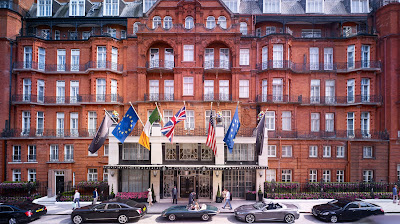
G.064.01 -  London - Claridge's Hotel - 1913


London - 14.11.1913
"The journey has gone well so far, leaving for France tomorrow." /Gerda 


G.072.02  - Vittel, France - L'Hôtel de l'Établissement - 1914

I did not find any contemporary hotel in Vittel by this name.
 An English Wikipedia article informs me that from November 1917 until February 1919, Vittel was home to U.S. Army Base Hospital 36 from Detroit, MI. "This unit was formed at the Detroit College of Medicine and Surgery now Wayne State University, School of Medicine. They occupied the five resort hotels in the city plus the casino." 


Vittel, France - 1914 (date unreadable)
"This is the hotel where I am now. Next week I'll be travelling from here to England." /Gerda

Or so she thought. That did not work out though - Gerda ended up remaining in France throughout WWI and until the autumn of 1919. She obviously soon managed to find a new employment in Lyon, though, with another lady (I think maybe American) who also liked to travel.  With the war going on, it seems they limited their trips to the south-east of France, but were also able to cross Lake Geneva by boat to Switzerland. On the French side of the lake, they stayed at Evian-les-Bains.


M.014.02  - Evian-les-Bains, France -  L'Ermitage

(Blank postcard)


Hôtel Ermitage, Evain-les-Bains
"Anglo-Normand architectural style and elegantly designed 80 rooms and family suites --- located at the heart of the Evian Resort ---  on the shores of Lake Geneva, in close proximity to the Alps. A harmonious blend of luxury, picture postcard scenery and tranquil pace of life." 


 G.077.02 - Lausanne, Switzerland - Royal-Hotel


Switzerland 19.09.1915: "I'm now out alone on a pleasure trip on the lake." /Gerda


"Royal Savoy Hotel & Spa is located in the center of Lausanne
and a 5-minute walk from Lake Geneva." 
"The hotel consists of of two wings:
the Savoy wing occupies an elegant Art Nouveau-style building
and all rooms and suites are with lake views or city views."


They also went down to Nice on the French Riviera a couple of times. (1916, 1918)

G.086.01 - Nice-Cimiez, France - Hotel Riviera Palace


Spring 1916 (sent from Lyon 1.6)
"Here you can see the hotel where we stayed on our trip. I'm marking our rooms with X."


"Like most Palace-Hotels in the area, the Riviera Palace did not survive the tourist disaffection between the wars and was converted into condominiums. The huge park, fortunately preserved, gives this residence an exceptional character. The apartments, which have mostly kept their Belle Epoque charm, enjoy a remarkable view of Nice and the sea, and a haven of greenery in the foreground, at the heart of Cimiez Hill."

And they also went up in the mountains, to Brides-les-Bains (1918).

M.014.02 - BRIDES-les-BAINS, France - Hôtel des Thermes - Etablissement  

(Blank postcard - c.1918)


Hôtel Mercure Brides Les Bains Grand Hotel des Thermes

"Perfect for relaxation, leisure and work,
where the mountains and the snow meet
 a spa resort set amidst lakes and streams."


At some point, Gerda also visited Vichy, a spa and resort town in the Auvergne-Rhône-Alpes region of central France. Whether that was before, during or after the war years, I can't say for sure, as I have only blank postcards from there.

M.017.02 - VICHY Rue Cunin-Gridaine et le Carlton-Hôtel

(Blank postcard)


My searches for Carlton Hotel in Vichy seemed only to lead to other old postcards and photos.
(Don't know when the photo above is from; I copied that from somewhere by screenshot.)

Also found a French article, though, from which I get the impression that it has nowadays been converted to apartments, but that back in WWI times it was a rather grand hotel. 

Google Translate to the rescue with the details: 
"Rebuilt almost entirely in 1912 by Joseph Aletti, the large Guillermen hotel, rue Wilson, is transformed into the Carlton palace. This new building, with a more sober and Art Deco decor, offers 300 rooms and 150 bathrooms. Its interior garden is reputed to be “a real little paradise”. In the 1960s, 20% of the Carlton was sold as apartments, with the rest of the rooms becoming a three-star hotel. Today, the entire building has become a condominium, the Résidence le Carlton."


2021-12-17

G.072.03 - G.073.01 - La Guerre - Lyon, December 1914 - Sepia Saturday 601 (1)

G.072.03

S. Farges, Edit. - Lyon
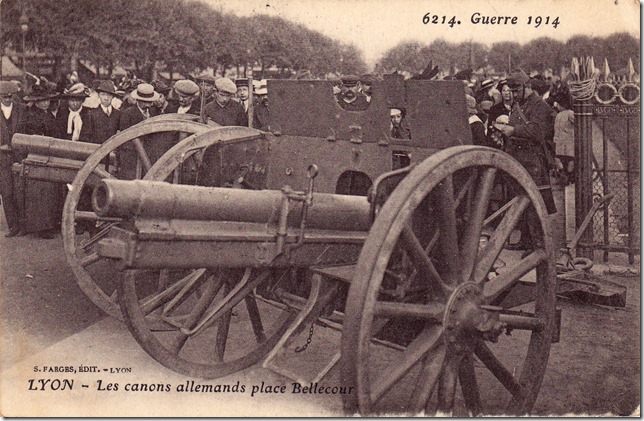
LYON - Les canons allemands place Bellecour - 6214. Guerre 1914

The German cannons on Place Bellecour
La Place Bellecourt is a large square in the centre of Lyon, France. It's one of the largest open squares in Europe, and nowadays part of a UNESCO world heritage site. Wikipedia does not mention the German cannons on display there back in the autumn on 1914.

De tyska kanonerna på Place Bellecour
La Place Bellecourt är ett stort fyrkantigt torg i centrala Lyon. Det är ett av de största öppna torgen i Europa, och numera listat som del av ett av UNESCOs världsarv. Wikipedia nämner inte de tyska kanonerna som förevisades där (som krigsbyte) hösten 1914.

To: Monsieur Gustaf Ekman, Backa, Brålanda, Suède 
From: Gerda (Lyon Brotteaux, Rhone, France,  12.12.14) 

Lyon d. 11 Dec 1914.
Käre bror! En glad och trevlig jul önskas dig hjärtligt. Har du fått mitt brev? Jag har ingenting hört hemifrån på en månad. Hoppas få höra från dig snart. Kära hälsningar, syster Gerda. 
[PS] Detta är kanoner som fransmännen tagit från tyskarna, de förevisas här.

Lyon 11 Dec 1914
Dear brother, from the bottom of my heart I wish you a happy and merry Christmas! Have you received my letter? I haven't heard anything from home for a month. Hoping to hear from you soon. Love, sister Gerda.
[PS] These are cannons that the French have taken from the Germans, they are shown here.


G.073.01

 La Guerre - Retour des Belges à Termonde

The Return of the Belgians to Dendermonde (Termonde)
Dendermode (French: Termonde): A city in East Flanders in Belgium. "The onset of World War I in September 1914 was disastrous for the city as more than half of its housing and the city archives were either bombed or burned down." [Wikipedia]

Belgarna återvänder till Dendermonde / Termonde:
Dendermonde (franska: Termonde) är en stad i östra Flandern i Belgien. Första världskrigets utbrott var katastrofal för den här staden. Mer än hälften av dess bostäder och även stadens arkiv antingen bombades eller brändes (enligt engelska Wikipedia).


To: Monsieur Gustaf Ekman, Backa, Brålanda, Suède
From: Gerda (Lyon Brotteaux, Rhone, France - 13.12.14)

Lyon d. 13.12.1914
Glad och trevlig jul och ett gott nytt år! önskar [jag] dig. 
Har du fått mitt brev?
Kära hälsningar,  syster Gerda 
[PS] Kanske du är hemma i Fristad nu över jul.
Jag väntar få höra från dig snart.

Lyon 13.12.1914
I wish you a Merry Christmas and a Happy New Year.
Have you received my letter?
Love, sister Gerda
[PS] Maybe you have gone home to Fristad for Christmas.
I'm expecting to hear from you soon.


COMMENTS:

So, in December 1914, Gerda is still in France. She is now (back) in Lyon. From more cards to come, it seems that she remained "based" in Lyon throughout the war, but also got to travel  to other parts of France now and then. She 
always avoids mentioning her employers or her own position on postcards; but my impression is that if her "English Lady" managed to return to Britain  (as I've been told in the past), Gerda must soon have found a new employment as lady's maid to someone else who also liked to travel. 

Anyway - it's now the middle of the December, 1914, Christmas coming up in a couple of weeks, and she has had no news from her family back in Sweden for a whole month. Distrusting the postal services, she writes two separate Christmas greetings to her favourite brother, posting them one or two days apart, in the hope that at least one of them will reach him. (She probably wrote to her other brothers and sisters as well, but I only have the cards written to Gustaf.)

KOMMENTARER:

I december 1914 är Gerda alltså fortfarande i Frankrike. Hon är nu (åter) i Lyon, och mitt intryck är att hon förblir "stationerad" där under krigsåren - men också reste till andra platser i Frankrike ibland. Hon undviker alltid att nämna vare sig sina arbetsgivare eller sin egen positon på vykorten. Men mitt intryck är att om hennes "engelska lady" lyckades ta sig hem till England, så måste Gerda ganska snart ha lyckats hitta en ny anställning som kammarjungfru hos någon annan som också tyckte om att resa. 

Hur som helst: Vi är nu i mitten av december 1914, med julen runt knuten, och Gerda har inte hört något från sin familj i Sverige på en hel månad. Då hon inte litar på postgången, skriver hon två kort med nästan likalydande julhälsningar till sin favoritbror Gustaf och postar dem med någon dags mellanrum, i hopp om att åtminstone något av dem ska nå honom. (Säkert skrev hon julhälsningar även till sina övriga syskon - men dem har inte jag.) 


Linking to: Sepia Saturday 601


PS. My next post, also from December 1914, will be linked to Sepia Saturday 601 as well. 

2021-11-13

Gerda as Red Cross volunteer (WWI) / Sepia Saturday 596


Sepia Saturday 596

The Sepia Saturday prompt picture this week shows a group of soldiers. I'm no expert on uniforms, but I guess it's from WWII. (If you know better, feel free to enlighten me.)

In my great-uncle Gustaf's postcard album, I'm still on the year 1913. But after 13 comes 14, and WWI - and some postcards with military scenes sent from his sister Gerda, who happened to be in France when that war broke out, and not able to get back to Sweden until after it was over. 

I don't know what employment Gerda managed to find (or maintain) in France during the war. She also probably wasn't able to write anything very revealing on the postcards. 

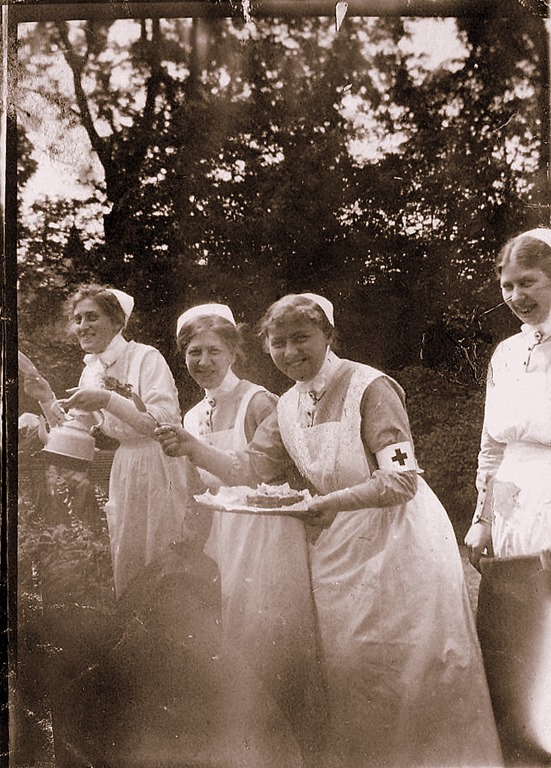
But in her photo album, there is one photo showing that at some point, she must have done some volunteer work for the Red Cross. Judging by the uniforms, and knowing that she spent WWI in France, I think it must be from those years.

Gerda in the middle, with the cross visible on her armband

As mentioned in last week's Sepia post, a decade or so later, Gerda started working for the Swedish Count & Countesse Bernadotte. During WWII (and after) she was still employed by them. Folke Bernadotte, closely related to the Swedish royal family, was vice president of the Swedish Red Cross during WWII. Towards the end of the war, he negotiated directly with Heinrich Himmler for the Red Cross and managed to rescue more than 30.000 prisoners of war from concentration camps in Germany in the so-called  'White Buses' operation. 

After WWII, Folke was chosen as mediator for the UN in the Arab-Israeli conflict, but was sadly assassinated by a Zionist group in Jerusalem in 1948. My great-aunt Gerda remained with his widow Estelle (born Manville) for many more years to come, though - long past normal retirement age. Estelle eventually got remarried, but not until the same year Gerda died (1973). (Gerda was born 1881, so lived to be 91 or 92.)

This past week, I've been re-reading/listening to a biography about Folke Bernadotte: A Forgotten Hero by Shelley Emling (2019). Well worth reading (although alas not including any glimpses from the servants' quarters of his household).


2014-02-01

Sepia Saturday: An Excellent Traveller and Packer

Gerda_beach-001

This week’s prompt for Sepia Saturday 213, a neatly packed suitcase, brings me once more back to my great-aunt Gerda (born 1881). I’m not sure exactly when or where this photo was taken, but the French Riviera seems likely. Whereever this particular photo is from, though, what I’m quite certain of is that Gerda packed a lot of suitcases in her life, and became very good at it!

At the age of 21, she emigrated to Chicago in America, where she lived for about ten years, working her way up as a maid. Then she returned to Sweden; but continued a career as lady’s maid and travelling companion to various noblewomen.

Last year I received a summary of her “CV” from a relative (the grandson of one of Gerda’s older sisters – while I am the granddaughter of their much younger half-sister). As documents kept by his side of the family include letters of recommendation from some of the positions she held, he has been able to fill in some “gaps” in her history for me.* (Thank you, Bengt!)

Among other things, Gerda is described (already in 1912, as well as subsequently in the late 1920s) as “an excellent traveller, packer and hairdresser, and a neat needlewoman”, fluent in English, and also good at French.

From 1928, or not very long after, she was employed in the household of the Swedish diplomat Count Folke Bernadotte (of the Swedish royal family), and his American wife Estelle (born Manville) – who of course also both travelled a lot. [Cf. my previous post from 26 January 2014.] Folke Bernadotte was tragically assassinated on duty for the UN in Jerusalem in 1948; but Gerda (who lived to be nearly 92 years old) remained working for / living with the Countess Bernadotte long past normal retirement age.

*På svenska, utdrag från Bengts mail:

Gerdas yrkesbeteckning i hennes flerspråkiga arbetsbetyg 1912-1928 var kammarjungfru, Lady´s Maid, femme de chambre.

1/10-1912 till 15/4 1913 i Sörby Ringstorp (Östergötland) kammarjungfru hos Adele de la Gardie (f Jacquier Frankrike gift 1911). Anställningen upphör när Adele reser utomlands. Gerda är skicklig i sömnad, hårskötsel, servering, talar engelska fullkomligt o har ”some knowledge of dressmaking”.

Nästa betyg är utfärdat i Lyon, France 28/9 1919. Gerda har arbetat som Lady´s Maid o är en ”excellent packer” o hairdresser o a neat needlewoman, her french is good.

20/5 1921 på brevpapper Oakhill Kungl.Djurgården (som varit prins Wilhelms) av oläsligt namn som skall återvända till USA.

21/7 1922 på brevpapper Sturefors  slott, Linköping  på franska av comtesse Sparre. Enligt Gerdas pass var hon i Frankrike under juli 1922. Sparres o Gerdas vägar skiljs för en tid  o under två år reser Gerda genom exotiska länder med en Lady Henry som

22/2 1924 anser Gerda vara en ”excellent traveller and packer and a neat needlewoman (vilket nog behövdes)”

7/3 1924 till 21/8 1928 på Sturefors slott hos Greta Bielke f Sparre. Comtessen återvände o gifte sig med slottsherren. Gerda är nu mycket skicklig i att sy kläder.

1928 var det år makarna Bernadotte gifte sig. Nästa dokument bland Gerdas papper är dock ett sorts identitetsbevis på franska utfärdat 9 mars 1932 om att hon är anställd i Paris på Square Lamartine no 3 som ”domestique au service du comte Bernadotte de Wisborg, neveu du Roi de Suéde”.

Ett annat dokument är ett intyg för inresa i USA om att grevinnan Bernadotte behöver Gerda som hjälp i hushållet när hon skall tillbringa julen 1948 med sönerna i sin våning på 885 Park Avenue, New York. Den julen var tre månader efter att maken Folke Bernadotte mördats i Palestina.

Gerda bodde länge på Dragongården. 1963 ringde jag henne där ---

En av kransarna på Gerdas begravning 1973 var från makarna Ekstrand. Grevinnan hade gift om sig samma år som Gerda dog.

2013-06-08

Sepia Saturday: First World War

The Sepia Saturday inspiration photo this week shows “the kitchen of the hospital train of Kaiserin Augusta Victoria and dates from the early years of the First World War”.

It brought to mind for me another photo from my great-aunt Gerda’s photo album:

Gerda 48-003

Unfortunately this photo like most of the others in the album does not come with any notes to explain when and where it was taken, or who the people are. The original photo is small, 6x8 cm. Again it was not until I got it scanned and enlarged on my computer screen that I realized that the woman in the middle, holding the plate and spoon, must be Gerda herself. (I say “again”, because it’s been like that with several photos in her album.)

Gerda 48-004

Compare it to the portrait of her in the sidebar of this blog, which she sent to her little sister, my grandmother, from Lyon in France in 1915 :

Gerda

There are several postcards in her brother Gustaf’s postcard album that were sent by Gerda from France in 1914-18. I will get to them in due time as I continue to blog my way through the album. But here is a foretaste for Sepia Saturday:

6214 Guerre 1914 canons _0002-001

6214. Guerre 1914.
E. FARGES, ÉDIT. – LYON
LYON – Les canons allemands place Bellecour

The Place Bellecour is a large square in the center of Lyon, France --- it is the largest clear square (i.e., without any patches of greenery, trees or any other kind of obstacles) in Europe /Wikipedia/

6214 baksida-001

Franked: Lyon Brotteaux 11.16, 12-12-14 Rhone

Lyon 11 Dec 1914
Dear brother,
I wish you a merry and happy Christmas! Did you get my letter, I haven’t had any news from home for a month. I hope I’ll hear from you soon. Lots of love from your sister Gerda. / These are cannons that the French have taken from the Germans, they are on display here.

Some six or seven months ago I got an email from a distant cousin of mine (grandson of one of Gerda’s older sisters). He tells me that after Gerda came back to Europe after her stay in Chicago (where she lived from 1902 and at least through 1910) she worked as lady’s maid/travel companion for (various) English ladies travelling in the British Commonwealth and to the US. When World War I broke out, Gerda was in France. The English lady she was working for at the time managed to get back home to England, but Gerda got stuck in France and remained there for years; judging by postcards sent to her brother it seems throughout the war.

Comparing Gerda’s portrait from 1915 with the photo of her in nurse’s uniform … It seems likely to me that it was at some point during the war in France that she also served as nurse. They seem very happy in that picture though… Were they celebrating victory? or just a private birthday party or something? I suppose that’s the kind of detail I’m not likely to be able to find out!