A 'Swenglish' journey through family photos, notes and postcards
from the early 20th century.
Showing posts with label street photos. Show all posts

2023-09-30

Randolph Street, Chicago (1904) - Sepia Saturday 692

G.027.2 - Randolph Street, Chicago (1904)

Reposted from 2019-06-17
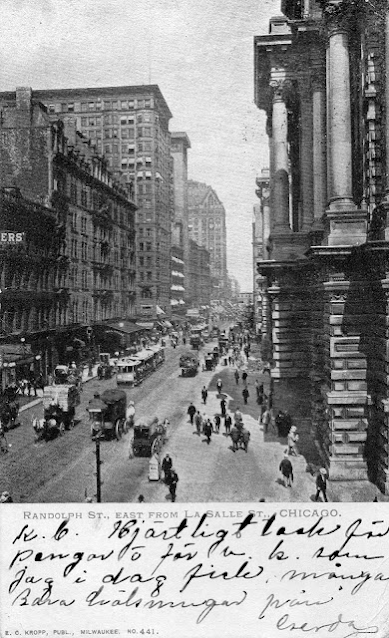

Randolph St., east from La Salle St., Chicago
E.C. Kropp Publ., Milwaukee, No. 441.


To: Gustaf Ekman, Galeton, PA
From: Gerda, Chicago; Oct 25, 1904 *

K.B. [Käre Broder] Hjärtligt tack för pengar o för v.k. [vykort] som jag idag fick.* Många kära hälsningar från Gerda. 

* 25 oktober var Gerdas födelsedag. (Hon var född 1881; så 1904 fyllde hon 23.)

Dear Brother, Many thanks for the money* and for the postcard that I received today.
Lots of love from Gerda.

* October 25 was Gerda's (23rd) birthday; so the money was probably a birthday gift.

Sister and brother Gerda and Gustaf were older half-siblings of my paternal grandmother Sally. They both emigrated from Sweden to America in 1902 and stayed there for about 8 years. Gustaf went to Pennsylvania to work in the lumber industry, and came to spend most of his time in Galeton. Gerda went to Chicago to work as a housemaid, and  worked her way up to lady's maid. Both siblings returned to Sweden in 1910/11. Gustaf went back to farm work. Gerda continued to work as lady's maid, and most of her employments after she returned from America still involved travelling abroad. During World War I she was in France. From 1928 onward she was employed by the Swedish count Folke Bernadotte and his American wife Estelle Manville-Bernadotte. 

Zooming in the street picture on the postcard: 


The vehicles on this photo seem to be horse-drawn, except for the tram/streetcar/trolley. The first streetcars in Chicago were horse cars, but the companies began substituting cable cars in the 1880s. By 1887, Chicago had the largest cable railway system in the world. It was also in the 1880s that electric-powered trolleys first became practical. The Chicago companies hesitated at first to install these faster and more efficient systems, but by the mid 1890s most of them had begun the conversion to electricity, which was completed in 1906. [Source: Wikipedia - Chicago Surface Lines

The busy city life in Chicago must have been such a contrast to the Swedish countryside where Gerda had lived all her life (21 years) until she emigrated.

Linking to Sepia Saturday 692


2023-09-02

Dijon, France, c.1918 - Sepia Saturday 688

The Sepia Saturday theme for September, On the Street, made me go back and look at some unwritten old postcards from my great aunt Gerda's collection. 

Readers who have been following me for a while probably remember Gerda - my grandmother's older half-sister, the travelling lady's maid. When World War I broke out, Gerda "got stuck" in France, where she spent the war years working for someone living in Lyon. I've not been able to establish whom. (In my imagination, a wealthy American woman who "got stuck" in France during the war as well - but I have no real evidence of that.)  What I do know, from Gerda's postcards written to her brother Gustaf during the war years, is that they were also able  to travel a bit now and then, in the eastern parts of France.


Dijon is situated north of Lyon, and they/Gerda could have travelled there by train. The last of the postcards below gives me an important clue as to when she actually bought that one, though: It can't have been until July 1918 at the earliest; and may not have been until on her way back home to Sweden in 1919, after the war was over...

I like how all these street photos also have people in them.

34. DIJON - Rue de la Liberté 


40. DIJON - La Caisse d'Epargne

3. DIJON - Place de la République et Monument Carnot

9. DIJON - Fontaine de la Jeunesse ('the fountain of youth')

27. DIJON - Eglise Saint-Pierre - Place du Président Wilson

 Wikipedia : "The square was originally called St. Peter's Square. In 1904, during a campaign of "secularization of the streets" led by the radical municipality, the square was renamed People's Square. During the First World War, on July 5, 1918, the municipality of Dijon gave it the name of Woodrow Wilson (1856-1924), 28th President of the United States, to salute the entry of the United States into the war on the side of the France."

All the cards also include the printed names Caloin, Dijon and Cl. Baudinfère. I got no relevant hits when googling, but I assume the latter to be the name of the photographer.


Linking to Sepia Saturday 688 - On the Street