G.027.2 - Randolph Street, Chicago (1904)
Reposted from 2019-06-17
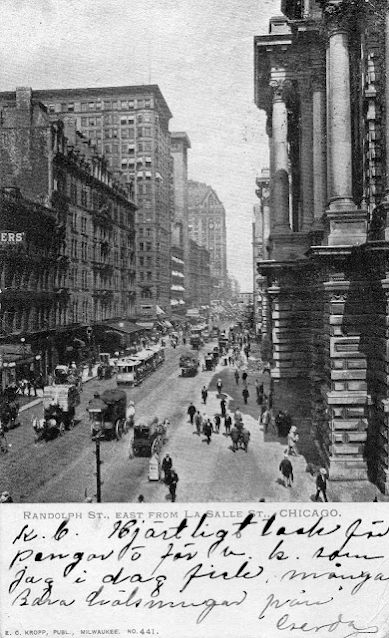
Randolph St., east from La Salle St., Chicago
E.C. Kropp Publ., Milwaukee, No. 441.

To: Gustaf Ekman, Galeton, PA
From: Gerda, Chicago; Oct 25, 1904 *
K.B. [Käre Broder] Hjärtligt tack för pengar o för v.k. [vykort] som jag idag fick.* Många kära hälsningar från Gerda.
* 25 oktober var Gerdas födelsedag. (Hon var född 1881; så 1904 fyllde hon 23.)
Dear Brother, Many thanks for the money* and for the postcard that I received today.
Lots of love from Gerda.
* October 25 was Gerda's (23rd) birthday; so the money was probably a birthday gift.
Sister and brother Gerda and Gustaf were older half-siblings of my paternal grandmother Sally. They both emigrated from Sweden to America in 1902 and stayed there for about 8 years. Gustaf went to Pennsylvania to work in the lumber industry, and came to spend most of his time in Galeton. Gerda went to Chicago to work as a housemaid, and worked her way up to lady's maid. Both siblings returned to Sweden in 1910/11. Gustaf went back to farm work. Gerda continued to work as lady's maid, and most of her employments after she returned from America still involved travelling abroad. During World War I she was in France. From 1928 onward she was employed by the Swedish count Folke Bernadotte and his American wife Estelle Manville-Bernadotte.
Zooming in the street picture on the postcard:


The vehicles on this photo seem to be horse-drawn, except for the tram/streetcar/trolley. The first streetcars in Chicago were horse cars, but the companies began substituting cable cars in the 1880s. By 1887, Chicago had the largest cable railway system in the world. It was also in the 1880s that electric-powered trolleys first became practical. The Chicago companies hesitated at first to install these faster and more efficient systems, but by the mid 1890s most of them had begun the conversion to electricity, which was completed in 1906. [Source: Wikipedia - Chicago Surface Lines]
The busy city life in Chicago must have been such a contrast to the Swedish countryside where Gerda had lived all her life (21 years) until she emigrated.


