A 'Swenglish' journey through family photos, notes and postcards
from the early 20th century.
Showing posts with label Falköping. Show all posts

2023-09-16

Falköping, Storgatan (1901) - Sepia Saturday 690

 (G.003.3 - Postcard previously posted on this blog 2012-02-29)

It struck me recently that there must be postcards in my inherited collection which, although I've posted them on the blog before, I did not link to Sepia Saturday. So I decided to go back and look among those for some image to repost for the current Sepia theme. (Actually interesting for myself as well, as I've both learned and forgotten a lot since I started this blog nearly 12 years ago...)

Falköping. Storgatan. (Main Street)


Lindgrens Bok- & Pappershandel (John Swedmark) Falköping.
Sommar-filial vid Mössebergs Badanstalt.
Lindgren's Books & Stationary - Summer Branch at Mösseberg Spa *


The sign on the building to the left says "Coats Shop"

Falköping (with surroundings) is widely known for its ancient remains of Stone Age, Bronze Age and Iron Age. The town is located between the two plateaus Mösseberg* and Ålleberg. The location has been inhabited since the end of the ice age and cultivated by people for 6000 years. (Wikipedia)

* There has been a spa at Mösseberg since 1865. The air up on the hill was considered healthy, there was a spring, and with the railway between Gothenburg and Stockholm passing Falköping (since 1862), the location was easily accessible. In 1885, a sanatorium for patients with tuberculosis was added. (There is still a spa there, but it has of course gone through a lot of changes since the start.)

To: Gustaf Ekman, Storegården, Fristad
From: Oscar Ekman, Odensberg

Obg. 5/10 -01
K.B.! [Käre Broder!] Tack för brefvet! Äfven tack för alla besvär, samt det jag kan få hjälp till erhållande af sågspån. Skall vidare släpas --- [?]. Gerda är som Ni kanske kanske redan vet nu åter uppe o kry, roligt nog! Hälsningar! Oscar

Odensberg 5/10 –01
Dear Brother, Thanks for the letter! Also thanks for all the trouble and for what help I can get to acquire sawdust. Must also be [transported...?] - As you may already know, Gerda is up and well again, I'm happy to report. Regards, Oscar

A postcard from October 1901, about a year before Gustaf and Gerda (brother and sister) both emigrated to America. Oscar was their older brother, manager of a country store in Odensberg, owned by his brother-in-law Brynolf (married to their sister Emma, and running another store in the village Floby, where they also lived). 

Falköping is the nearest bigger town to both Odensberg and Floby.


Oscar’s handwriting is not all easy to decipher, but comparing the information on this card with another card written the same month, it seems that he was doing some kind of work that required sawdust as "filling"(?), and is asking his brother (and perhaps also their father) for help with that. At the time, Gustaf was staying with their father Samuel and his new family (baby Sally - my grandmother - not yet two years old). At the end of the message Oscar adds that Gerda is up and well again – as they might already have heard. (She was probably staying with Emma and her husband in Floby.) 

Both Gustaf (23) and Gerda (20) were probably feeling rootless at this point in time - sometimes staying at their father's farm and sometimes with their older siblings, depending on where their help was best needed. No doubt this contributed to both of them deciding to seek their fortune in America instead. 


Linking to Sepia Saturday 690 - On the Street


2012-03-07

G.004-1 Falköping Ranten (1901)

004.1A-2
Förstoring från vykortet nedan/Enlarged from the postcard below

Falköping – Ranten (1901)
Lindgrens Bok- och Pappershandel (John Swedmark), Falköping
1183

004.1A-1

004.1B-1


Till/to: Herr Gustf. Ekman, Storeg., Fristad
Från/from: Oscar

Obg. 3/12 -01

K.B.! [Käre Broder!]

Tack för brefvet! Wore bra du komme så snart möjligt. Behöfver ej taga med häst ty vi kan nu köra Freja. Lös enkel biljett, du måste stanna öfver jul!

Många hälsningar till er alla!
Wälkommen!
I hast, Broder Oscar

Det verkar som om planerna från det föregående vykortet 3.3 fortsätter. Oscars handstil är inte enkel att tyda men att det finns ett sammanhang mellan flera kort i följd underlättar. Liksom plötsliga insikter som att han i vissa ord stavar med “w” i stället för “v”. (wore, wälkommen)

---

In English

Odensberg 3/12 –01

Dear Brother,

Thanks for the letter. Please come as soon as possible. No need to bring a horse since we can now use Freja. Buy a one way ticket, you must stay for Christmas!

Many greetings to you all!
Welcome!
In haste,
Brother Oscar

So it seems the plans from the previous postcard 3.3 are moving forward. Gustaf is to come to Odensberg to help his older brother Oscar with some work on his farm. It seems there has been some discussion whether Gustaf would also need to bring a horse (from his father’s farm), but no need for that, since there is now a horse available closer at hand. (Whether Oscar’s own or some neighbour’s?) So Oscar suggests that Gustaf takes the train and stays over Christmas.

1 Falköping Ranten was the first railway station at Falköping, built in the 1850’s. It took its name from a big estate nearby. The area around the station grew to become a sort of suburb and later merged with the town.

---

1 Falköping Ranten – Falköping C

Det ursprungliga stationshuset uppfördes 1857-1858 och stationen fick namnet Falköping Ranten eftersom den byggdes en bit ifrån dåvarande staden vid gården Ranten. (Namnet Ranten lär härstamma från det ålderdomliga ordet rant, som betyder jordrygg.)

Stationen var en nyckelknutpunkt i den första statsbanenätet i Sverige. Järnvägen Falköping-Malmö anslöt här till järnvägen Stockholm-Göteborg. Att resa mellan Stockholm och Malmö under 1860-talet innebar byte i Falköping.

Ett tag fanns det två järnvägsstationer i Falköping, nuvarande station i Ranten och en station närmare centrum. Efter 1931 bytte den namn till Falköpings Södra och samtidigt bytte stationen vid Ranten namn till Falköping Central.

Källa: Wikipedia/Falköpings Centralstation

Postcard

2012-02-29

G.003-3 Storgatan, Falköping (1901)

003.3A-2

Falköping, Storgatan. / Falköping, main street. (1901)
(förstoring från kortet nedan / enlarged from the card below)

Lindgrens Bok- & Pappershandel (John Swedmark), Falköping
No 170. Imp.
Sommar-filial vid Mössebergs Badanstalt (se 3.1).

003.3A-1

Text på butiksskylten: Kappmagasin – Skrädderiaffär
The sign says: Coat Store – Tailor’s Shop

003.3B-1

Till/to: Herr Gustaf Ekman, Storeg. Fristad
Från/from: Oscar

Obg. 5/10 -01

K.B.! [Käre Broder!]
Tack för brefvet! Äfven tack för alla [besvär?] , samt det jag kan få hjälp till erhållande af sågspån. Skall vidare [släpas? ---?] Gerda(?) är som Ni kanske kanske redan vet nu åter uppe o kry, roligt nog! Hälsningar! Oscar

Så här är ännu ett kort från Oscar (i Odensberg) till Gustaf (på Storegården), och daterat ca 2½ vecka innan det förra (3.2). (Jag går igenom korten i den ordning de sitter i albumet.) Oscars handstil är inte den lättaste att tyda! Lägger jag ihop pussel-bitarna från kortet skrivet 22/10 och detta från 5/10, så tolkar jag det som om Oscar höll på med något arbete där det behövdes “fyllning”, som kan ha bestått av sågspån, som han också kan ha behövt ekonomisk och/eller praktisk hjälp att anskaffa, och sedan att köra och få på plats.

Det framgår också att någon åter är uppe och kry; namnet är suddigt, men jag tror att det kan stå Gerda; vilket i så fall troligen syftar på systern – som denna tid verkar ha vistats hos den äldsta systern Emma (Wilander) med familj (i Sörby nära Floby, idag tillhörande Falköpings kommun). (Slutsats från några av korten i Gerdas album.) Detta kan stämma med Oscars osäkerhet om familjen på Storegården kanske redan nåtts av nyheten att hon var bättre.

Från vad jag minns att pappa berättat, så var Emmas make (Brynolf Wilander) “handlar’n i Floby”. Enligt släktträd som pappa ritat upp, hade de tre barn, Edit, Erik och Ella. (Inga datum.) Erik gifte sig med Vera, och de i sin tur fick tre barn, varav ett var Ulla, född 1939.

Oscar var gift med Elin, och de hade (enl samma släktträds-skiss) tre söner: Sven (+ 1973) (ing Malmö), Justus (fondchef Sundbyberg), Ingvar (ing Nr +). (Vad står Nr för??)


In English

Odensberg 5/10 –01

Dear Brother!
Thanks for the letter! Also thanks for all the [trouble?] and for what help I can get to acquire sawdust. Must also be dragged [ from there?] Gerda (?) is, as you may already know, up and well again, glad to say. Regards, Oscar

I’m scanning and going through the old postcards in the order they are in the album; which turns out not to be strictly chronological. This card was written 2½ weeks before the one in the previous post (3.2). Oscar’s handwriting is not always easy to decipher, but putting together the information from the two cards, I would say that in October 1901, Oscar was doing some kind of (farm) work  that required sawdust as “filling”, and he needed help with that from his brother Gustaf, who was otherwise living with their father and his new family. Possibly – but this is more of a guess based on a somewhat unclear turn of phrase – Oscar might also have asked their father for financial help in connection with this.

At the end there is the good news that someone is up and well again – as they may already have heard. The name is smudged, but I think it says Gerda. This makes sense, since from cards in her postcard album I conclude that around this time, Gerda was probably staying with their oldest sister Emma and her family, also in the vicinity of Falköping (Sörby near Floby), but not the same village as Oscar and his family (Odensberg).

If memory serves me right from what my father told me, Emma’s husband (Brynolf Wilander) was merchant/shopkeeper at Floby.

A family tree that my father sketched shows that Emma and Brynolf had three children: Edit, Erik and Ella. No birthdates given.

Oscar, according to the same sketch, was married to Elin, and they had three sons: Sven, Justus and Ingvar. No birthdates given.

2012-02-27

G.003-2 Swans (Mösseberg, Falköping)

003.2A-2
(förstoring från vykortet nedan – enlarged from postcard below)

Mössebergs Svanor (1901)

Lindgrens Bok- & Pappershandel, Falköping
A.J. Lindgrens Tr.

003.2A-1

003.2B-1

Poststämpel/postmark: 22.10.1901 PKXP (Falköping)
Frimärke/stamp: 5 öre
Till/to: Herr Gust. Ekman, Storeg., Fristad
Från/from: Oscar

003.2A-3

Obg.  d. 22/10 1901.  [Odensberg]

K.B.! [Käre broder!]
Tack för brefvet. Om du kunde få tillfälle ånyo komma hit en à 2 veckor o hjälpa till med körning, så vore bra snällt. Kom då snarast möjligt! Det passar så bra köra fyllning[?] här nu. Hälsa pappa o fråga [hur?] svar jag får på brefvet – om han kunde [läsa?] det? Många hälsningar! Broder Oscar.

Det här kortet verkar bekräfta att Gustaf under 1901 tidvis vistades på Storegården i Fristad och tidvis hos brodern Oscar i Odensberg nära Falköping. Vad “köra fyllning” på senhösten innebär vet jag inte riktigt. Jag har också svårigheter att tyda ett eller två ord i den sista meningen… Det verkar som om Oscar väntar på ett brevsvar från fadern (Samuel) också.


In English

Odensberg, 22/10 1901

Dear Brother,
Thanks for your letter. If you can find time to once again come there for one or two weeks to help out with driving, that would be kind of you. If you can, come as soon as possible! It’s a good time right now for driving [backfill?]. My greetings to Dad and ask him [when? how?] I’ll get an answer to my letter – if he could read it? Many greetings! Brother Oscar

This postcard seems to confirm that in 1901, Gustaf’s home was the family farm (with his father and stepmother) at Fristad but that he also periodically helped out at his brother Oscar’s farm(?) at Odensberg near Falköping. I’m afraid I’m not able to guess exactly what kind of filling or backfill is referred to here. There are also a couple of words hard to decipher in the last sentence, but it seems Oscar is also waiting for an answer to a letter he sent to their father.

For Mösseberg, see the previous postcard (3.1)

2012-02-25

G.003-1 Mösseberg, Falköping (1901)

003.1A-1

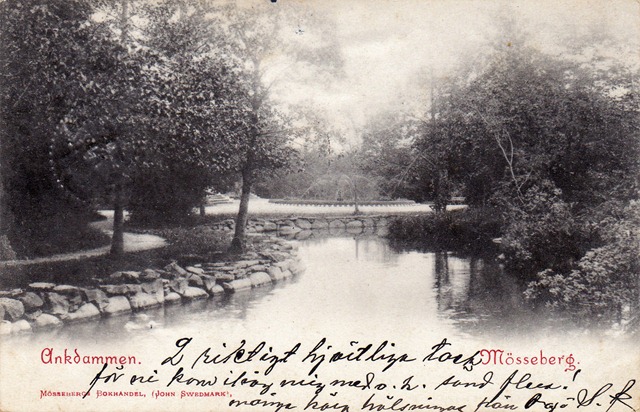
Ankdammen, Mösseberg (Falköping)/ Duck pond, Mösseberg

Mössebergs Bokhandel, (John Swedmark)
Oscar E. Kulls Grafiska Anst, Malmö - 202

003.1B-1

Till/to: Herr Gustaf Ekman, Storeg., Fristad
Från/from: (oläsligt/illegible)
Poststämpel/Postmark: 6(?).10.1901

(Poststämpeln har gjort avtryck i pappret och är därmed halvt läslig trots att frimärket är avlägsnat.)

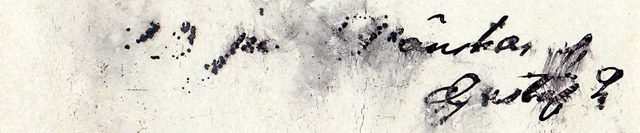
2 riktigt hjärtliga tack för ni kom ihåg mig med v.h. Sänd flera! Många kära hälsningar från (…?…)

Jag kan inte tyda namnteckningen.

Från http://www.kurortenmosseberg.se/historik/ hämtar jag information som nedan återges något förkortad.

1746 genomförde Carl von Linné sin västgötska resa och kom en blåsig julidag till Falköping. Han studerade floran på såväl Mösseberg som Ålleberg och förundrades över den växlingsrika naturen. Det skulle dock dröja ytterligare ett sekel innan den viktigaste komponenten för en framtida kurort skulle läggas på plats – dragningen av Västra Stambanan.

Greve Gösta Posse, en av initiativtagarna till järnvägens etablering på Falbygden, undersökte traktens möjligheter för en lokalisering av en vattenkurort och Mösseberg valdes då vattnet visade sig vara “särdeles ymnigt” i S:t Eriks källa. Vattnet kunde lätt pumpas upp och komma en kurbadinrättning till godo. En annan god anledning var att Mössebergssluttningen ansågs naturskön med en vegetation av ädellövskog och mattor av vår- och sommarblomster. Efter en studieresa till franska och tyska badinrättningar lades ritningar och förslag fram till byggnation på Mössebergssluttningen.

Den 30 augusti 1864 fick projektet Kungl. Maj:ts godkännande för bolagsordningen för Mössebergs Kallvattenkurinrättning Aktiebolag, en benämning som senare ändrades till Mössebergs Vattenkuranstalts Aktiebolag.

År 1867 tillträdde dr Otto Torstensson, den förste badläkaren vid Mösseberg, i ”den ståtligaste och vackraste badanstalt som detta land dittills skådat”.

I Ny Illustrerad Tidning kunde man samma år läsa följande: “Några minuters väg från Falköpings jernvägsstation å den södra sluttningen av det egendomliga Mösseberg, der bokskog ännu påminner om flydda dagars skogrikhet, framqväller en källa, kring vilken den nya badanstalten blifvit uppförd i smakfull stil. Inredningen är efter nyaste och bästa mönster.”

Det vackraste badhuset i Sverige blev endast fyra år gammalt. I slutet av badsäsongen, natten mellan den 5 och den 6 september 1871, eldhärjades denna stora träbyggnad. Badsäsongen var egentligen slut, inga gäster fanns kvar i byggnaden men tre badbetjänter innebrändes. Anläggningen ödelades helt.

Redan ett år senare uppfördes ett nytt badhus på samma grund som det eldhärjade. Gästerna som mot slutet av 1800-talet till stor del bestod av lungsjuka, ersattes med de som återigen såg kurortslivet som en tillvaro för de mer bemedlade – samhällets toppskikt.

Med sekelskiftet byggdes kurorten till ytterligare. Den 14 november 1907 invigde prins Gustaf Adolf Vintersanatoriet som förutom gästrummen hade en sällskapsvåning med magnifika salonger i svit, rökrum, biljardsal, matsal samt fullständig badavdelning, kök och en stor ekonomiavdelning i en souterrängvåning. Tidens finesser fanns här som elektriskt ljus, centralvärme och vattenklosetter.

År 1901 verkar det troligt att Mösseberg fortfarande huvudsakligen var en kurort för lungsjuka snarare än en “semesteranläggning”.

Jag vistades själv på Mösseberg i två veckor i januari 2003 för en rehabiliteringsutredning, och då såg ankdammen ut så här:

19##_F21

Duck pond, Mösseberg, Falköping, January 2003 (my photo)

In English:

2 really heartfelt thanks for remembering me with friendly greetings. Send more! ‘Lots of love’ from (…?…)

(It strikes me that in translating greeting phrases it’s not easy to be sure that one catches the right level of initimacy. Especially not from 110 years ago!)

I can’t decipher the signature on this postcard.

Mösseberg was and is a spa resort in Falköping. The history page on their (Swedish) website tells me that the spa resort was founded in the mid-1860’s in connection with the railway being built.

[I think my blogging friend GB pinpointed Falköping very well with the following comment on a previous post here: “Between Google Earth and Wikipedia it's interesting to build up a picture of the locality of the sender and the recipient. Falköping looks very much like a road and rail hub despite not being a very large place.”]

Besides beautiful nature in the surroundings there was a spring well suited for a health spa. When it was first opened in 1867, it was described as the most beautiful and luxurious of its kind in our country. Unfortunately, the original building was destroyed in a fire only four years later; but a new building was erected the following year, on the same foundation as the old one.

In 1907 there was a major renovation and additional buildings with the latest facilities were added, and it became more of a fashionable resort for nobility and royalty and other people with a lot of money to spend. In 1901, however, it was probably still mainly a resort for people suffering from consumptive diseases.

So the friend who received friendly greetings and sent thanks back for them may have been someone spending time at Mösseberg spa for that reason. On the other hand, it could of course have been someone visiting or living in or near Falköping for other reasons.  For example, it seems from the two next postcards in the album (coming up here soon), that Gustav’s brother Oscar lived at Odensberg near Falköping. But this seems not to be his signature (comparing with those other two). 

In January 2003, I spent two weeks at Mösseberg myself, in connection with an evaluation of my capacity for work after an accident. Not going into the details of that here (it was not a happy time) but one of the few photos I took while there was one of the duck pond, from the same perspective as that old postcard. It was a very cold January, as I recall around -20°C.

2012-02-16

G.001-1 Fristads Missionshus 1901

Sid 1_0001-4

Det allra första vykortet i Gustafs vykortsalbum är från 1901 och visar Fristads Missionshus. / The very first postcard in Gustaf’s postcard album is from 1901 and shows the Mission Covenant Chapel at Fristad.


2012_02_16 Sid 1 

‘BREFKORT’ – POSTCARD

Poststämplat1/postmarked: Odensberg 1901
Till/to: Herr Gustaf Ekman, Odensberg2
Avsändare/sender: Gustaf (?)

1Den andra poststämpeln på vykortet kan jag inte uttyda.
Portot ser ut att ha varit 5 öre.

2Odensberg ligger i Falköpings kommun.
Odensberg is a locality near Falköping, Västergötland.


Sid 1_0001-3

Den handskrivna texten på framsidan har delvis suddats ut, men kortet verkar ha sänts som julhälsning från en annan Gustaf.

The writing on the front of the card is smudged, but it seems to have been sent as a Christmas greeting, from another Gustaf.

♥ ♥ ♥

Missionskyrkan i Fristad idag (foto från deras hemsida 2012):
The modern Mission Covenant Church at Fristad:

image

Svenska Missionskyrkan är ett svenskt nyevangeliskt, reformert trossamfund grundat 1878, fram till 2003 kallat Svenska Missionsförbundet.

The Mission Covenant Church of Sweden  was founded in 1878.  It is a Swedish Reformed free church with its origins in the Lutheran Church of Sweden. As a movement they have roots in Pietism and the spiritual awakenings of the nineteenth century.

When Swedish Covenanters emigrated to the United States and Canada in the last half of the nineteenth century they formed the Evangelical Covenant Church.

♥ ♥ ♥

År 1884 var Gustafs far (min farmors far) Samuel Emanuelsson, med om att bilda missionsförsamlingen i Borgstena (där familjen bodde under åren 1867-1897). I denna församling var Samuel till att börja med vice ordförande. Han var också söndagsskollärare. (Uppgiften hämtad från en artikel i Fristadsbygden 2007  skriven av Sten Emanuelsson, sonson till Samuel och Selma.)

In 1884, Gustaf’s father Samuel was involved in founding a mission covenant church in the village where he and his family then lived – Borgstena (not far from Fristad). Samuel was vice chairman in the beginning, and Sunday School teacher.