A 'Swenglish' journey through family photos, notes and postcards
from the early 20th century.
Showing posts with label Selma. Show all posts

2023-10-14

Family Portraits - Sepia Saturday 694


This portrait of  my great grandfather Samuel, born 1835, is the only one of him that exists. The sign he is holding says "Lord, increase our faith". Back in childhood I always wondered why, and I can't recall anyone ever explaining. (Possibly they did not know either.) He was a farmer and a merchant; not a clergyman. However (thanks to research done by one of my dad's cousins), much later I learned that Samuel was involved in the founding of a local free church in 1884. Then he was 49 years old, which seems to fit with this photo.

Back then, he was still married to his first wife, Anna Sophia. She died in 1894. (There is no photo of her.) Together they had 9 children, born between 1866-84. Two died in childhood, and another (at age 31) in 1899, before my own grandmother was born.

In 1898, Samuel got remarried to my great grandmother, Selma (born 1861);  she also a widow, with a young daughter. There is no wedding photo or other portrait of Samuel and Selma together either.


This photo of Selma is probably from her first marriage - or even earlier. Her first husband was younger than her; but died when their daughter Hildur was only two years old.

Together, Samuel and Selma got two more children: my grandmother Sally (born 1900) and her brother Nils (born 1902). Samuel died in 1907 (72 years old) and then Selma was a widow again, now with three young children. She did not get married again, but remained living on the farm with her step-son Carl (single), who had taken over the running of the farm already around 1903/4.  

In the census of 1910, two separate households are listed for the farm: Selma and her children (probably at the time living in a separate cottage) counted as one family; and Carl, his brother Gustaf (recently returned from eight years in America) and their sister Ester (housekeeping for them) as another. Later on, it seems that Carl, his stepmother and her children all lived together in the farmhouse, though. 


Selma (born 1861) and her sister Ida (born 1865). Not sure which year, but my guess is c. 1917. 

Ida and her husband Gustav  in 1908
(the year actually printed on the photo!)


My grandmother Sally (born 1900) and her half-sister Hildur (born 1892 in Selma's first marriage). Same studio background as in the photo of Selma and Ida. Could be from the same occasion.


Hildur, Selma and Sally, around the same time as well. (Compare Hildur's bow tie here to the one Ida is wearing in the first portrait.)


Another studio portrait of Sally and Hildur
 - a few years later, I think.


Sally's half sisters on her father's side, Ester (born 1876) and Gerda (born 1881). Must be from before Gerda emigrated to America - 1902 or earlier.


Ester, a bit later in life (year unknown)


▲Gerda with a friend, from Chicago (1902-1910)▼
LEFT: Gerda to the right - RIGHT: Gerda to the left


Gerda returned to Sweden in 1910/11, but soon went abroad again.


Gerda in Lyon, France, 1913 (or 15?)


Hildur, Gerda and Sally. My guess is that this was taken on Gerda's return from France in 1919 - after the end of WWII.


Gustaf, born 1878, also emigrated to America in 1902, and returned in 1910. The portrait above is from Port Allegany, probably 1903. The photo below is one I just recently found and realised that it must be Gustaf to the right. It's printed on American postcard paper (but not written on) so I'm guessing that it must be from his later years in America. I don't know who the other two men are.


Once back in Sweden, Gustaf did not go abroad again. He helped out on the family farm for a while; then moved away to work elsewhere in Sweden (also with farm work); then returned again to help out at the family farm - and took over when his older brother Carl died in 1928. But I think the farm was sold after Sally, Nils and Hildur all got married and moved away - to do with distribution of inheritance.


Carl, Selma, Hildur and Sally 


Hildur, Selma and Sally, probably summer 1930


Nils, Sally and Selma
("when big hats were the fashion")


Linking to Sepia Saturday 694 - Portraits


2023-02-05

Aerial Photography - Sepia Saturday 658


Flygbild av Mullsjö 

Aerial Photo from Mullsjö

ÄKTA FOTOGRAFI 
Ensamrätt
A/B Almquist & Cäster, Hälsningborg
Ahrenbergsflyg

GENUINE PHOTOGRAPH
Exclusive rights


This postcard was sent to my great-grandmother Selma for Mother's Day in May 1937, from her step-daughter Ester (one my grandmother Sally's older half-sisters), living in Mullsjö - a village by a lake with the same name, located some 25 km north-west of Jönköping.

At first glance, a postcard like this looks rather dull to me - but when I started thinking about it, it struck me that aerial photography like this was probably still rather new in Sweden in 1937.

The name of the company "Ahrenbergsflyg" took me to a Swedish Wikipedia article about Albin Ahrenberg, 1889-1968. Leaving military aviation in 1924 he started his own company, with flights for postal services and aerial photography. In 1929 he planned a flight from Stockholm to New York, via Norway, the Faroe Islands, Iceland, Greenland and the Labrador region of Canada. He got as far as Greenland - but was forced to return to Sweden from there (by boat), because of technical trouble.

In 1931, he returned to Greenland to help search for an English meterological research expedition that had gone missing there. He was successful and returned a hero this time. 

Later on, during WWII, he served again in some military position, with surveillance of the Stockholm archipelago. (I'm afraid my knowledge of military terms and organisation is not sufficient - in either language! - to quite grasp the details.) 

Anyway - the story serves to support my thought that back in 1937, a black and white aerial photo of a countryside village probably still seemed a lot more impressive to the recipient than it would today!

In 1937, Selma was 76 years old, and living with her daughter and son-in-law (my grandparents Sally and Gustaf), and her grandson Bertil (my father, 6 going on 7 that year). 

And below is an aerial photo of the house to which the card was sent. It's the house that my grandparents built, and moved into in 1930, when they got married. 

I'm not sure whether that photo is from the 1930s, 40s or 50s, though. (It was obviously black and white with the colours added to it afterwards.) When my brother and I sold the house in 2014 (rather different-looking by then - twice as big, and yellow), we left the original of this photo hanging in the house for the new owners, as we don't have a younger generation of family to pass it on to anyway.


"Aero Foto Vetlanda"


2022-04-15

Stockholm Exhibition 1930 - Sepia Saturday 617

 M.002.01 - Stockholmsutställningen 1930 

STOCKHOLMSUTSTÄLLNINGEN 1930.
Reklammasten och Huvudrestauranten.

STOCKHOLM EXHIBITION 1930
Advertising Mast and Main Restaurant


To: Fru Selma Emanuelson, Storegården Fristad
From: Gerda (Stockholm, 24.5.1930)

Hjärtliga hälsningar till Mor från Gerda
Best wishes to Mother from Gerda

- - -

Mother's Day greeting from Gerda to Selma
25th May 1930 was Mother's Day (Mors Dag) in Sweden  (the last Sunday in May). 

Gerda's birthmother, Anna Sophia, died when Gerda was only 12 going on 13. Most likely, neither Gerda nor her older siblings were entirely happy about their father (Samuel) getting remarried four years later, to a younger widow (with a six-year-old daughter from her first marriage).

Later in life, it seems they all came to accept Selma as their step-mother and part of the family, fhough. Mors dag was introduced in Sweden in 1919. From the 1920s/30s I have this and a couple of more cards showing that Gerda and her sister Ester both sent greetings to Selma for Mother's Day, addressing her as Mor = Mother. 
Short Review (for whoever may find it useful): 
When my grandmother Sally was born in 1900, Gerda was 19, and Gustaf 22. Gustaf's postcard collection starts in 1901, and from addresses on cards it seems that by then, he and Gerda were staying mostly with their older married siblings rather than with their father. 
In the autumn of 1902, Gustaf and Gerda both emigrated to America. When they both returned to Sweden in 1911, their father had been dead four years, and their oldest brother Carl had taken over the farm. Selma and her children (including my grandmother) still lived there with him.
Gerda went on finding various employments as lady's maid, and continued to travel abroad a lot (inclding spending all of WWI in France).
Gustaf helped out at the family farm for a while when he first came back, but then moved away to work at other farms in Sweden for a few years. He returned to the family farm in 1918; and after Carl died in 1928, he took over there. 
- - -

The Stockholm Exhibition (Stockholmsutställningen) was an exhibition that took place from May to September 1930 in Stockholm, Sweden, and entertained about four million visitors. Swedish artists, craftsmen and companies showed their latest products.  All of the fair buildings were temporary, but the fair's ideas lived on and influenced Swedish housing for years to come. The exhibition had great impact on the architectural style called functionalism. "Especially conspicuous was the Paradise Cafe [the main restaurant] and the Entry Pavilion, with its exposed steel frame, airy expanses of glass, and dramatic lighting at night. Above the fair, a towering advertising mast stood with an electrically lit version of Lewerentz's 'Flying V' logo." (Wikipedia)

Broschyr från Stockholmsutställningen i PDF-format. 
(Brochure from the exhibition - in Swedish, but also with photos.)

Film från öppnandet av utställningen med tal av kung Gustaf V. 
(Film from the opening of the exhibition, with speech by King Gustaf V, and views of the area and the crowd attending the event. You also get a closer view of for example the advertising mast.)


M.002.02 - Greetings from Livorno

Saluti a Piccola Velocità da Livorno

"Greetings at slow speed" [?] from Livorno


To: Herr Gustaf Emanuelsson, Storegården, Fristad
From: Gerda (Stockholm, 5.6.1930)

Hjärtliga hälsningar på namnsdagen från syster Gerda
Best wishes on your Name Day from sister Gerda


(6th June is Gustaf's Name Day in the Swedish calendar)

Livorno is a port city on the western coast of Tuscany in Italy. I'm not sure when Gerda visited Livorno; but if it was with Estelle and Folke Bernadotte (cf. previous post), it would have been in 1929 rather than in the spring of 1930. Why? That couple's firstborn child, Gustaf Edward Bernadotte af Wisborg, was born 30 January 1930, in Stockholm. 


Linking to : Sepia Saturday 617


A smaller exhibition - but they seem to have
grasped the importance of Big Advertising!


Morsdagshälsning från Gerda till Selma:
Gerdas mor, Anna Sophia, dog när Gerda bara var 12 gammal. Varken hon eller hennes äldre syskon var antagligen överlyckliga åt att fadern (Samuel) fyra år senare gifte om sig med en yngre änka (Selma), med en sex-årig dotter från sitt första äktenskap. Senare i livet tycks de dock ha kommit att acceptera Selma som styvmor och tillhörande familjen. 'Mors dag' introducerades i Sverige 1919. Från 1920- och 30-talen finns detta och ytterligare ett par kort som visar att Gerda och hennes syster Ester båda skickade Morsdags-hälsningar till Selma, och då kallade henne Mor.
Kort sammanfattning (för den som känner behov av det): 
När min farmor Sally föddes i februari 1900, var Gerda 19 år  gammal, och Gustaf 22. Gustafs vykortssamling startar 1901, och därifrån framgår att både Gustaf och Gerda vid den tiden vistades mer hos sina äldre gifta syskon än hos fadern med familj på Storegården. 
1902 utvandrade Gustaf och Gerda till Amerika. När de återvände 1911, hade fadern varit död i fyra år, och deras äldste bror Carl hade tagit över Storegården. Selma och hennes barn bodde fortfarande kvar där med honom. 
Gerda fortsatte att finna anställningar som kammarjungfru till förmögna damer, och kom också fortsättningsvis att resa mycket utomlands (inklusive att hon tillbringade hela första världskriget i Frankrike). 
Gustaf hjälpte till på Storegården under ett par år efter att han först återvänt till Sverige, men flyttade sedan för att arbeta på andra gårdar under några år. Han återvände till Storegården 1918; och efter att Carl dog 1928, tog han över där. 

Stockholmsutställningen 1930 ägde rum mellan maj och september det året, med totalt omkring fyra miljoner besökare. Svenska konstnärer, hantverkare och företag visade upp sina senaste produkter. Alla byggnader var temporära, men idéerna levde kvar och fortsatte utöva inflytande på bl.a. funktionalismen som präglade svensk arkitektur under lång tid framöver.

Hälsningar från Livorno
Livorno är en hamnstad i Toscana i Italien. Jag vet inte säkert när Gerda besökte Livorno - men om det var tillsammans med Estelle och Folke Bernadotte, så måste det ha varit 1929 snarare än 1930. Varför? Jo, parets förstfödde, Gustaf Edward Bernadotte af Wisborg, föddes 30 januari 1930, i Stockholm.

2013-07-28

Sepia Saturday 187: The Old Book/“Postillan”

I’ve not had much time on the computer the past couple of weeks and actually almost missed this Sepia Saturday. But when I saw that it was about Family Bibles (or similar) I decided just had to put in a post, even if a little late; because I had intended to do one on this theme soon anyway!

CIMG5825-001

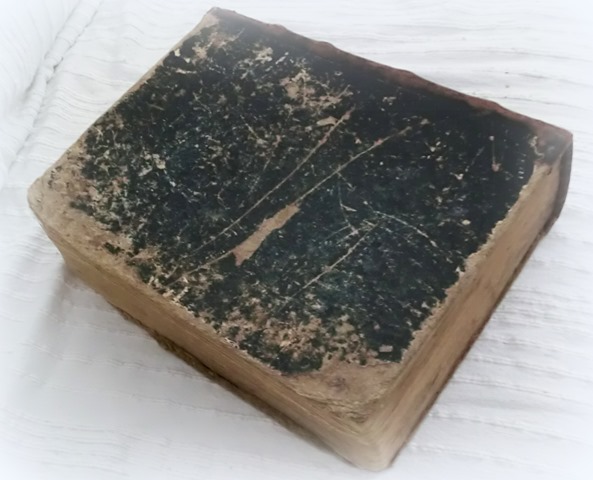
Actually one of the things that kept me away from the computer last week was that my brother and I were going through books in the house that belonged to our parents (and before them, to my paternal grandparents). Among them were some that we managed to sell to a second-hand bookshop, but also some that in spite of their age are considered to have no monetary value.

CIMG5828-001

As we’re getting closer to actually selling the house soon, we now have to make final decisions about many objects that we’ve been hesitating about. I remember finding this book two years ago and deciding to settle for just taking photos of the notes on the inside of the covers…

2013-07-23 Samuels Postilla, M Luther's Book of Sermons1

But that was before I’d found the postcard collection and other notes and photos that gave me more interesting keys to the family history.

So at long last, I ended up taking the heavy old book home with me after all.

CIMG5819-001

It’s not a Bible but a selection of sermons by Martin Luther, printed in 1861. In Swedish known as Luther’s Postilla.

CIMG5868-002

CIMG5829-001 

It was given to (or possibly bought by) my great-grandfather Samuel and his first wife Anna Sophia in connection with their marriage in 1866. Samuel was 31 years old at the time and his wife 28.

CIMG5830-002

Tillhör
S. Emanuelsson & Anna Sophia Emanuelsson
Herre Led Oss i Din Sanning, för Ditt Namns Skuld.

Belongs to
S. Emanuelsson & Anna Sophia Emanuelsson
Lord, Lead Us in Thy Truth
for Thy Name’s Sake

CIMG5830-003

1866 den 27de Januari Blefvo vi förenade till äkta makar härpå Jorden. O trofaste Jesus, behåll oss alltid i din kärlek, att vi till sist för evigt får fira Bröllop med dig i Himmelen.

In 1866 on 27th January we were united as husband and wife here on Earth. Oh faithful Jesus, keep us always in Thy love, that in the end we may celebrate the eternal Wedding with Thee in Heaven .

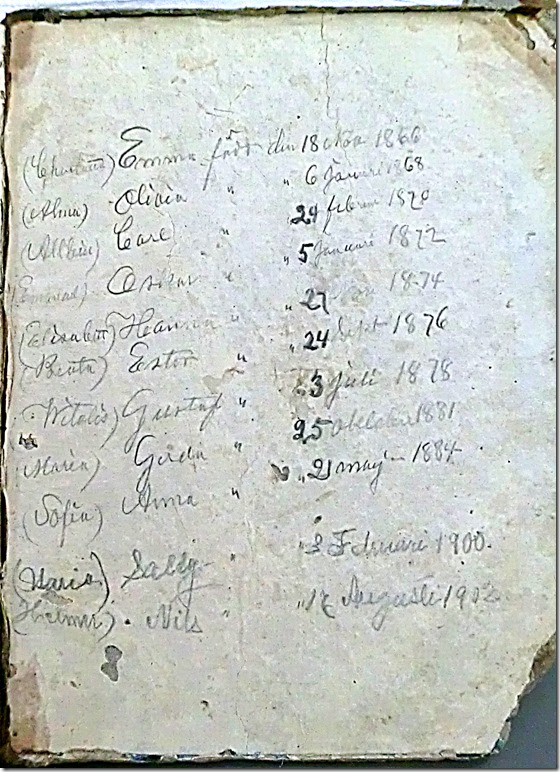
As far as I’ve been able to discover, there is no note made in the Postilla of the death of Anna Sophia in 1894, or of Samuel’s second marriage to my great-grandmother Selma in 1898. But all the birthdays of his children are listed on the inside of the back cover, including the two youngest born to him by Selma:

CIMG5862-001

No death dates are entered, even for the children who died young. Hanna Elisabeth, born in 1874, died in 1882 at age 8. And Anna Sophia’s youngest daughter, born in 1884 and named after herself, died on Christmas Eve 1893 at age 9(½). The mother herself died four months later, aged 57.

Samuel’s second oldest daughter Olivia also died (in 1899, at age 31) before my grandmother was born .

Samuel got remarried in December 1898 (at age 63) to Selma (37), a widow with an 8 year old daughter (Hildur). My grandmother Sally was born just over a year later (February 1901), and her brother Nils in August 1902. They were a whole generation (37-38 years) younger than their oldest half-sister Emma!

Samuel died in 1907 (when my grandmother was 7 years old). Selma did not get married again but stayed on the farm with her children and Samuel’s oldest son Carl (who never married). Carl died in 1928. In 1930, the farm was sold and all three of Selma’s children (Hildur, Sally and Nils) got married. The rest of her life until her death in 1943, Selma lived mainly with my grandparents – who built the original house, which my brother and I are now in the process of emptying of its last contents before we sell it. (After my grandmother’s death the house remained in our family as summer cottage for a number of years; and then my parents built an extension and moved in there permanently and lived there the rest of their lives.)

So that’s how the Postilla ended up with me. It has been kept in the same house since 1930 when that house was built.

CIMG5850-001

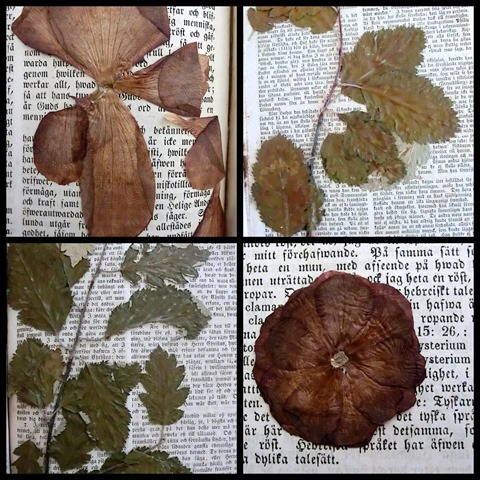
I’m not sure how much anyone ever read it after Samuel died (I think I can safely say that I will never be reading more than maybe a few sentences here and there from it). But evidently, at some point in time, it was considered useful for other purposes as well:

2013-07-23 Samuels Postilla, M Luther's Book of Sermons

I wonder if there is a way to determine when (and by whom) in the past it was used for pressing flowers in? Samuel or Anna Sophia back in the late 1800s? Selma in the early 1900s? My grandmother or my father in the 1940s?

2012-03-05

Sally (1900-1979) (my grandmother)

Som jag nämnde i föregående inlägg, kan jag inte hitta några barndomsfoton av min farmor Sally (född 1901). Det är inget konstigt med det i och för sig – det fanns säkert ingen kamera i familjen på den tiden. Det enda som är underligt är att jag ändå har en minnesbild av att i min egen barndom ha sett ett sådant foto, av Sally som liten “tulta”, i vit klänning och hätta med knytband – inte ett porträttfoto, utan en bild tagen på avstånd, med den lilla flickan på en väg eller gångstig, med Storegården i bakgrunden…

När jag själv var liten, så brukade jag sitta med farmor och titta i hennes fotoalbum, och hon berättade för mig om sin egen barndom. Och jag kunde nästan ha svurit på nu, att det där fotot skulle finnas bland dem i ett av de där bruna albumen med kort nedstuckna i utskurna luckor för bilder i olika format – en del ovala, en del fyrkantiga. Men det finns inte ett enda som visar farmor yngre än i övre tonåren. 

Jag kan bara dra slutsatsen att jag måste ha målat upp den där barndomsbilden för min inre syn, medan farmor berättade för mig om ett minne från sin barndom – kanske inte ens hennes eget minne, utan en historia som hon i sin tur fått berättad för sig av sin mamma och sina äldre syskon: Hur hon en gång, som mycket liten (ett par år?) “rymde hemifrån”. Men hur någon i familjen såg henne i hennes lilla vita klänning och hätta tulta neråt vägen… Och snart hann ifatt henne! Vad jag är tämligen säker på är att jag själv hörde den historien flera gånger från farmor – och själv brukade be henne att “berätta om när du rymde hemifrån”. Och hon berättade, och broderade säkert ut det hela lite också.

Men de tidigaste bilderna jag hittat är nog ett par som fanns bland farmors halvsyster Hildurs efterlämnade foton:

Ett är taget i trädgårdsmiljö, troligen på Storegården: Hildur t.v. och Sally t.h., tillsammans med mor Selma. Utifrån att framför allt Selma ser äldre ut på de kort som jag kan datera till slutet av 20-talet; och därtill de långa kjolarna och Hildurs hatt, så tror jag att detta kanske kan vara taget ca 1916-17.

H.album_0005-1

Hildur, Sally and Selma (ca 1916-17?)

image

Likaså det nedanstående fotot av Sally och Hildur som uppenbarligen är taget i porträttstudio (också det från Hildurs fotosamling):

H.album_0006-1 

Sally and Hildur  (also ca 1916-17?)

I ett kuvert som pappa märkt “före 1930) hittade jag också ett som verkar vara tagit i samma studio (jämför bakgrunden!), av deras mor Selma (t.v.), och troligen hennes syster Ida (antecknat av pappa med ? på baksidan). Det som talar för att dessa kort skulle kunna vara tagna vid ungefär samma tid är modedetaljen med den stora rosetten, som bärs av Hildur på trädgårdsfotot ovan, och av Ida på ateljéfotot nedan:

IMG-1

Great-grandmother Selma with her sister Ida(?)
probably ca 1916-17 as well

---

CIMG7357-1 

Sally, ~ late 1920’s

I farmors senare album finns det här kortet från hennes ungdom inklistrat, bara med anteckning “Vid Öresjö”. Det är en unik bild på henne med det långa håret utslaget. Min gissning är att det kan vara taget av farfar under deras förlovningstid.

Farmor hade kvar sitt långa hår länge – jag tror ända till in på 1970-talet - men hade det alltid upprullat i en låg knut eller valk i nacken. Från ett eller flera tillfällen när jag som barn bodde över själv (utan mamma och pappa) hos farmor och farfar, minns jag farmor i långt vitt nattlinne göra kvällstoalett vid köksbänken (något badrum hade de ju inte), kamma sitt långa mörka hår och fläta det för natten. Fortfarande då (tidigt 60-tal) nästan midjelångt. Jag minns också att hon sa att farfar tyckte om hennes långa hår, och inte ville att hon skulle klippa av det...

Här är en annan bild från stranden vid Öresjö (Skalle),
troligen från deras förlovningstid:

H.album_0001-1

Sally & Gustaf ca 1929

H.album_0004-1

Sally & Gustaf ca 1954


In English

As said in the previous post, I can’t find any childhood photos of my grandmother Sally (b. 1901). There is nothing really strange about that – I don’t suppose they had a camera in the family. The only thing which is odd about it is that I still have a mental image in my head of having seen – in my own childhood – a photo of her as a toddler; wearing a little white dress and bonnet kind of hat – not a portrait photo, but one taken from a bit of distance, with her toddling down a path or driveway, with the farmhouse in the background.

When I was a little girl myself, I know I sometimes used to sit with my grandmother and look in her old photo albums. And I could almost have sworn that such a photo would be in there! But there isn’t. I think I must have made up the image in my head, based on a story she used to tell me (and which I liked, so that I would ask her to tell it again, and again) about one time, when she at very young age, only a toddler,  “ran away from home” – although did not get very far before some other family member caught sight of her little white bonnet and caught up with her and fetched her back. It probably wasn’t even her own memory, but a story she herself was told over and over by her mother and older siblings.

The earliest photos I’ve found of her seem to be from her upper teens, and showing her together with her (half-) sister Hildur. Judging by the fashion and how tall Sally is, my guess is 1916-17. (Hildur was eight years older, but much shorter!) One of the photos is an outdoors picture (presumably at the farm) and the other a studio portrait.

I also found a portrait from the same studio of their mother Selma, presumably with her sister Ida. (Note made by my father on the back of the photo.) One detail besides the studio background that supports the idea that this photo is from around the same time, is the same kind of big bow worn by Hildur in the garden photo and by Ida in the studio photo.

The next photo is a unique one showing Sally with her long hair let down. My guess is this might have been taken by my grandfather Gustaf while they were dating/ engaged in the late 1920’s. Sally kept her long hair until in her 70’s, and it did not turn grey until then either. But she always wore it in a bun or rolled up at the nape of her neck. From some stay at their house in my childhood, early 1960’s, I remember her combing and braiding her hair at night (still reaching almost down to her waist); and telling me that my grandfather liked her long hair and did not want her to cut it off… (Gustaf died in 1969 at the age of 65. Sally survived him by ten years and died in 1979.)

The next-to-last photo is probably from around 1929, it’s from the lake beach below where they built the house they moved into as newly-weds in 1930. The last photo I think was taken in connection with my grandfather’s 50th birthday in 1954 (same summer my parents got married, and the year before I was born).