A 'Swenglish' journey through family photos, notes and postcards
from the early 20th century.
Showing posts with label railway. Show all posts

2022-11-18

The Platelayer's Cottage - Sepia Saturday 648

Startning with another letter from Sally to Gustaf; written about two weeks after the last one (cf. my post last week / SS647). (You'll find out about the Platelayer's Cottage further down!)


Storegården, [Wednesday] 29 April, 1925

My dear friend ”Nothin”,

Many thanks for your letter. I'm glad to hear you're feeling well again. I'm afraid I can't say the same for myself just now, which also means I'm not quite my usual cheerful self. As you know, nothing is much fun when one is not feeling well.

I did go into town on Saturday, and then passed on your greetings to Thea. She said to pass on to you in return, when I write, her thanks for the card that you sent her before you went off to Kviberg.

Today it's very windy here, and no warm winds, but rather cold. Strange that it isn't warmer when it's soon May 1st.

On Sunday we were at the chapel at Mölarp for a party. There was singing and music, and coffee was served. Quite a lot of people were gathered there. They have almost completed the chapel on the inside now, except for painting.

I now have greetings to you from 'Him with captial H'. Both he and Hildur from Länghem were here on Sunday. I passed on regards from you to them, and they asked me to send theirs to you in return.

On Monday the funeral for the vicar's wife took place. It was a very solemn ceremony. I wasn't there, but Mum, Hildur [Sally's sister] and Nils [their younger brother] were. You asked in your letter if Gustav [older brother] is still staying at the vicarage. Yes, he is. Well, he's also down at Sparsör a lot [another part of the parish], but that's still for the vicar. But he'll probably be moving out on May 1st, at least as far as I know now.

Do you know what, ”Nothin” - we have now started weaving. Well, high time I suppose, as we've been taking a long time with the preparations. As for spring work at the farm, we haven't done much about that yet. No particular rush yet, but I suppose we'll have to get started soon. You promised in your letter to be with us in your thoughts when it's time to plant potatoes. If memory serves me right, you were present in person last year, helping out.

I think I shall have to stop writing for today. I'm going down to the loom for a while now. Mum is down there already. Hildur has gone to Källeberg, so I'm alone in the house at the moment.

Best wishes to you from all of us here. I hope you'll write back when you can.

Best wishes also from your friend "Bengtamor"

[PS] I've not heard anything more about the "Nothin" who was going to start a shop in Fristad. I don't know what became of his shop. But I felt I had to give you a [nick]name, [too], because as the saying goes: "One gift for another makes good friends."

"Paus i postatisupptagning 1921"

Photo from a coffee break while harvesting potatoes at Storegården in 1921. Sally 2nd from the right.


NOTES

"Nothin" - Sally's nickname for Gustaf, introduced in the previous letter. A possible origin seems to be hinted at in the PS here, although still obscure. Sally also argues that if Gustaf can give her a nickname (Bengtamor = "mother Bengta"), it's only fair that she gives him one as well.

Thea - A mutual friend also referred to in the previous letter. (Anyone else getting a feeling that Sally may be feeling a slight sting of jealosy about Gustaf also writing to Thea? She dutifully passes on greetings beteween them, but doesn't add another word about her own meeting with Thea in town.) 

'Him with capital H' - The same expression was used in the previous letter, and refers to Olle Hellsten, for whom Sally's sister Hildur was "carrying a torch". (They did eventually get married, but at this point in time, things were not yet settled between them). 

Gustav / The Vicarage - Sally's and Nils' older half-brother had apparently been staying at the vicarage while doing some work for the vicar. Gustav was also a church warden - I'm not sure exactly how much 'this and that' was included in that position. In 1925, the family farm was still run by Gustav's older brother Carl. My guess is that in the winter, there wasn't enough work at the farm for both of them, so Gustav also took on additional other jobs.

Källeberg - I remember a place by that name from my own childhood (1950s/60s): then the home of three elderly siblings, a brother and two sisters, friends of my grandparents. We went by car when visiting then, and I have no real concept of the distance. Seems to me quite a long way for them to walk - but I feel the same about certain other places they would also walk to back then. Having no other means of daily transport, I guess they were used to it! 

The Platelayer's Cottage at Länghem

Sally keeps mentioning a 'Hildur at Länghem', in her letters - always adding the "at Länghem" to distinguish that Hildur from her own sister by the same name. I've been assuming that Länghem was a neighbouring farm; but after a bit of research, I find that it was a platelayer's [AE trackman's] cottage along the railway, which Sally & co would pass between the farm and the main village and railway station (Fristad). A platelayer [BE] is a railway employee who inspects and maintains a railway. The Swedish word for the profession is (was) banvakt (='railway guard').

"In Sweden, each railway employed a number of platelayers with the responsibility for the maintenance of a designated part of the line. --- they lived in cottages along the line (banvaktsstugor, singular banvaktsstuga). These cottages were usually designed to match the stations in architectural design. Each cottage would typically have a couple of rooms and a kitchen, and the platelayers often kept a cow or chicken, as well as growing vegetables and fruit. The platelayer system was finally dismantled in the 1950s" [Wikipedia]

My grandfather Gustaf collected a lot of information during his lifetime about 'croft' cottages (torp) in the parish where he lived, intending to publish a book when he retired. As in his 60s he got Parkinson's disease, and died at age 65, he wasn't able to complete the book himself. But my parents and my grandmother completed it after his death, and had it published posthumously. It was in this book that I found the platelayer's cottage Länghem included, with the added information that in 1925, the inhabitants were platelayer Karl Andreasson, born 1898, and his wife Hildur, born 1899. 

My own father, who grew up in another house close to the railway (built by my grandparents in 1930, the year they got married), took a special interest in railway history, and also wrote books about local railways. In his book about Borås-Herrljunga railway, I found this photo of the platelayer's cottage at Länghem. The man in uniform on the draisine (rail-cycle) is Karl Andreasson (with two friends):


"Länghems banvaktsstuga på 1920-talet. På dressinen sitter
banvakten Karl Andreasson och ett par 'civila' kamrater."

Going back to my grandparents' photo albums, I also found the photo below, of "The platelayer at Länghem, at the feet of the woman" (or women!) The woman on the left is my grandmother Sally, and the one furthest to the right is her sister Hildur; so I suppose that makes the one in the middle "Hildur at Länghem", the platelayer's wife.

"Banvakten på Länghem vid kvinnans fot."

And having identified the second Hildur, I also found these photos of the two Hildurs and Sally together with a fourth young woman (so far unidentified), taken "at Länghem". 

"Vid Länghems berså, i ungdomens dagar."   (Hildur L, Hildur A, Sally +?)

"På Länghem" 

There is also a photo from inside the platelayer's cottage, at Christmas. 

"När juldagsmorgon glimmar. I Länghems banvaktsstuga."

It's clearly from after Sally and Gustaf had sorted out their feelings for one another... But I see no engagement rings on their fingers, which narrows down the year to 1926, 27 or 28. (They got engaged in the autumn of 1929.) (In Sweden, rings are exchanged between the man and the woman at the engagement. The bride then gets an additional ring at the wedding.) The man at the back is Sally's older brother Gustav. The woman to the left of him I now recognise as Hildur, the platelayer's wife. The couple sitting at the table are unknown to me. (I think the woman is the same as the unknown one in the two photos above, though. It also looks to me like she resembles Hildur a little bit - maybe they were sisters?) I suppose the platelayer himself may have been behind the camera. - The note in the album quotes a hymn about Christmas morning; so my guess is they had all been to the traditional early morning church service on Christmas Day, and were invited in for coffee on their way back.
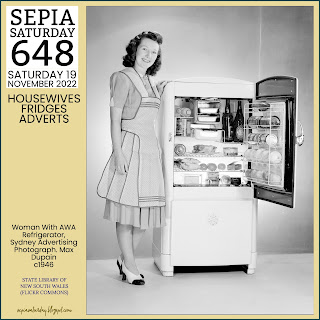

Linking to Sepia Saturday 648


... although it would be decades yet before my grandmother could show off a fridge in her kitchen. (I'm not sure, but I think my grandparents still did not have one in my early childhood, in the late 1950s. They had a walk-in larder, and additional food storage down in the cellar; but I can't recall a fridge.) 


SVENSKA

Storegården d. 29 April 1925 [onsdag]

Bäste vän ”Nothin”!

Hjärtligt tack skall du ha för brevet. Roligt höra att du nu är kry igen. Själv känner jag mig för närvarande inte så värst bra, vilket gör, att mitt annars ganska goda humör nu inte är så mycket bevänt med, för som du vet så är ingenting roligt när man ej känner sig kry.

I lördags var jag i stan'. Framförde då din hälsning till Thea. Hon bad att jag, när jag skriver till dig, skall hälsa och tacka för kortet som du sände henne innan du reste till Kviberg.

I dag blåser det väldigt här, men det är inte precis några ljumma vindar, utan ganska kallt. Det är konstigt att det ej är varmare när det nu snart är 1 maj.

I söndags voro vi i Mölarps missionshus på en fest. Det var sång o musik o kaffeservering. Ganska mycket folk var samlat där. De har nu missionshuset färdigt invändigt, så när som målningen.

Kan nu hälsa dig från Honom med stort H. Både han o Hildur på Länghem* var här i söndags. Jag hälsade dem från dig, och de bådo om sin hälsning tillbaka.

I måndags ägde prostinnans jordfästning rum. Den var mycket högtidlig. Jag var ej i kyrkan, men Mamma, Hildur [Sallys syster] o Nils [deras yngre bror] var där. Du frågar i ditt brev om Gustav är kvar i Prästgården. Ja, det är han ännu, d.v.s han är ju mycket nere på Sparsör, men det är ju likväl i prostens tjänst, men troligen kommer han att flytta därifrån nu den 1 maj, åtminstone efter vad jag nu vet.

Jaha du ”Nothin”, nu har vi redan börjat väva, ja det är ju ingen dag för tidigt förstås, så länge som vi hållit på med våra ”återgångar”. Vi har ej gjort något nämnvärt vid vårarbetet ännu. Det har ju inte heller varit så värst bråttom ännu, men nu snart är väl tiden inne. Du lovade ju i brevet att du skulle vara med i tankarna när vi skola sätta potatis. Förra våren var du visst personligen närvarande, och hjälpte till, efter vad jag vill minnas.

Jag får nog sluta brevet för idag nu. Förlåt mig för tt jag skrivit illa. Jag tänkte gå ner till väven en stund nu. Mamma är förut där nere. Hildur har gått till Källeberg, så jag är ensam inne.

Hjärtliga hälsningar till dig från samtliga här. Hoppas du skriver när tillfälle gives.

Nu till sist är du hjärtligt hälsad av din vän ”Bengtamor”

[PS] Den ”Nothin” som skulle sätta up affär i Fristad har jag ej hört något mer om sedan. Vet ej vad det blev av hans affär, men det var ju ändå så att jag fick ge dig ett namn, för du vet ju att [med] ”gåvor o gengåvor varar vänner längst”.

Kommentarer:

"Nothin" – Sallys smeknamn för Gustaf (jmf föregående brev, SS 647). Här antyds i Sallys PS ett samband med ett rykte om en affär som någon tänkt starta i Fristad, men som tydligen inte blev någonting av. (Kopplingen är fortfarande oklar för mig, men jag får väl förutsätta att den var tydligare för både Sally och Gustaf.)

Thea – en gemensam vän som antagligen också åsyftades i förra brevet, där Sally nämnde att hon skulle träffa någon i Borås. (Jag noterar att Sally här framför hälsningar, men inte skriver ett ord mer till Gustaf sitt möte med Thea. Kanske kan detta tolkas som att det fanns en smula svartsjuka med bilden?)

”Han med stort H” - syftar liksom i förra brevet på Olle Hellsten, som Sallys syster Hildur senare gifte sig med; men vid den här tiden var de ännu inte ett par).   

Gustav / Prästgården – Gustav, Sallys och Nils' äldre halvbror, hade tydligen bott i prästgården ett tag medan han utförde arbeten åt prosten. Han var också kyrkvärd – jag vet inte exakt vad som ingick i den uppgiften. 1925 drevs Storegården fortfarande av Gustavs bror Carl (Kalle). Jag gissar att det vintertid inte fanns nog med arbete på gården för dem båda, så att Gustav också sökte och åtog sig diverse andra arbeten.

Källeberg – Jag kommer ihåg stället från min egen barndom. De som bodde där då var tre äldre syskon, en bror och två systrar, vänner till mina farföräldrar. Jag ville minnas att de hade en ladugård med kor, så antagligen var det en gård snarare än ett torp. När vi hälsade på var det med bil, och mitt intryck är att det måste ha varit långt att gå till fots från Storegården. Men jag har inget riktigt grepp om avståndet; och det är uppenbart från breven att de var vana att gå långa sträckor på den tiden.

Länghems Banvaktsstuga

Länghem – Sally nämner ofta "Hildur på Länghem" i sina brev. Jag tänkte först att Länghem måste vara en närliggande gård, men efter att ha forskat lite finner jag att det var en banvaktsstuga, som farmor och övriga passerade när de gick mellan Storegården och Fristad station/ samhälle. 

https://sv.wikipedia.org/wiki/Banvakt 

"Banvakt var i Sverige fram till ungefär 1960 den järnvägstjänsteman vars huvudsakliga uppgift var att hålla uppsikt över en viss sträcka av en järnvägslinje. Förutom att bevaka och besiktiga banvallen längs denna sträcka, ingick det även i yrkesrollen att leda underhållet både av spårområdet samt marken runtomkring. Sträckan skulle besiktigas minst en gång per dag, och detta skedde antingen till fots eller genom att åka dressin.

Banvakter var utstationerade med bara några få kilometers avstånd längs alla större järnvägssträckningar i landet, och bodde i särskilda banvaktstugor med sina eventuella familjer. Dessa banvaktstugor byggdes och tillhandahölls av järnvägen, och det ingick i banvaktens sysslor att också sköta om huset. Ofta var banvaktstugorna små och hade banvakten en stor familj blev det därför ofta trångt om utrymmet.

Även om boendeförhållandena inte alltid var de bästa och lönen var låg, såg många banvaktstjänstgöringen som ett tryggt och ganska fritt arbete. Fanns det dessutom en vägövergång med manuellt manövrerade bommar i närheten kunde banvaktshustrun dryga ut familjeinkomsterna som grindvakt. I trädgården kring banvaktstugan odlade familjen ofta grönsaker och frukt till husbehov." 

Min farfar Gustaf samlade under sitt liv mycket information om torpstugor i Fristads socken. Eftersom han fick Parkinsons när han var i 60-årsåldern, och dog när han var 65 (1969), så kunde han inte fullfölja den bok han tänkt skriva; men mina föräldrar och min farmor färdigställde den och gav ut den efter hans död. I den boken fann jag uppgiften att banvaktsstugan Länghem år 1925 beboddes av banvakten Karl Andreasson och hans fru Hildur. [Gustaf Thulin, Torpen i Fristad Socken, 1971, sid 126-127.]

Min egen far, som växte upp i ett annat hus vid järnvägen (byggt av mina farföräldrar), kom att utveckla ett stort järnvägsintresse, och skrev flera böcker om lokala järnvägar. En av dem har ett foto av Länghems banvaktsstuga på 1920-talet, där Karl Andreasson är med. [Bertil Thulin/Svenska Järnvägsklubben, Borås-Herrljunga Järnväg, 1863-1988. Sid 89.]

I mina farföräldrars fotoalbum finns också flera foton tagna vid Länghem; och även ett från ett julfirande inne i banvaktsstugan. (Jag gissar att de varit på julotta i kyrkan tillsammans och blev inbjudna till banvaktsstugan på hemvägen.) Fotot är uppenbarligen taget efter att Sally och Gustaf officiellt blivit ett "par", men jag ser inga förlovningsringar på deras händer, vilket begränsar året för fotot till 1926, 27 eller 28. (De förlovade sig hösten 1929.)  

2022-11-11

Much Ado About Nothin' - Sepia Saturday 647


My grandmother and her family at the Farm loved their coffee breaks - and not least when they were able to sit outdoors! 

The photo shows Sally (my grandmother), her sister Hildur and their mother Selma, with guests, sitting at a coffee table in front of the farm house at Storegården. My guess is around 1929, which is the year when both Sally and Hildur got engaged to their future husbands (both also included in the photo). The two other women are unknown to me, but the text below the photo (in one of the albums where it appears) says they're visitors from Gothenburg (Göteborg).

Standing: Gustaf (my grandfather), Unknown, and Sally. Sitting: Unknown, Hildur, Selma and Olle (more about him below). 

Much Ado About Nothing
- a romantic comedy by Shakespeare, c. 1599 
"Through 'noting' (sounding like 'nothing', and meaning gossip, rumour, overhearing), Benedick and Beatrice are tricked into confessing their love for each other..."  [Wikipedia]

Between the previous letter from Sally (SS 646) and the one following below, Gustaf has been home on leave for Easter (10-13 April 1925). 

Comments on the content will follow below the letter.


Storegården, Fristad, [Friday] 17 April 1925 

Dear Gustaf,

This afternoon I'm going to seek consolation in answering the letter that I got from you last week. Nils received his today, and I'm pleased to hear that you're feeling better and back to health again. How did it turn out with your tooth, did that get worse or did it blow over? I hope it got better without turning into an abscess, as that's really painful – I've got some experience of that myself, so I know how that feels!

So, ”Nothin”, it's now been a week since we were out looking at the Easter bonfires. We've since had rather awful weather for a couple of days, but today the sun is shining from a clear sky again. But I guess it was good that we got some rain as well.

I'm feeling sorry for you that you have to be down there now [in Gothenburg], rather than being free, with spring and summer approaching. But somehow one just has to get on with things, doesn't one. Everything passes, and so will the misery that you're enduring against your will at the moment.

Today, Hildur has fetched an Easter card for you, which I enclose with this letter. I'm also sending you ”Glimpses from Easter in Fristad” by ”The Rambler”. Quite lovely ”glimpses”, I think. 

There were a lot of people on the train that you left with on Easter Monday. We had intended to get closer to the train after you got aboard, but as you may remember, a ”couple” got in front of us, which made us stand back. We then had company with Ebba on the way home, and when we got to Länghem, Hildur met us there and joined us. Gustav was also home for a while in the evening.


Vintage photos/postcards from Fristad railway station, reprinted for a railway jubilee in 2013

He with captial H has not been here since then – don't you find that strange? Imagine, two whole weeks on Sunday since he was last here, and yet he's [working] at the carpentry shop down at Mölarp [= not all that far away]. Doesn't that seem disquieting to you? Hildur writes [to him] every evening, sometimes to Borås, and sometimes to the ”Miss Lundbergs”,  but nothing seems to help. - As you're familiar with the situation, I'm writing about it, because I find it amusing myself, and so that you will know that things are the same as always.

Oh, and I can also tell you that I got a letter from [?] in Skedeskamma. She was well, and wanted me to meet her in Borås on Saturday 25 April, which I also think I will, if I can.

Yesterday, we set up the loom, but we are not quite ready to start weaving yet, we haven't ”warped” yet. Next time you come home, I hope you'll get to see some result of our work, if all goes to plan.

Now I'm running out of paper, but I'll use all the corners of the sheet, even if that doesn't look very neat. We saw you grandfather walking by here today, he didn't come in, but it's good to see that he's in good health. Best wishes from all of us here. 
  • Tonight the Salvation Army will be in the chapel, but I don't think we'll be going.
  • Tomorrow night the 'Blue Band' Temperance Society will be having a parcel auction, I suppose you'll be there for that.
  • You'll notice that I've remembered your new name, ”Nothin”. Don't you think it's pretty?
  • Hoping to hear from you soon, best wishes from your friend ”Bengtamor”.  

Example of Sally's use of "all the corners of the sheet":


An unwritten Easter card, but it will serve to represent whatever card it was that Sally was sending on to Gustaf with her letter. (I suppose the family at the farm was authorized to fetch his mail for him at the post office, or whereever it was delivered to.) 


COMMENTS

"Nothin" - I have no background for this new nickname. In this letter, where she first uses it, she spells it "Notin"; but later, "Nothin". "Notin" has no meaning at all in Swedish, but the spelling "Nothin" seems to support that it might refer to the English word "nothing". Neither Sally nor Gustaf would have learned any English in school, though (and it seems even more unlikely that they'd be familiar with the Shakespeare play in the original language). But I guess they might have picked up a few English words and phrases, for example from Sally's older brother Gustav, who had lived in America for almost a decade. But in the 1920s, he was back living with the family at the farm, or nearby in the same village. As for what may have triggered the word "nothin" to be used as a nickname for Gustaf, I can only speculate, though. (Perhaps he sometimes had a tendency to doubt himself, and his talent? - or something like that... But in that case, they must also have joked about it, as I'm sure Sally would never have used it other than in jest.)

Easter bonfires - It was common in this part of Sweden to light bonfires on Easter Eve.

Glimpses/The Rambler - As Gustaf used to write articles of this kind for a local newspaper, I think it was probably his glimpses that had been published, using that signature.

He with captial H, and Hildur - "He with capital H" clearly refers to Olle Hellsten (cf. previous post), who ended up marrying Sally's sister Hildur. He was a carpenter by trade. As for Hildur, she was always worrying about things... I remember her like that even from my own childhood. Gustaf, knowing the whole family well, would have had no problem understanding Sally's ironic hints.

"[?] in Skedeskamma" Here I'm struggling to read (and failing to make sense of) another nickname, referring to a person unknown to me. Her real name may have been Thea, because in the next letter Sally mentions meeting a Thea in town. That still doesn't give me any clue to how they knew each other, though. The place name probably refers to a Skedskamma situated on the other side of Borås - which explains why they would meet in town. (They could both travel into town by train; but from different directions, and on different railway lines.)

"we set up the loom..."  - For me this clears up a mystery from the previous letter, which involved some words there unknown to me, but that must refer to a weaving project.

"Blue Band" - A temperance society. As has already been mentioned more than once, Gustaf used to write short reports for the newspaper from various kinds of meetings held by local societies, chapels, churches etc. If he had weekend leave of absence from his military service in Gothenburg (I don't know how often they did?) he could take the train from there back to the village, and still do some such reporting (just as it seems he did at Easter).

"Bengtamor" - Gustaf's nickname for Sally, but not clear to me why. (Possibly referring to her acting "motherly" towards him sometimes. Just my guess, though!) [Cf. SS 645]


Storegården, Fristad, d. 17 April 1925 [fredag]

Bäste vän Gustaf!

Nu i eftermiddag tänkte jag taga tröst av och besvara brevet, som jag fick från dig förra veckan. Nils har i dag fått ditt brev och det var ju roligt att höra att du bättrat dig, så att du nu är kry igen. Hur blev det med tanden, blev det något ont eller gick det över lindrigt. Det var ju väl om det gick bort utan att bli ”varbildning”, för det är ju något rysligt, det har jag själv haft, så det vet jag hur det känns. 

Jaha du ”Notin”, nu är det snart en vecka sedan vi voro ute och sågo påskeldarna. Vi har nu haft ganska ruskigt väder ett par dagar, men i dag strålar solen klar igen. Ja det var ju gott att vi fick lite regn också.

Det är synd om dig att du skall behöva gå där nere nu, och ej vara fri, när det närmar sig våren och sommaren, men det är ju så att det måste ju gå allting. Allting går ju över, så också det ”eländet” som du nu är tvingad uti. 

Idag har Hildur hämtat ett påskkort till dig, som jag nu skickar med i brevet. Även medsänder jag ”Glimtar från Påsken i Fristad” av ”Vandraren”. Det ”glimtar” ju riktigt vackert, tycker jag. Det var visst väldigt mycket folk med tåget, som du reste med Annandagen. Vi skulle gått lite närmare tåget när du stigit upp, men som du minns så kom det ett ”par” emellan, vilket gjorde att vi höll oss bakom. Vi fick sedan sällskap med Ebba hem, och när vi kommer till Länghem mötte Hildur oss där och följde med oss upp. Gustav var också hemma en stund på kvällen.

Han med stort H har inte varit här sedan, tycker du inte det är märkvärdigt? Tänk dig, 2 hela veckor på söndag sedan han sist var här, och så är han nere i Mölarp på Snickerifabriken. Tycker du inte det ser betänkligt ut? Hildur skriver varje kväll, ibland till Borås och ibland till ”Lundbergsfröknarna”, och inget tycks hjälpa. Eftersom du så väl känner till det, skriver jag om det, för jag tycker det är roligt, och för att du skall få höra att det är sig likt. 

Jo du, så skall jag tala om att jag fått brev från ”tryspan” [?] i Skedeskamma. Hon mådde bra, och ville att jag skulle träffa henne i Borås lördag den 25 april, vilket jag också tror att jag gör, om inget oförutsett hinder möter. 

Igår satte vi upp väven, men vi äro inte riktigt färdiga att börja väva ännu, vi har inte ”varpat” ännu. Nästa gång du kommer hem, hoppas jag du skall få se något resultat av vårt arbete, om allt går som vi beräknat. 

Ja, nu börjar visst pappret att taga slut, men jag får väl skriva fullt i alla hörn på arket, fastän det inte ser så fint ut. Thulin har vi sett gå förbi här idag, men han gick ej in, men det är ju ändå gott att se att han är kry. 

Hj. hälsn. Från alla här

PS1 - Ikväll är Frälsningsarmén i Missionshuset, men jag tror ej vi går dit. 
PS2 - I morgon kväll har blåbandisterna paketauktion, då skall väl du vara med.
PS3 - Du ser att jag kommit ihåg ditt nya namn, ”Notin”. Tycker du inte det är vackert?

I hopp om att få höra från dig är du nu till slut hjärtligt hälsad av vännen ”Bengtamor”. 

KOMMENTARER

"Notin" - I följande brev har stavningen korrigerats till "Nothin", vilket får mig att undra om det syftar på det engelska ordet "nothing" (dvs. "inget"). Varken Sally eller Gustaf lär ha lärt sig engelska under sin korta skolgång, men jag tänker att de kan ha plockat upp vissa ord och uttryck från Sallys äldre halvbror Gustav, som ju bott nästan tio år i Amerika. Men på 1920-talet var han ju tillbaka i Fristad och på Storegården. Jag tänker mig att ordet i den betydelsen möjligen skulle kunna vara relaterat till att Gustaf ibland kände sig missmodig och tvivlade på sin egen talang etc. Men i så fall måste det relatera till något de gemensamt skämtat om - eftersom det annars inte är troligt att Sally skulle referera till det i sina brev.  [Själv kan jag inte låta bli att associera till Shakespeare's pjäs Much Ado About Nothing, där originalet utnyttjar ordlikheten mellan "noting" (notera) och "nothing" (ingenting/obetydligheter). Jag tvivlar dock på att Sally och Gustaf var bekanta ens med titeln...] 

"Glimtar från Påsken i Fristad" av signatur Vandraren - Jag uppfattar det som att denna artikel skrivits av Gustaf själv.

"Han med stort H" syftar otvivelaktigt på Olle Hellsten, som senare gifte sig med Sallys syster Hildur. Han var snickare till yrket; och avståndet mellan Storegården och Mölarp inte alltför långt (med den tidens mått mätt). Vad Hildur beträffar, så oroade hon sig ständigt för saker och ting (och folk) - så minns jag henne även från min egen barndom... Gustaf bör inte ha haft något problem att uppfatta Sallys halvt ironiska syftningar.

[?] i Skedeskamma - Ett smeknamn (?) inom citattecken här är svårtytt. Hennes verkliga namn kan ha varit Thea, för i nästa brev nämner Sally att hon träffat en Thea i stan. Hur och varifrån de var bekanta med varandra framgår inte. Det finns dock ett Skedskamma nära Hillared, på andra sidan Borås; vilket gör det logiskt att träffas i stan (dit de båda kunde ta sig per tåg, från olika håll). 

"Igår satte vi upp väven" - Detta förklarar Sallys prat om "tvinna återgångar" i tidigare brev (även om jag fortfarande inte vet exakt vad det uttrycket innebär). 

"Blåbandisterna" - Blå Bandet var/är en nykterhetsorganisation på kristen grund. Som tidigare nämnts brukade ju Gustaf skriva tidningsnotiser om olika möten i lokala föreningar och kyrkor osv. När han hade helgpermission från Kviberg, så kunde han förstås ta tåget hem och bidra med en del sådana reportage även under sin värnpliktstid.

"Bengtamor" - Gustafs smeknamn för Sally (jmf Sepia Saturday 645). Ursprunget forfarande oklart men jag tänker mig att det ev skulle kunna syfta på att hon ibland kanske uppträtt lite "moderligt" gentemot honom. 


2012-04-23

G.005-3 Jyväskylä, Finland (1902)

005.3A-001

Iyväskylä park (Jyväskyla, Finland)

005.3B-001

Datum/date: 17.3.1902
Poststämplat/postmark: Borås
Till/to: Herr Gustaf Ekman, Storegården, Fristad
Från/from: G.L.

Borås den 17 Mars 1902. Jag är nu i Borås.
Många hälsningar från G.L.

Ännu ett vykort endast undertecknat med signatur. Det skulle kunna vara från samme Gustaf L. som sände det första kortet i vykortsalbumet (1.1).

Kortet är från Finland; en logisk slutsats är väl att avsändaren nyligen återvänt till Borås från en resa till grannlandet i öster.

Jyväskyla i Mellersta Finland nåddes av järnvägen 1897. Det var Finlands snabbast växande stad under 1900-talet. År 1900 hade staden 3000 invånare. Idag ca 131.000.

In English

Borås 17 March 1902. I am now in Borås.
Many greetings from G.L.

Another postcard signed by signature – G.L. This could be the Gustaf L. who sent the very first postcard in the album (1.1)

The card is from Finland, but sent from Borås.
A logical conclusion would be that the sender has just returned from a journey to Finland.

Jyväskylä is the largest city and municipality in Central Finland  and on the Finnish Lakeland. It was reached by railway in 1897. It was the fastest growing Finnish city in the 20th century. In 1900, it had 3000 inhabitants. Today 131.000.

2012-03-07

G.004-1 Falköping Ranten (1901)

004.1A-2
Förstoring från vykortet nedan/Enlarged from the postcard below

Falköping – Ranten (1901)
Lindgrens Bok- och Pappershandel (John Swedmark), Falköping
1183

004.1A-1

004.1B-1


Till/to: Herr Gustf. Ekman, Storeg., Fristad
Från/from: Oscar

Obg. 3/12 -01

K.B.! [Käre Broder!]

Tack för brefvet! Wore bra du komme så snart möjligt. Behöfver ej taga med häst ty vi kan nu köra Freja. Lös enkel biljett, du måste stanna öfver jul!

Många hälsningar till er alla!
Wälkommen!
I hast, Broder Oscar

Det verkar som om planerna från det föregående vykortet 3.3 fortsätter. Oscars handstil är inte enkel att tyda men att det finns ett sammanhang mellan flera kort i följd underlättar. Liksom plötsliga insikter som att han i vissa ord stavar med “w” i stället för “v”. (wore, wälkommen)

---

In English

Odensberg 3/12 –01

Dear Brother,

Thanks for the letter. Please come as soon as possible. No need to bring a horse since we can now use Freja. Buy a one way ticket, you must stay for Christmas!

Many greetings to you all!
Welcome!
In haste,
Brother Oscar

So it seems the plans from the previous postcard 3.3 are moving forward. Gustaf is to come to Odensberg to help his older brother Oscar with some work on his farm. It seems there has been some discussion whether Gustaf would also need to bring a horse (from his father’s farm), but no need for that, since there is now a horse available closer at hand. (Whether Oscar’s own or some neighbour’s?) So Oscar suggests that Gustaf takes the train and stays over Christmas.

1 Falköping Ranten was the first railway station at Falköping, built in the 1850’s. It took its name from a big estate nearby. The area around the station grew to become a sort of suburb and later merged with the town.

---

1 Falköping Ranten – Falköping C

Det ursprungliga stationshuset uppfördes 1857-1858 och stationen fick namnet Falköping Ranten eftersom den byggdes en bit ifrån dåvarande staden vid gården Ranten. (Namnet Ranten lär härstamma från det ålderdomliga ordet rant, som betyder jordrygg.)

Stationen var en nyckelknutpunkt i den första statsbanenätet i Sverige. Järnvägen Falköping-Malmö anslöt här till järnvägen Stockholm-Göteborg. Att resa mellan Stockholm och Malmö under 1860-talet innebar byte i Falköping.

Ett tag fanns det två järnvägsstationer i Falköping, nuvarande station i Ranten och en station närmare centrum. Efter 1931 bytte den namn till Falköpings Södra och samtidigt bytte stationen vid Ranten namn till Falköping Central.

Källa: Wikipedia/Falköpings Centralstation

Postcard