A 'Swenglish' journey through family photos, notes and postcards
from the early 20th century.
Showing posts with label New York. Show all posts

2026-09-19

Two Steamboat Postcards from 1909 - Sepia Saturday 844

Two steam boat postcards from 1909, reposted for Sepia Saturday 844 (previously posted on this blog 2021-04-24 and 2021-05-01

Both cards sent by a John Beckman to my great-uncle Gustaf Ekman in 1909, while Gustaf was living in Galeton, Pennsylvania (working at a sawmill there).  

Str City of Buffalo, landing at dock, Celeron, N.Y.

 
Made expressly for S.H. Knox & Co. Printed in Germany

To: Mr Gust Ekman, Galeton, Pa

From: John Beckman (Jamestown N.Y., Jul 18, 1909)

Str City of Buffalo, landing at dock, Celeron, N.Y.

Hello Gust. I will send you a postal now and thanks you very much for the postal you send me. I hear you had good times on 4 of July in Buffalo, did you have any girls whed [with] you all [-?-] Gust. I had lovely times out here in Jamestown to[o]. Alfred and Henning is working here in town now so pretty soon all de Boy [all the boys] from Galeton will be here in Jamestown. I supoese Hilding have a picnic now whed all de girls. Good bye, ans. soon. / John Beckman, 27 Broadhead Ave., Jamestown N.Y.

Hej Gust. Jag skickar ett kort och tackar så mycket för det kortet du skickade mig. Jag hör att du hade trevligt 4 juli i Buffalo, hade ni några flickor med er? Jag hade det härligt här i Jamestown också. Alfred och Henning arbetar här nu, så snart är väl 'alla pojkarna' från Galeton här i Jamestown. Jag antar att Hilding kan välja och vraka bland alla flickorna nu. Hej då, skriv snart. /John Beckman, 27 Broadhead Ave., Jamestown N.Y.


Boat Landing at Celoron, Chautauqua Lake, N.Y.

(Can't interpret the publisher's symbol)


To: Mr Gust Ekman, Galeton Pa, Box 342
From: John Beckman (Jamestown N.Y., Aug 26, 1909)
Boat Landing at Celoron, Chautauqua Lake, N.Y.

Hello Gust
I thought I will send you a postal now and thank you very much for the letter you sent. I se[e] you whont [won't] come over to Jamestown. I was to a picnic 2 weeks a go, and here is the boat. How do you like it all. Tell you Gust I had [a] pretty good time that day. Ans. soon. - Best regards from your friend J. Beckman. Send my best regards to mine girl, you know who that is.

Swedish text:
Hej Gust, jag tänkte jag skickar dig ett kort nu och tackar så mycket för brevet du skickade. Jag ser att du inte tänker komma över till Jamestown. Jag var på en picknick för 2 veckor sedan, och här är båten. Vad tycker du om det hela. Du ska veta att jag hade roligt den dan. Skriv snart. - Bästa hälsningar från din vän J. Beckman. Hälsa så mycket till min flicka, du vet vem jag menar.


My note from 2021: I googled "steamboats celeron new york", and found a web page from Chautauqua County Historical Society: Large Chautauqua Lake Steamboats. (Phew, that is one tricky name to keep spelling...) Evidently there were several steamboats of this kind in traffic on this lake in the late 19th /early 20th century. On a previous card (G.042.03) from John B. we had the steamer City of Buffalo, The one on this card looks similar but not identical. The card does not reveal its name, and I can't find an exact match on that web page either. 


2022-07-23

Christmas Greetings from aboard SS Europa (1936) - Sepia Saturday 631

 M.008.02


NORDDEUTSCHER LLOYD BREMEN
Vierschrauben-Turbinen-Schnelldampfer
"EUROPA"

SS Europa, later SS Liberté, IMO 5607332, was a German ocean liner built for the Norddeutsche Lloyd line (NDL) to work the transatlantic sea route. She and her sister ship, Bremen, were the two most advanced, high-speed steam turbine ocean vessels in their day --- [Wikipedia] 


To: Herr Gustav Samuelson, Storegården, Fristad, Schweden
From: Gerda (sent from Cherbourg, France, 18.12.1936)

d. 17.12  Resan har varit bra hitintills. Det regnar här men är lugnt och ej kallt. Vi stannar i Cherbourg, Frankrike, för flera passagerare, och levererar post där. Sedan stannar vi ej förrän in New York. En god och trevlig Jul önskas dig varmt. Kära hälsningar, syster Gerda.

17.12 [1936] The journey has gone well so far. It's raining here but calm and not cold. We'll be stopping in Cherbourg, France, to take on more passengers and deliver post. Then we won't be stopping until we're in New York. Sending you my warmest wishes for a happy Christmas. Love, sister Gerda.

In December 1936, Gerda (my great-aunt, the travelling lady's maid) and the Bernadotte family (Folke, Estelle and their sons Folke and Bertil) are off to the United States again - presumably to celebrate Christmas with Estelle's parents in Pleasantville. Aboard the SS Europa, Gerda writes a Christmas greeting to her brother, which then seems to have been posted from Cherbourg the next day.

M.038.01 

(Blank Christmas card from Gerda's collection. Year unknown.)

Linking to Sepia Saturday 631


Till: Herr Gustav Samuelson, Storegården, Fristad, Schweden
Från: Gerda (sent from Cherbourg, France, 18.12.1936)

d. 17.12  Resan har varit bra hitintills. Det regnar här men är lugnt och ej kallt. Vi stannar i Cherbourg, Frankrike, för flera passagerare, och levererar post där. Sedan stannar vi ej förrän in New York. En god och trevlig Jul önskas dig varmt. Kära hälsningar, syster Gerda.

I december 1936 är det återigen dags för Gerda och (hennes arbetsgivare) familjen Bernadotte (Folke och Estelle med sönerna Folke och Bertil) att resa till USA - sannolikt för att fira julen hos Estelles föräldrar i Pleasantville, New York. Gerda skriver en julhälsning till sin bror ombord på båten, som  ser ut att ha blivit postad dagen efter från Cherbourg i Frankrike, där båten mellanlandade.

2022-06-10

Via Paris to New York (1935) - Sepia Saturday 625


From the year 1934, I don't have any postcards written by Gerda; but I'm choosing this small card of unknown date and origin to represent what must have dominated that year for the Bernadotte family (her employers): The birth and death of Folke's and Estelle's third son, Fredrik Oscar Bernadotte. He was born 10 January, 1934 (in Stockholm) but only lived to be 7 months old. He died in August the same year, also in Stockholm. I can't recall having seen the cause of death anywhere. 

In 1935, Gerda's postcards reveal that she and the family were travelling again, though. Via Paris to New York at the end of March, and back to Sweden via England a month later.  (The children Gustaf and Folke Jr  now 5 vs 4 years old.)

M.005.02


The Eiffel Tower in Paris was constructed from 1887 to 1889 as the centerpiece of the 1889 World's Fair. It is named after the engineer Gustave Eiffel, whose company designed and built the tower.


To: Gustav Samuelson, Storegården, Fristad, Suède
From: Gerda (Paris, 27.3.1935)

Här är sommar och varmt. Allting har gått utmärkt bra.
Stiger på båten i e.m. Kära hälsningar, Gerda 
[Paris] d. 27 kl 9 fm

It's summer here, and warm. Everything has gone very well,
Boarding the ship this afternoon. Love, Gerda
[Paris] the 27th, 9 a.m.

M.005-03

33. CHERBOURG. - Vue d'ensemble de la gare Maritime
(Levavasseur, arch.) - LL.

CHERBOURG - Overview of the Gare Maritime (Harbour Station). Architect: René Vavavasseur

Cherbourg Gare Maritime station or Gare Maritime Transatlantique was a railway station at the end of the railway line from Paris' Gare Saint-Lazare. The complex consisted of the transatlantic hall, a two-storey building through which passengers boarded ocean liners, and also various amenities (including a post office). It was inaugurated in 1933, and was at the time the second largest construction in France after the Palace of Versailles. On the Transatlantic side two ships could berth and empty a thousand passengers into the station in an hour. On the Railway side, up to seven trains a day would take passengers to Paris in 3½ hours. [Wikipedia]


To: Herr Gustav Samuelsson, Storegården, Fristad, Suède
From: Gerda (Cherbourg, 27.3.1935)

d. 27 kl halv 5 em. Har nu kommit till havet och det är lugnt och blått och solen skiner. Får vänta här till kl 6, går då på båten. Resan har gått mycke bra och jag känner mig kry. Kära hälsningar, Gerda.

[Cherbourg] the 27th, 4:30 pm. Have arrived at the sea and it's calm and blue and the sun is shining. Waiting here until 6 pm, then boarding the ship. The journey so far has gone very well and I'm feeling in good health. Love, Gerda.


M.006.01

Empire State Building, New York City   3A - H91

The building was designed by Shreve, Lamb & Harmon and built from 1930 to 1931. Its name is derived from "Empire State", which was the nickname of the state of New York. [Wikipedia]


Text printed on the back of the card: "EMPIRE STATE BUILDING AND MIDTOWN NEW YORK - This is the world's tallest building, rises 1250 feet above Fifth Avenue and 33rd Street. Has 102 floors and can shelter 80,000 people. Mooring mast at the top is intended for dirigibles." *

*  "dirigible: a large aircraft without wings, consisting of a large bag filled with gas that is lighter than air and driven by engines. The pilot, passengers, etc. travel in a structure hanging below."
[Cambridge Dictionary]

Did you know that about the Empire State Building? 
That it was designed to be a "parking place" for airships??

Wikipedia: "The final stage of the building was the installation of a hollow mast, a 158-foot (48 m) steel shaft fitted with elevators and utilities, above the 86th floor. At the top would be a conical roof and the 102nd-floor docking station. Inside, the elevators would ascend 167 feet (51 m) from the 86th floor ticket offices to a 33-foot-wide (10 m) 101st-floor waiting room. From there, stairs would lead to the 102nd floor, where passengers would enter the airships. The airships would have been moored to the spire at the equivalent of the building's 106th floor."


To: Herr Gustav Samuelson, Storegården, Fristad, Sweden
From: Gerda
(Grand Cen Annex NY, April ?? 1935)

K. bror! Tack skall du ha för brev, som jag fick med samma jag kom hit. Vi mår alla bra. Reser härifrån den 26 ds, men stannar en vecka i England. Är hemma omkring den 10.5 igen, tror jag. Kära hälsningar, Gerda

Dear brother, Thanks for your letter, which I got as soon as I had arrived here. We are all well. We'll be leaving here on the 26th, but will be stopping in England for a week. Will be back home again around May 5, I think. Love, Gerda

Whether this trip to New York had any other purpose than to visit Estelle's parents in Pleasantville, I don't know. Gerda never mentions her employers by name, nor their reasons for going where they're going - just occasionally lets us sense their presence in an anonymous "we"... 


P.S. On October 6 the same year, 1935, there was a new baby in the family: Bertil Oscar, born in Stockholm.


(Maybe they made time for some shopping in the big city??)


Från 1934 har jag inga vykort skrivna av Gerda, men låter ett litet kort med en vit duva (okänt datum och usprung) representera vad som väl måste ha dominerat detta år för hennes arbetsgivare, familjen Bernadotte: Deras tredje sons födelse och död. Fredrik Oscar Bernadotte föddes10 januari 1934 i Stockholm, men dog i augusti samma år (också i Stockholm), bara sju månader gammal. (Jag kan inte påminna mig att jag sett dödsorsaken nämnas någonstans.)

Från år 1935 finns dock återigen vykort från Gerda som vittnar om att hon och familjen nu var ute och reste igen: via Paris till New York i slutet av mars, och tillbaka till Sverige via England en månad senare. Barnen Gustaf och Folk Jr var nu 5 resp 4 år gamla.

Vykort M.005.02: Eiffeltornet i Paris byggdes mellan 1887 till 1889 för 1889 års världsutställning. Det har fått sitt namn efter ingenjören Gustave Eiffel, vars bolag designade och byggde tornet.

Till Gustav Samuelson, Storegården, Fristad, Suède
Från Gerda (Paris, 27.3.1935)

Här är sommar och varmt. Allting har gått utmärkt bra. Stiger på båten i e.m. Kära hälsningar, Gerda d. 27 kl 9 fm

Vykort M.005-03: CHERBOURG – Vy över hamnstationen.
Arkitekt: René Vavavasseur.
Cherbourgs hamnstation var en järnvägsstation vid slutet av linjen från Paris. Här fanns en stor tvåvåningsbyggnad varifrån passagerare gick av och på transatlantiska oceanångare, samt diverse annan service, som t.ex. ett postkontor. Anläggningen invigdes 1933, och var då den näst största byggnaden i Frankrike efter Versailles-palatset. På den transatlantiska sidan kunde två fartyg lägga till samtidigt och tusen passagerare passera till järnvägsstationen på en timma. På järnvägssidan kunde upp till sju tåg om dagen föra passagerare till Paris på 3½ timma.

Till Herr Gustav Samuelsson, Storegården, Fristad, Suède
Från Gerda (Cherbourg, 27.3.1935)

d. 27 kl halv 5 em. Har nu kommit till havet och det är lugnt och blått och solen skiner. Får vänta här till kl 6, går då på båten. Resan har gått mycke bra och jag känner mig kry. Kära hälsningar, Gerda

Vykort M.006.01: Empire State Building, New York City
Empire State Building designades av Shreve, Lamb & Harmon och byggdes mellan 1930-1931. Byggnaden fick sitt namn från ”Empire State” som var ett smeknamn på staten New York

På baksidan av vykortet står tryckt: ”EMPIRE STATE BUILDING AND MIDTOWN NEW YORK – Detta är världens högsta byggnad. Den reser sig 381 meter över Femte Avenyn och 33:e Gatan, har 102 våningar och kan hysa 80,000 människor. Förtöjningsmasten högst upp är avsedd för luftskepp.”

Enligt Wikipedia var den 48 meter höga ihåliga masten ovanför 86:e våningen försedd med hissar upp till ett väntrum på 101:a våningen. Därifrån gick trappor upp till 102:a våningen varifrån passagerare skulle kunna gå ombord på luftskeppen.

Till: Herr Gustav Samuelson, Storegården, Fristad, Sweden
Från: Gerda (Grand Cen Annex NY, April ?? 1935)

K. bror! Tack skall du ha för brev, som jag fick med samma jag kom hit. Vi mår alla bra. Reser härifrån den 26 ds, men stannar en vecka i England. Är hemma omkring den 10.5 igen, tror jag. Kära hälsningar, Gerda

Om deras resa till New York 1935 hade något annat syfte än att besöka Estelles föräldrar i Pleasantville vet jag inte. Gerda nämner aldrig sina arbetsgivare vid namn, och heller inte deras skäl för sina resor – hon låter bara läsaren förstå deras närvaro genom att använda ordet ”vi”.

PS. Den 6 oktober samma år, 1935, i Stockholm, föddes Folkes och Estelles fjärde son - Bertil Oscar.

2022-04-08

Twists and Turns (1929) - Sepia Saturday 616

 M.001.03 - The New York Entrance to the Holland Tubes 

The New York Entrance to the Holland Tubes, New York City
© American Photo Service. Inc.

"The Holland Tunnel is a vehicular tunnel under the Hudson River. It connects the New York City neighborhood of SoHo in Lower Manhattan to the east with Jersey City in New Jersey to the west. --- Construction of the Holland Tunnel started in 1920, and it opened in 1927. At the time of its opening, the Holland Tunnel was the longest continuous underwater vehicular tunnel in the world. --- The Holland Tunnel was the world's first mechanically ventilated tunnel..." [Wikipedia]

Published by Manhattan Post Card Co., New York, N.Y.

To: Herr Gustaf Emanuelson*, Storegården, Fristad
From: Gerda (Stockholm 31.12.29)

Käre bror! Ett gott nytt år! Jag ringde till Elin igår, det är visst detsamma med Oscar. Jag tänker resa dit en dag. Elin ville att jag skulle komma innan någon annan o se vad jag tycker. Kära hälsningar, Gerda. [Tack för kort! - skrivet upp-o-ner på framsidan]

Dear brother, Happy New Year! I called Elin yesterday, it seems to be the same with Oscar. I intend to go visit them [soon]. Elin wanted me to come before anyone else and see what I think. Love, Gerda. [Thanks for the card! - written upside-down on the front]

Another New York postcard from Gerda to Gustaf, showing recent architectural progress in the US since the first decade of the century, when sister and brother were both living there.  

This card is the only one I have from 1929, and like the one from 1928 (cf. previous post), this one too was not posted from New York, but from Stockholm, on New Year's Eve. So it does not really tell us what Gerda had been up to during the past twelve months. But, assuming that she was indeed already employed by Estelle and Folke Bernadotte, she may have spent at least part of 1929 in New York.  According to Shelley Emling's biography A Forgotten Hero: Folke Bernadotte, Folke's father-in-law wanted him to get familiar with American business life, and...  

"...for six months, Folke went to work at Lee, Higginson & Co., an investment bank in New York, where he got a crash course in the proverbial corporate ladder as he moved from one junior-level job to another.”

[Emling, Shelley. A Forgotten Hero: Folke Bernadotte, the Swedish Humanitarian Who Rescued 30,000 People from the Nazis (p. 52). ECW Press. Kindle Edition.]

At New Year, Gerda is in Stockholm, though. And from the message on the postcard, it seems that things are not well with Oscar - older brother of her and Gustaf. Oscar's wife (Elin) is obviously worried, but also seems not quite sure what to think, as she has asked Gerda to come and give her opinion. That sounds to me like perhaps Oscar had had a stroke or something of that kind. However, Oscar is the one of Gerda's brothers that I know the least about. I know he was born in 1872, and from postcards I have learned that he and his family moved to Norrköping. But checking the family tree, I see that I don't have the year of his death. (Note to self: put that on the list of things to look into.) 

Before that, in September 1928, the eldest brother, Carl (born 1870), at Storegården in Fristad, Västergötland, had passed away.

Gustaf (born 1878), had moved back to Storegården in 1918, and after Carl's death, took over the reins there. In 1929, his step-mother and her children were still living there as well - but wouldn't be for much longer. In 1930,  his three half- and step-siblings would be getting married and move away (and their mother Selma too). Gustaf remained living at the farm at least through the 1930s, though. (If he was able to stay on there for the rest of his life, I'm not sure, as I have no postcards from the 1940s. But when he died in 1952, he was buried in Fristad.) 


Storegården, c. 1929: Mother Selma; Hildur and her fiancé Olle; Sally and her fiancé Gustaf T (my grandparents-to-be); and Gustaf ... er... whatever surname he was using at the time...
(Missing: Youngest brother Nils, and his fiancée Carin.)

"What's in a Name"?

As mentioned in the previous post, at some point after moving back to the farm in Fristad, Gustaf changed his last name back from Ekman to Emanuelsson, and then to Samuelsson. Since I have no postcards from the earlier years of the 1920s, until 1928, I'm not sure when exactly he decided  to drop Ekman. But (based on Gerda's postcards) between 1928-1930 (possibly starting earlier) he seems to have used the name Emanuelsson, but from 1931, switched to Samuelsson.

The story behind the name-changes, as I've heard it: 

The most common practice in the late 1800s and early 1900s was that children, both male and female, inherited the father's surname, as family name. Earlier in history, the practice was that children were given a surname based on their father's first name. (When looking back in family history records, at least among farmers, you will find chains of names like: Sven Larsson was the son of Lars Svensson, who was the son of Sven Larsson, who was the son of Lars Svensson, who...) 

All of Samuel Emanuelsson's children originally inherited his surname Emanuelsson, though - with one exception: Gustaf. The story beind that is that at his christening, by mistake, the surname Samuelsson was entered into the church records. And so he officially got stuck with a different surnamne than all the rest of his brother and sisters. (What he called himself, or usually got called by others, I don't know.) 

Some time in their youth, though, Gustaf and three of his older siblings (Oscar, Ester and Gerda) decided to take the shorter surname Ekman. (My guess is that this was probably after the death of their mother, or in connection with their father getting remarried - to my great-grandmother Selma.) 

I don't think there was much bureaucracy involved back then in changing your surname. There were so many people with "-son" names that I think it was even encouraged. (For one thing, I know the army found it confusing to have too many Andersson and Johansson and whatever, so they often just gave new soldiers a different surname, if they didn't come up with one themselves.) The oldest brother, Carl, who took over the farm after his father, kept the name Emanuelsson, though. (And the oldest sister, Emma, was probably already married at the time.) 

Oscar, Ester and Gerda kept the name Ekman throughout their lives. Why Gustaf dropped it after moving back permanently to the farm, I'm not sure. Maybe he found it easier when reconnecting with the past, to just be an Emanuelsson again. As for why, in the 1930s, he ended up going the "full circle" back Samuelsson, I'm again not sure. Perhaps there was some legal aspect to it after all, with that being his name in the church records. Anyway, the name on his gravestone was also Samuelsson.


Linking to: Sepia Saturday 616


"I have a broad sense of where the story is going; I know the end, I know the end of the principal characters, and I know the major turning points and events --- but I don't necessarily know each twist and turn along the way. That's something I discover in the course of writing and that's what makes writing enjoyable." - George R. R. Martin 

SVENSKA
 
M.001.03 – Infarten till The Holland Tubes– en fordonstunnel under Hudson-floden i New York.

Till: Herr Gustaf Emanuelson*, Storegården, Fristad
Från: Gerda (Stockholm 31.12.29)

Käre bror! Ett gott nytt år! Jag ringde till Elin igår, det är visst detsamma med Oscar. Jag tänker resa dit en dag. Elin ville att jag skulle komma innan någon annan o se vad jag tycker. Kära hälsningar, Gerda. [Tack för kort! - skrivet upp-o-ner på framsidan]

Ännu ett vykort från New York, från Gerda till Gustaf, som visar på utveckling som ägt rum där sedan nittonhundratalets första årtionde, då syster och bror båda bodde i Amerika. Detta är det enda jag har från 1929, och liksom det förra (från 1928, i föregående inlägg) så postades även det här från Stockholm på nyårsafton (ett år senare). Det ger oss egentligen ingen ledtråd till var Gerda tillbringat det senaste året. Men om vi antar (som jag gjorde redan i förra inlägget) att hon faktiskt blev anställd av Estelle och Folke Bernadotte redan hösten 1928 (före deras bröllop), så kan hon ha tillbringat åtminstone en del av 1929 i New York. Av Shelley Emling's biografi A Forgotten Hero: Folke Bernadotte...* framgår att Folkes svärfar ville att han skulle bekanta sig med amerikanst affärsliv, och att Folke därför tillbringade sex månader på investerings-banken Lee, Higginson & Co i New York. 

*[Emling, Shelley. A Forgotten Hero: Folke Bernadotte, the Swedish Humanitarian Who Rescued 30,000 People from the Nazis (p. 52). ECW Press. Kindle Edition.]

Till nyår 1929 är dock Gerda uppenbarligen  tillbaka i Stockholm igen. Av meddelandet på vykortet till Gustaf framgår att det inte står så bra till med deras bror Oscar. Oscars hustru Elin är tydligt oroad. Det verkar också som att hon inte riktigt vet vad hon ska tro, eftersom hon har bett Gerda komma dit och bedöma läget också. För mig låter detta som om Oscar kanske haft en stroke eller liknande. Oscar är dock den av Gerdas bröder jag vet minst om. Jag vet att han föddes 1872, och av vykort har framgått att han och hans familj flyttade till Norrköping. När jag kollar släktträdet ser jag dock att jag saknar årtal för hans död. (Påminnelse till mig själv: Kolla upp.)

Innan allt detta, så hade också deras äldste bror, Carl (född 1870), gått bort i september 1928. 
Gustaf (född 1878) hade flyttat tillbaka till Storegården 1918, och efter Carls död verkar han ha tagit över jordbruket. År 1929 bodde fortfarande hans styvmor Selma och hennes barn kvar där också – men inte så länge till. 1930 skulle alla tre halv- och styvsyskonen gifta sig och flytta därifrån. Gustaf tycks dock ha stannat på Storegården åtminstone genom hela 1930-talet. Om han kunde bo kvar där ända till sin död vet jag inte, eftersom jag saknar vykort från andra världskrigets början och framåt. När han dog 1952 begravdes han dock i Fristad, och i samma grav som brodern Carl och deras styvmor Selma.

Foto: Storegården c. 1929: Mor Selma, Hildur och hennes fästman Olle, Sally och hennes fästman Gustaf (mina farföräldrar),  och Gustaf ... hm, vilket efternamn han nu använde just då...
(Saknas: Nils och hans fästmö Carin)

Om Gustafs byten av efternamn:

Någon gång efter att han återvänt till Storegården, ändrade Gustaf tillbaka sitt efternamn från Ekman till Emanuelsson, och därefter till Samuelsson. Eftersom jag saknar vykort från de tidigare åren på 1920-talet, så vet jag inte exakt när han fattade dessa beslut. Men mellan 1928-30 (ev tidigare) verkar han dock ha använt namnet Emanuelsson, för att sedan (ca 1931) byta igen, till Samuelsson.

Det vanligaste kring förra sekelskiftet verkar ha varit att att hela familjen hade samma efternamn. Tidigare i historien var ju seden att barnen fick sitt efternamn baserat på faderns förnamn, med -son eller -dotter på slutet. Ser man bakåt i släkthistorien finner man ofta (åtminstone på landsbygden) långa serier av generationer med namn som Sven Larsson – Lars Svensson – Sven Larsson – Lars Svensson etc. (ofta med tillägg av gårdsnamn)

Alla Samuel Emanuelssons barn fick dock efternamnet Emanuelsson – utom Gustaf. Historien som berättats för mig är att vid hans dop så var det någon som hörde fel, så istället för Emanuelsson blev namnet Samuelsson infört i kyrkboken. (Vilket av efternamnen han till vardags använde eller kallades för under uppväxten vet jag inte.)

Någon gång i unga år så enades dock fyra av syskonen om att istället anta efternamnet Ekman – Oscar, Ester, Gerda och Gustaf. Jag tror detta var efter deras mors död, eller när fadern gifte om sig.

Jag tror inte det var så mycket byråkrati kopplat till att byta namn på den tiden. I det militära t.ex fick ju många med 'son'-namn sina namn utbytta vare sig de ville eller inte. Den älste brodern Carl behöll dock namnet Emanuelsson (och äldsta systern Emma var antagligen redan gift då).

Oscar, Ester and Gerda behöll efternamnet Ekman livet ut. Varför Gustaf ändrade tillbaka vet jag inte riktigt. Kanske kände han att det underlättade när han flyttade tillbaka till Storegården, att ses som”en Emanuelsson” igen. Men så var det ju det där med Samuelsson. Kanske fanns det trots allt även någon juridisk aspekt inblandad? Eller så fann han det bara för gott att ”sluta cirkeln” och återta det namn han fått i barndomen. I alla fall blev Samuelsson också det efternamn som stod på hans gravsten.

”Jag har en bred känsla av vart historien är på väg: Jag vet hur det slutar, jag vet hur det kommer att gå för huvudpersonerna, och jag vet de viktigaste vändpunkterna och händelserna --- men inte nödvändigtvis varje svängom och kullerbytta längs vägen. Det är något jag upptäcker under skrivandets gång, och det är det som gör det roligt att skriva." - George R.R. Martin


2022-04-02

A Royal Wedding (1928) - Sepia Saturday 615

 M.001.02 - Municipal Building, New York City

Municipal building, New York City.
© by Irving Underhill, N.Y.

Irving Underhill (1872–1960) "was one of the most notable commercial photographers in New York City during the first half of the 20th century. He produced work that was featured in postcards and numerous publications while he was still alive, and that continues to be exhibited and receive recognition long after his death." [Wikipedia]


MUNICIPAL BUILDING, BY NIGHT,
NEW YORK CITY.
Facing City Hall at Park Row and Center Streets,
contains offices for all the city departments and is the
largest structure of its kind in the world. It is 34 stories,
580 feet high, including 30 foot statue of Miss Civic Pride
on tower. Foundation consists of 116 Pneumatic caissons
sunk 260 feet below water level. Total cost $ 13,000,000.


To: Herr Gustaf Emanuelson*, Storegården, Fristad
From: Gerda (Stockholm, 31.12.1928)

Ett gott nytt år!!! önskas Er alla med hälsningar från Gerda
A Happy New Year!!! to all of you, with best wishes from Gerda

[*At some point after moving back to the family farm in Fristad, Gustaf changed his last name back from Ekman to Emanuelsson, and then to Samuelsson. His father's name was Samuel Emanuelsson.]

. . .

The construction of Manhattan Municipal Building began in 1909 and continued through 1914. That means this card can't be an old one that Gerda had saved since she lived in America. She returned to Sweden in 1911, and after that I have found nothing to indicate that she revisited the US - until, perhaps, in 1928. This postcard seems to support the theory that she did visit New York in the autumn of 1928 - even if at the same time, it also seems to prove s that she was back in Sweden to post Christmas and New Year greetings from Stockholm. (Cf card, M.001.01 - Sturefors castle)

The reason why I want Gerda to have been in New York around December 1, 1928, is the wedding between the couple that were to be her next (and last) employers: the Swedish Count Folke Bernadotte (nephew to King Gustav V of Sweden) and his American wife Estelle Manville, from Pleasantville, New York.

Folke Bernadotte, Count of Wisborg, born 1895, was a Swedish nobleman, diplomat, and nephew to King Gustav V of Sweden. In WWII he was to become famous for negotiating the release of about 31,000 prisoners from German concentration camps - the so-called White Buses operation. A few years after the war, he was tragically assassinated in Jerusalem in 1948.

Before all that, back in 1928, on December 1, in Pleasantville, New York, Folke married Estelle Romaine Manville, born 1904 in Pleasantville; the only daughter of a wealthy American industrialist, Hiram Edward Manville, and his wife Henrietta Estelle Romaine. 

Folke and Estelle met in Nice on the French Riviera in the summer of 1928. It has been said that it was King Gustav V of Sweden himself who introduced Estelle to his nephew; and it seems to have been more or less "love at first sight". Their engagement was officially announced on August 3, 1928. 

From my own family context, I seem to recall hearing Gerda's position in the Bernadotte household being spoken of as 'housekeeper' at their home in Stockholm, Dragongården. However, from what I've gathered later, it seems it was't until a few years later that Folke and Estelle properly settled in Sweden and moved into that house - a 20-room villa in central Stockholm, which was to become their family home. (Nowadays it is the Chinese embassy in Stockholm). 

Because of this, I'm not quite sure when exactly Gerda started working for the Bernadottes. But the more I've learned about Gerda's life , the more likely I find it that she probably got employed as lady's maid to Estelle even before the wedding - although not very long before.

According to the list I have of Gerda's eimployments, she left Sturefors Castle on August 21, 1928. That's just 2½ weeks after Folke and Estelle got engaged. And I have no record of her having had another employment in between. 

Estelle - a young American girl, 24 years old, "out of the blue" about to marry a Swedish nobleman and diplomat, nephew to the king... What would people around her consider her in need of? I'm thinking: Someone to help her with the transformation from rich American girl to Swedish Countess. Like... a mature and experienced lady's maid, speaking Swedish, English and French, used to working for Swedish nobility as well as wealthy Americans - and with the reputation of being "an excellent traveller and packer and a neat needlewoman". Gerda (47 years old in 1928), although the daughter of a Swedish farmer, by now filled those requirements and more. Actually, the more I've learned about her previous employments, the more I think she may even have got "head-hunted" for the position. 

Besides the New York postcard above, another indication that Gerda might have been in the US for the wedding in 1928 is a newspaper cutting found among her postcards and photos:


HERE COMES THE BRIDE: - Miss Estelle Romaine Manville arriving at the church wearing wedding veil worn by the late Queen Sophie, grandmother of the bridegroom. 
THE ROYAL GUESTS! - Count Wachtminster, Countess Martha Wachtminster*, Countess Anna Bonde and Count Platen* (l. to r.) of the Swedish nobility, leaving church after ceremony. (By Pacific & Atlantic) 

*(Wachtminster = Wachtmeister, and Platen = von Platen, I think...)

Of course a cutting from a magazine doesn't necessarily prove that Gerda was there in person. But it is from an American magazine, not a Swedish one. I kind of doubt that Gerda got to attend the actual wedding ceremony, because from what I've read, only "250 of the couple's closest friends and family members" were present in the church. But it seems likely that  as lady's maid Gerda would have been there for the preparations, and also present "in the background" at the big reception held afterwards at the Manville estate Hi-Esmaro (with around 1500 guests attending). 

After the wedding, Folke and Estelle seem to have spent some time in America, incuding Christmas at Hi-Esmaro with Estelle's family - while  Gerda was evidently (with postcards to prove it) back in Stockholm for Christmas and New Year. I suppose that spending the honeymoon in the US, the newlyweds preferred to manage on their own most of the time. So Gerda may have been given some time off - and perhaps there were also things she could help arrange for them back in Stockholm. 

I have several photos of Gerda from the Manville estate in Pleasantville; but with most of them, I don't know the year. Below is one obviously taken in winter. Whether December 1928, I dare not say. But fashion-wise, I think it's possible. (Cf. a 1928 fashion website I found.)

Stories of how I managed (with the help of readers) to establish that this and more photos in Gerda's album were taken at the Manville estate in Pleasantville can be found in various early posts on the blog - several years ago now. For example: The Secret Garden in Pleasantville, N.Y. (1914-01-26)


Linking to: Sepia Saturday 615


SVENSKA

Vykort: Municipal Building, New York City

Till: Herr Gustaf Emanuelson*, Storegården, Fristad
Från: Gerda (postat i Stockholm, 31.12.28)

Ett gott nytt år!!! önskas Er alla med hälsningar från Gerda

*[Vid någon tidpunkt efter att Gustaf flyttat tillbaka till Storegården i Fristad ändrade han tillbaka sitt efternamn från Ekman till Emanuelsson, och ytterligare lite senare till Samuelsson. Hans fars namn var Samuel Emanuelsson.]

. . .

'Stadshuset' Municipal Building på Manhattan i New York började byggas 1909 och stod färdigt först 1914. Det betyder att det här vykortet inte kan vara från åren då Gerda bodde i Amerika, utan måste ha köpts senare. Gerda återvände till Sverige 1911, och jag har inte funnit något som pekar på att hon besökte Amerika igen förrän, kanske, 1928. Det här kortet verkar stödja min teori om att hon faktiskt var i New York då; även samma kort också bevisar att hon var tillbaka i Stockholm igen vid jul/nyår.

Orsaken till att jag gärna tänker mig att Gerda besökte New York hösten 1928, är bröllopet mellan Folke Bernadotte och hans amerikanska hustru Estelle Manville, från Pleasantville, N.Y. - som Gerda kom att tjäna hos under resten av sitt liv. Paret gifte sig den 1 december 1928 i St. John's Episcopal Church i Pleasantville.

Folke Bernadotte, greve av Wisborg, född 1895, var en svensk adelsman, diplomat, och brorson till kung Gustav V. Under andra världskriget, då han var vice ordförande i svenska Röda Korset, kom han att bli känd för att ha befriat 31.000 fångar från koncentrationsläger i Tyskland. (Efter kriget blev han tragiskt nog mördad i Jerusalem, 1948.)

Långt innan allt detta, den 1 december 1928, gifte han sig alltså i Pleasantville, New York, med Estelle Romaine Manville, dotter till den förmögne amerikanske affärsmannen Hiram Edward Manville och hans hustru Henrietta Estelle Romaine.

Folke och Estelle träffades i Nice på franska rivieran sommaren 1928. Det sägs ha varit kung Gustav V själv som introducerade them för varandra; och det blev ”kärlek vid första ögonkastet”. Deras förlovning eklaterades redan den 3 augusti 1928. 

Från min egen uppväxt tycker jag mig minnas att Gerda omtalades som ”husföreståndarinna” på Dragongården, paret Bernadottes hem i Stockholm. När jag senare sökt efter mer detaljer, så finner jag att det nog inte var förrän några år senare som Folke och Estelle på allvar bosatte sig i Sverige och flyttade in på Dragongården – en villa med 20 rum, som numera hyser kinesiska ambassaden.
Därför har jag inte känt mg helt säker på när  Gerda egentligen började arbeta för paret Bernadotte – om det var först när de flyttade till Dragongården, eller redan tidigare. 

Ju mer jag hittat om Gerdas liv, desto mer lutar jag nu dock åt att hon troligen anställdes som kammarjungfru till Estelle redan före bröllopet.

En ung amerikanska, 24 år gammal, som helt plötsligt ska gifta sig med en svensk greve, därtill nära släkt med kungen själv – vad för slags hjälp kan hon behöva i denna omställning?  Jag tänker mig: En mogen och erfaren kammarjungfru, som behärskar både svenska och engelska (och därtill även franska); van att arbeta för både svensk adel och ”nyrika” amerikaner; och välrenommerad för sin erfarenhet av  långa resor, med handhavande av packning och sömnad mm. Vid det här laget stämmer allt detta in på Gerda. Dotter till en lantbrukare, men nu 47 år gammal, och med många erfarenheter och långa utlandsvistelser i bagaget. Ju mer jag tänkt på det, desto troligare syns det mig att hon antagligen blev ombedd att ta den här tjänsten, snarare än att hon själv ”sökte” den.

Enligt Gerdas betyg, så lämnade hon sin anställning hos grevinnan Bielke på Sturefors den 21 augusti 1928. Det var 2½ vecka efter Folkes och Estelles förlovning. Och i listan över hennes anställningar finns inget som tyder på att hon skulle haft något annat arbete efter Sturefors, innan hon började hos paret Bernadotte. 

Förutom vykortet från New York ovan, så finns ytterligare ett ”indicium” på att hon kan ha varit i USA vid tiden för bröllopet: Ett medfaret tidningsurklipp med foton från detsamma, som hon bevarat i alla år tillammans med diverse foton och vykort.

Urklippet bevisar väl inte i sig att Gerda var med vid bröllopet - men det är från en amerikansk tidskrift, inte en svensk. Troligen var Gerda inte med vid själva vigselakten i kyrkan, för enligt uppgift var det bara 250 av ”brudparets närmaste familj och vänner” som deltog där. Men som kammarjungfru bör hon väl ha funnits med i föreberedelserna, och även i bakgrunden vid den stora mottagningen efteråt på Manvilles egendom Hi-Esmaro, då det lär ha varit 1500 gäster inbjudna. 
 
Efter bröllopet ska Folke och Estelle ha tillbringat sin smekmånad i USA, och även ha firat julen med Estelles föräldrar på Hi-Esmaro.  Gerda var dock uppenbarligen tillbaka i Stockholm vid jultid, eftersom hon sände jul- och nyårshälsningar till anhöriga därifrån (förutom New York-kortet till Gustaf, också kortet på Sturefors slott till sin styvmor Selma, jmf föregående inlägg).
 
Det förefaller dock inte så konstigt, om brudparet avstod från att ha sin svenska kammarjungfru med på smekmånaden i USA, där Estelle var på ”hemmaplan”.Jjag tänker mig att Gerda fick lite julledighet; men kanske att hon också hade saker att utföra för paret Bernadottes räkning i Stockholm. (De måste ju ha haft någonstans att bo i Stockholm även före Dragongården.)

Jag har flera foton på Gerda från Manvilles egendom i Pleasantville, men med de flesta vet jag inte när de är tagna. Fotot här är dock uppenbarligen taget vintertid. Om det är från 1928 eller något eller några senare vet jag inte – men modet ser ut att kunna stämma rätt bra med 1928.

Bland tidigare inlägg på den här bloggen (som jag startade 2012) finns flera som redogör för hur jag, med hjälp av läsare bosatta i Pleasantville som hört av sig, kommit att kunna fastställa att vissa foton i Gerdas fotoalbum måste vara tagna på Hi-Esmaro. Huset är rivet, men vissa murrester från trädgården finns kvar.

Exempel från januari 1914:  The Secret Garden in Pleasantville, N.Y.


2013-04-14

G.015.3 Soldiers’ and Sailors’ Monument, N.Y.

G.015.3A-001
Soldiers’ and Sailors’ Monument, New York
200,033
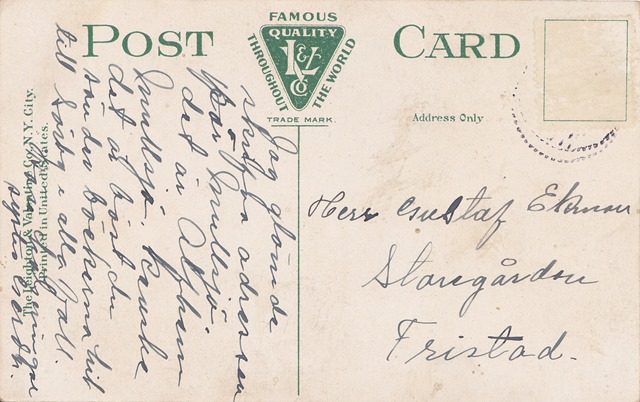
The Leighton & Valentine Co., N.Y. City.
Printed in the United States.

The Soldiers' and Sailors' Memorial Monument in New York commemorates Union Army soldiers and sailors who served in the American Civil War. It is located at 89th Street and Riverside Drive in Riverside Park in the Upper West Side of New York City.

Ground was broken for the monument on September 21, 1900. Mr. Guggenheimer turned the first spadeful of dirt. About 200 people were present at the ground breaking ceremony. The first stone was laid in January 1901. On the cornerstone was a simple inscription saying that the monument was erected by the citizens of New York. It was finally dedicated on Memorial Day in May 1902 with Governor Theodore Roosevelt officiating. During the dedication, the monument was unveiled following a parade of Civil War veterans up Riverside Drive. The memorial bears the simple inscription: "To the memory of the brave soldiers and sailors who saved the Union".  [Wikipedia]

G.015.3B-001

Date: Unknown – probably 1902
To: Herr Gustaf Ekman, Storegården, Fristad
From: Gerda

G.015.3B-002

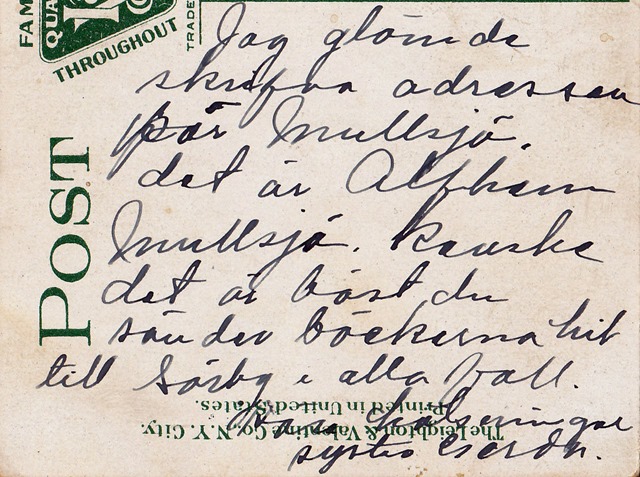
Jag glömde skrifa adressen för Mullsjö. Det är Alfhem Mullsjö. Kanske det är bäst om du sänder böckerna hit till Sörby i alla fall. Kära hälsningar, syster Gerda.

Texten visar att kortet uppenbarligen sänts från Sörby även om bilden är från New York. Poststämpeln har inte lämnat något avtryck. Om vykortet sänts 1902 måste det ha varit på hösten kort innan syskonen emigrerade, eftersom monumentet på bilden inte invigdes förrän i slutet av maj 1902. (I så fall måste kortet antingen ha ingått i en samling nyligen importerade kort; eller ha skickats till Gerda av någon vän som redan emigrerat.) Alternativet är att kortet inte sändes förrän ca tio år senare när båda syskonen var tillbaka i Sverige igen.

In English

I forgot to write the address in Mullsjö. It is Alfhem, Mullsjö.* Maybe you had better send the books here to Sörby after all. Best wishes, sister Gerda.

*Mullsjö is a locality near Jönköping.

The postcard was obviously sent within Sweden even if the view is from New York. As the monument itself was not finished until May 1902, this means the card was either sent in the autumn of 1902 before either of the siblings left for America (but must have had started making plans). If the card was sent in 1902, it must have been in a collection of recently imported ones, or sent to Gerda by some friend who had already emigrated. The alternative  is that this card was not sent until about ten years later, when they were both back in Sweden again. There is not enough left of the postmark to give a clue.