A 'Swenglish' journey through family photos, notes and postcards
from the early 20th century.

2023-10-14

Family Portraits - Sepia Saturday 694


This portrait of  my great grandfather Samuel, born 1835, is the only one of him that exists. The sign he is holding says "Lord, increase our faith". Back in childhood I always wondered why, and I can't recall anyone ever explaining. (Possibly they did not know either.) He was a farmer and a merchant; not a clergyman. However (thanks to research done by one of my dad's cousins), much later I learned that Samuel was involved in the founding of a local free church in 1884. Then he was 49 years old, which seems to fit with this photo.

Back then, he was still married to his first wife, Anna Sophia. She died in 1894. (There is no photo of her.) Together they had 9 children, born between 1866-84. Two died in childhood, and another (at age 31) in 1899, before my own grandmother was born.

In 1898, Samuel got remarried to my great grandmother, Selma (born 1861);  she also a widow, with a young daughter. There is no wedding photo or other portrait of Samuel and Selma together either.


This photo of Selma is probably from her first marriage - or even earlier. Her first husband was younger than her; but died when their daughter Hildur was only two years old.

Together, Samuel and Selma got two more children: my grandmother Sally (born 1900) and her brother Nils (born 1902). Samuel died in 1907 (72 years old) and then Selma was a widow again, now with three young children. She did not get married again, but remained living on the farm with her step-son Carl (single), who had taken over the running of the farm already around 1903/4.  

In the census of 1910, two separate households are listed for the farm: Selma and her children (probably at the time living in a separate cottage) counted as one family; and Carl, his brother Gustaf (recently returned from eight years in America) and their sister Ester (housekeeping for them) as another. Later on, it seems that Carl, his stepmother and her children all lived together in the farmhouse, though. 


Selma (born 1861) and her sister Ida (born 1865). Not sure which year, but my guess is c. 1917. 

Ida and her husband Gustav  in 1908
(the year actually printed on the photo!)


My grandmother Sally (born 1900) and her half-sister Hildur (born 1892 in Selma's first marriage). Same studio background as in the photo of Selma and Ida. Could be from the same occasion.


Hildur, Selma and Sally, around the same time as well. (Compare Hildur's bow tie here to the one Ida is wearing in the first portrait.)


Another studio portrait of Sally and Hildur
 - a few years later, I think.


Sally's half sisters on her father's side, Ester (born 1876) and Gerda (born 1881). Must be from before Gerda emigrated to America - 1902 or earlier.


Ester, a bit later in life (year unknown)


▲Gerda with a friend, from Chicago (1902-1910)▼
LEFT: Gerda to the right - RIGHT: Gerda to the left


Gerda returned to Sweden in 1910/11, but soon went abroad again.


Gerda in Lyon, France, 1913 (or 15?)


Hildur, Gerda and Sally. My guess is that this was taken on Gerda's return from France in 1919 - after the end of WWII.


Gustaf, born 1878, also emigrated to America in 1902, and returned in 1910. The portrait above is from Port Allegany, probably 1903. The photo below is one I just recently found and realised that it must be Gustaf to the right. It's printed on American postcard paper (but not written on) so I'm guessing that it must be from his later years in America. I don't know who the other two men are.


Once back in Sweden, Gustaf did not go abroad again. He helped out on the family farm for a while; then moved away to work elsewhere in Sweden (also with farm work); then returned again to help out at the family farm - and took over when his older brother Carl died in 1928. But I think the farm was sold after Sally, Nils and Hildur all got married and moved away - to do with distribution of inheritance.


Carl, Selma, Hildur and Sally 


Hildur, Selma and Sally, probably summer 1930


Nils, Sally and Selma
("when big hats were the fashion")


Linking to Sepia Saturday 694 - Portraits


2023-10-07

Mysterious Girl with Moustache - Sepia Saturday 693

The Sepia Saturday October theme of Portraits gives me an opportunity to repeat another early post from this blog, with an old postcard that I still find very intriguing.

G.001-3 – Girl with Moustache 
Previously posted on this blog 2012-02-17


A postcard sent to Gustaf at Odensberg in 1901, while he was staying with his brother Oscar. (Cf. my post for SS 690. Before he emigrated to America in 1902, Gustaf seems to have alternated between staying with his father at his farm, vs with his brother who was running a country store at Odensberg.)

The postmark PKXP indicates a railway line and a locality along that line. In the early days, post was sorted aboard the trains.
 
The second printed line on the back of the card (Bostad - om den kan uppgifvas)  indicates that this space is set aside for the recipient's residential address – “if it can be given". Most people probably had to collect their post at the nearest post office, railway station or village shop.


The message is rather mysterious. Besides the moustache and beard added to the image, the message is written in incomplete sentences and using abbreviations ("text message" style of 100 years ago?). The last sentence is also written upside-down; and the sender is anonymous. But this is how I read it:

"Undrar hur Ni befinner Er. Hoppas inte som - hjärtligt tack därför i alla fall - i för. vk. [= i förra veckan] Jag har f.n. tandvärk o är mycket retlig."

“I wonder how you are. Hope not like  - many thanks for that anyway -  last week. I am currently having a toothache, and am very irritable.”  

My guess is that sender and receiver had been "up to something" together the week before, which probably made the message easier to interpret for Gustaf than it is for us, 120+ years later.

The sender has also given the young lady in the picture an ink moustache and beard - in the same way one sometimes sees it done to Da Vinci’s Mona Lisa. 

The remarkable thing is that when I checked, I found that the most famous parody of Mona Lisa with moustache and beard (L.H.O.O.Q by Marcel Duchamp) was not made until 1919. But this postcard was sent in 1901... 

I also noticed one more thing on "my" postcard: An ink line drawn across one of the girl's fingers, which makes it look like she's wearing a ring. (It's on her right hand, while an engagement ring would normally be worn on the left hand - but still...) 

If anyone has come across similar parody images from before 1919, I'd be interested to learn about it!

Linking to Sepia Saturday 693 - Portraits


2023-09-30

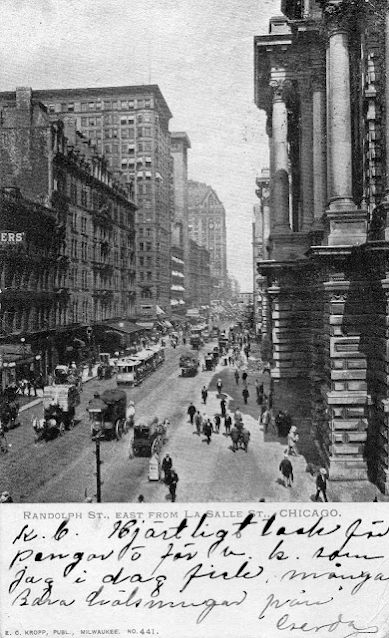
Randolph Street, Chicago (1904) - Sepia Saturday 692

G.027.2 - Randolph Street, Chicago (1904)

Reposted from 2019-06-17


Randolph St., east from La Salle St., Chicago
E.C. Kropp Publ., Milwaukee, No. 441.


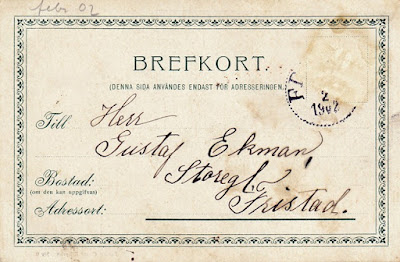
To: Gustaf Ekman, Galeton, PA
From: Gerda, Chicago; Oct 25, 1904 *

K.B. [Käre Broder] Hjärtligt tack för pengar o för v.k. [vykort] som jag idag fick.* Många kära hälsningar från Gerda. 

* 25 oktober var Gerdas födelsedag. (Hon var född 1881; så 1904 fyllde hon 23.)

Dear Brother, Many thanks for the money* and for the postcard that I received today.
Lots of love from Gerda.

* October 25 was Gerda's (23rd) birthday; so the money was probably a birthday gift.

Sister and brother Gerda and Gustaf were older half-siblings of my paternal grandmother Sally. They both emigrated from Sweden to America in 1902 and stayed there for about 8 years. Gustaf went to Pennsylvania to work in the lumber industry, and came to spend most of his time in Galeton. Gerda went to Chicago to work as a housemaid, and  worked her way up to lady's maid. Both siblings returned to Sweden in 1910/11. Gustaf went back to farm work. Gerda continued to work as lady's maid, and most of her employments after she returned from America still involved travelling abroad. During World War I she was in France. From 1928 onward she was employed by the Swedish count Folke Bernadotte and his American wife Estelle Manville-Bernadotte. 

Zooming in the street picture on the postcard: 


The vehicles on this photo seem to be horse-drawn, except for the tram/streetcar/trolley. The first streetcars in Chicago were horse cars, but the companies began substituting cable cars in the 1880s. By 1887, Chicago had the largest cable railway system in the world. It was also in the 1880s that electric-powered trolleys first became practical. The Chicago companies hesitated at first to install these faster and more efficient systems, but by the mid 1890s most of them had begun the conversion to electricity, which was completed in 1906. [Source: Wikipedia - Chicago Surface Lines] 

The busy city life in Chicago must have been such a contrast to the Swedish countryside where Gerda had lived all her life (21 years) until she emigrated.

Linking to Sepia Saturday 692


2023-09-23

Warrior Kings and Salvation Army - Sepia Saturday 691

 G.005.1 - Postcard previously posted on this blog 2012-04-20


005.1A-1
Karl XII:s staty. Stockholm. - Förlag Oscar Ellqvist, Nr 9.
(Statue of King Charles XII of Sweden.)

005.1A-003

Tack för kortet! Skrif Snart! 
Många Hälsningar från en vän - ALARIK

Thanks for the card! Write soon!
Many Greetings from a friend – ALARIK

005.1B-1 
 8.2.1902
To: Herr Gustaf Ekman, Storegd, Fristad

Some of Gustaf's friends back in the early 1900s seem to have enjoyed sending him anonymous and/or cryptic postcard messages. (I suppose he probably did the same to them.) This postcard from Stockholm is signed using the old runic alphabet: 


Runes are very old letters which Germanic people used before they started using Latin letters in the Middle Ages. In its broadest sense, the word runes can mean any cryptic letters, but it usually means the alphabets used by Scandinavian people from about the year 150 AD to the Middle Ages. The oldest of these is called the Elder Fuþark, used from about 150 to 800 AD.

Interest in runes and Old Norse mythology etc had a sort of renaissance here for a while back in the so-called "Romantic Nationalism" of the 19th and early 20th century.

So the name of the friend who sent the card seems to be Alarik. It is an old masculine Germanic name meaning "ruler of all".  Whether this was his real name or not, I don't know. But the name Alarik was added to (i.e. given a "name day" in) the Swedish almanac in 1901. (It is still included - 5 August - but I don't think there are a lot of Alariks around in our time. Names do tend to "come and go", though...) 

One famous Alarik in history was Alaric I, king of the Visigoths from 395 to 410 - said to be the first Barbarian ruler to invade Italy. He was a professed Christian and was also seen by some Christians as God's wrath upon a still pagan Rome.

005.1A-002 

The statue on this postcard is of the Swedish king Karl XII (1682-1718), in Swedish history often called the Warrior King. The statue in Stockholm shown on the postcard was made by Johan Peter Molin (1814-73). It's cast in bronze and weighs 2½ tons.

Modern photo from Wikipedia

005.1A-004

The young women in the foreground on the old postcard are female Salvation Army soldiers, dressed in typical hats, and carrying guitars and and leaflets. 

It's one of those street views which may seem ordinary at first glance - just a statue and some random people - but which could just as well be used to convey a hidden message... To me there seems to be a certain irony in the fact that the women soldiers here are turning their back on the old warrior king, and are walking in the opposite direction to where he is pointing!

The Salvation Army, founded 1865 in London, was introduced in Sweden in 1882 by Hanna Ouchterlony. (Wikipedia) She was born in Värnamo, Sweden, in 1838. From 1857 to 1864 she served as housekeeper with relatives in Stockholm; then opened a book shop in Värnamo. In the 1870s, she had a religious crisis, and became active within Christian social work. In 1878, she got acquainted with Bramwell Booth (son of William Booth, the founder of the Salvation Army) who was visiting Värnamo for recreation. She became identified with the values of the Salvation Army, and Booth considered her suitable to introduce the movement to Sweden. Between 1878 and 1881, she took correspondence courses from the Salvation Army; and in 1881, she visited London, staying in the home of Catherine and William Booth. She became an officer of the Salvation Army in London 28 November 1882; and upon her return to Sweden, introduced the movement here. 

Hanna served as chief of the Swedish Salvation Army from 1882 until 1892. In 1887–1888, she also founded the Norwegian Salvation Army. She travelled for the Salvation Army in the United States in 1892 and was the territorial leader of the movement between 1894 and 1900. She retired in 1904 and died in Stockholm in 1924.

Linking to Sepia Saturday 691 - On the Street


2023-09-16

Falköping, Storgatan (1901) - Sepia Saturday 690

 (G.003.3 - Postcard previously posted on this blog 2012-02-29)

It struck me recently that there must be postcards in my inherited collection which, although I've posted them on the blog before, I did not link to Sepia Saturday. So I decided to go back and look among those for some image to repost for the current Sepia theme. (Actually interesting for myself as well, as I've both learned and forgotten a lot since I started this blog nearly 12 years ago...)

Falköping. Storgatan. (Main Street)


Lindgrens Bok- & Pappershandel (John Swedmark) Falköping.
Sommar-filial vid Mössebergs Badanstalt.
Lindgren's Books & Stationary - Summer Branch at Mösseberg Spa *


The sign on the building to the left says "Coats Shop"

Falköping (with surroundings) is widely known for its ancient remains of Stone Age, Bronze Age and Iron Age. The town is located between the two plateaus Mösseberg* and Ålleberg. The location has been inhabited since the end of the ice age and cultivated by people for 6000 years. (Wikipedia)

* There has been a spa at Mösseberg since 1865. The air up on the hill was considered healthy, there was a spring, and with the railway between Gothenburg and Stockholm passing Falköping (since 1862), the location was easily accessible. In 1885, a sanatorium for patients with tuberculosis was added. (There is still a spa there, but it has of course gone through a lot of changes since the start.)

To: Gustaf Ekman, Storegården, Fristad
From: Oscar Ekman, Odensberg

Obg. 5/10 -01
K.B.! [Käre Broder!] Tack för brefvet! Äfven tack för alla besvär, samt det jag kan få hjälp till erhållande af sågspån. Skall vidare släpas --- [?]. Gerda är som Ni kanske kanske redan vet nu åter uppe o kry, roligt nog! Hälsningar! Oscar

Odensberg 5/10 –01
Dear Brother, Thanks for the letter! Also thanks for all the trouble and for what help I can get to acquire sawdust. Must also be [transported...?] - As you may already know, Gerda is up and well again, I'm happy to report. Regards, Oscar

A postcard from October 1901, about a year before Gustaf and Gerda (brother and sister) both emigrated to America. Oscar was their older brother, manager of a country store in Odensberg, owned by his brother-in-law Brynolf (married to their sister Emma, and running another store in the village Floby, where they also lived). 

Falköping is the nearest bigger town to both Odensberg and Floby.


Oscar’s handwriting is not all easy to decipher, but comparing the information on this card with another card written the same month, it seems that he was doing some kind of work that required sawdust as "filling"(?), and is asking his brother (and perhaps also their father) for help with that. At the time, Gustaf was staying with their father Samuel and his new family (baby Sally - my grandmother - not yet two years old). At the end of the message Oscar adds that Gerda is up and well again – as they might already have heard. (She was probably staying with Emma and her husband in Floby.) 

Both Gustaf (23) and Gerda (20) were probably feeling rootless at this point in time - sometimes staying at their father's farm and sometimes with their older siblings, depending on where their help was best needed. No doubt this contributed to both of them deciding to seek their fortune in America instead. 


Linking to Sepia Saturday 690 - On the Street