A 'Swenglish' journey through family photos, notes and postcards
from the early 20th century.
Showing posts with label Nice. Show all posts

2022-06-24

Côte d'Azur, March 1936 - Sepia Saturday 627

 M.007.01 - MONTE-CARLO

178. MONTE-CARLO - Ensemble du Casino (Demerié et Dutroux, arch.) - LL


To: Herr Gustav Samuelsson, Storegården, Fristad, Suède
From: Gerda  (Nice, 10.3.1936)

Käre bror! Tack för brevet. Blir ej av att man skriver här. Nu har vi skönt väder med sol. Första tiden regnade det mycke. Reser härifrån till U.S.A. den 18 ds. med en båt härifrån som heter [Coute de Suire?] Det tar bara 5 dagar, och den går sydligt, så det blir nog skönt. Vi mår alla bra. Kära hälsningar, Gerda  

[Skrivet upp-och-ner på framsidan av kortet:]
Jag har här (Monte Carlo) i söndags och såg mig omkring.

Dear brother, thanks for your letter. One doesn't get round to writing here. We're having nice sunny weather now. At first it was raining a lot. We'll be leaving for the U.S.A. on the 18th with a ship named [Coute de Suire]* It only takes 5 days, and it will take a southern route, so I expect that will be nice. We're all well. Love, Gerda 

[Written upside-down on the front of the card:] 
I was here (Monte Carlo) on Sunday and had a look around.

Monte Carlo is officially an administrative area of Monaco (officially the Principality of Monaco), a sovereign city-state and microstate on the French Riviera, bordered by France to the north, east and west.

I had difficulties deciphering the name of the ship they would be travelling with to the U.S.A, but my guess is that Gerda had only heard the name spoken, and had difficulties spelling Côte d'Azur (= the French name for the Riviera). (I've not been able to find any ship by that name either that fits the time period - but it seems likely to me that there may well have been one anyway.)


M.007.02 - CÔTE D'AZUR - Jardin Fleuri

62. COTE D'AZUR - Jardin Fleuri


To: Herr Gustaf Samuelsson, Fristad, Storegården
From: Gerda (Nice, 18.3.1936)

K. bror! Nu är vi resfärdiga igen. Här är mycke skönt nu, skulle gärna stanna längre. Hur har du det, hoppas det ej är allt för kallt. Vi mår alla bra. Kära hälsningar, Gerda

Dear brother, now we're ready to travel again. It's very nice here now, I would not mind staying  longer. How are things with you, I hope it's not too cold. We're all well. Love, Gerda

Readers who follow regularly may remember from my post last week (Sepia Saturday 626), that in mid February 1936, Gerda and her employers, Folke and Estelle Bernadotte (and their sons Folke Jr, age 5, and little Bertil, 4½ months) left the gloomy Swedish winter behind and travelled down to Nice on the French riviera, shortly after the tragic death of the couple's 6-year-old son, Gustaf. After about a month's recuperation for them all in the warmer Mediterranian climate, Gerda's postcards to her brother in Sweden tell us that they're now setting off from there to the U.S.A. As I've read ahead, I think the main reason for that was to spend some time with Estelle's parents in Pleasantville, New York.

- - -

Nice was where Folke and Estelle first met, back in the summer of 1928; and the person who introduced them to each other was Folke's uncle, King Gustaf V of Sweden - born 1858, and king from 1907 until his death in 1950. The reason I'm bringing him back "into the picture" this week is the theme of Sepia Saturday 627: Tennis. Because King Gustaf V was also a competitive tennis player, and was often seen playing tennis on the Riviera. (But also in Sweden and in other European countries.) As tennis player he was also known under the alias 'Mr G'.

King Gustaf V playing tennis.
(Photo found online.)


Newsreel clip from 1934
(https://youtu.be/8noWp0nqD8c)

Linking to: Sepia Saturday 627

"Anyone for tennis?"


Vykort M.007.01: MONTE-CARLO - Ensemble du Casino

Till: Herr Gustav Samuelsson, Storegården, Fristad, Suède
Från: Gerda (Nice, 10.3.1936)

Käre bror! Tack för brevet. Blir ej av att man skriver här. Nu har vi skönt väder med sol. Första tiden regnade det mycke. Reser härifrån till U.S.A. den 18 ds. med en båt härifrån som heter [Coute de Suire?] Det tar bara 5 dagar, och den går sydligt, så det blir nog skönt. Vi mår alla bra. Kära hälsningar, Gerda

[Skrivet upp-och-ner på framsidan av kortet:]
Jag har här (Monte Carlo) i söndags och såg mig omkring.

Monte Carlo är ett område i centrala delarna av furstendömet Monaco, som ligger på Franska rivieran vid Medelhavet, några kilometer från den fransk-italienska gränsen men i övrigt omgivet av Frankrike.

Jag kan inte riktigt tyda namnet på båten de skulle resa med till U.S.A, men jag gissar att Gerda hade problem med att stava till Côte d'Azur (det franska namnet för Rivieran). Jag har inte kunnat hitta något fartyg med det namnet som passar in i tidsperioden, men det verkar ändå troligt att det kan ha funnits ett sådant.

Vykort M.007.02 - COTE D'AZUR - Jardin Fleuri

Till: Herr Gustaf Samuelsson, Fristad, Storegården
Från: Gerda (Nice, 18.3.1936)

K. bror! Nu är vi resfärdiga igen. Här är mycke skönt nu, skulle gärna stanna längre. Hur har du det, hoppas det ej är allt för kallt. Vi mår alla bra. Kära hälsningar, Gerda

Den som följer den här bloggen regelbundet kanske minns från mitt inlägg förra veckan (Sepia Saturday 626), att i mitten av februari 1936 lämnade Gerda och hennes arbetsgivare, Folke och Estelle Bernadotte (med sönerna Folke Jr, 5 år och Bertil, 4½ månad) den dystra svenska vintern bakom sig och åkte ner till Nice, kort efter att den äldre sonen Gustaf (6 år) tragiskt hade avlidit i komplikationer efter en svår öroninflammation. Efter omkring en månads återhämtning för dem alla i det varmare medelhavsklimatet, så får vi nu veta (från ytterligare vykort skrivna av Gerda till hennes bror i Sverige) att de nu är på väg att resa vidare till U.S.A. (Och eftersom jag ”läst i förväg” lite, så vet jag att huvudsyftet med det nog var att tillbringa lite tid med Estelles föräldrar i Pleasantville, New York.

- - -

Det var i Nice som Folke och Estelle först träffades, sommaren 1928; och den person som förde dem samman var Folkes farbror, kung Gustaf V. Han var född 1858, och var kung av Sverige från 1907 till sin död 1950. Att jag för in honom i sammanhanget igen i just det här inlägget beror på veckans temabild för Sepia Saturday, som råkar handla om tennis. Gustaf den V var nämligen också aktiv tennisspelare, och sågs ofta spela tennis på Rivieran. (Men också i Sverige och i andra europeiska länder.) Som tävlingsspelare kallades han ofta 'Mr G'.

Fotot av kung Gustaf V på tennisbanan återfinns på flera olika web-sidor.
YouTube-klippet är från 1934. (https://youtu.be/8noWp0nqD8c)


2022-02-18

G.090.01-091.01 - "Away On A Little Trip Again" (1918) - Sepia Saturday 609

 G.090.01 - Lyon (January, 1918)
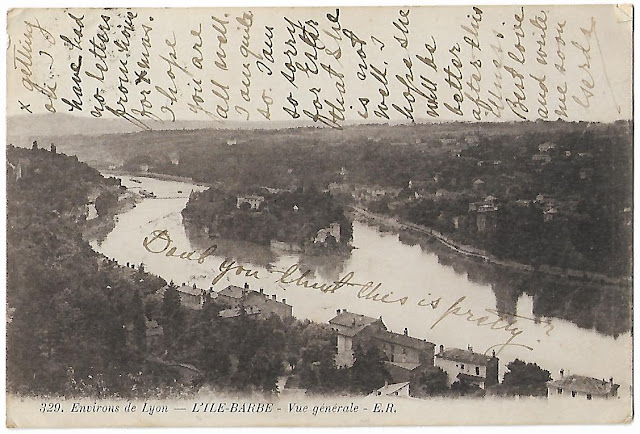
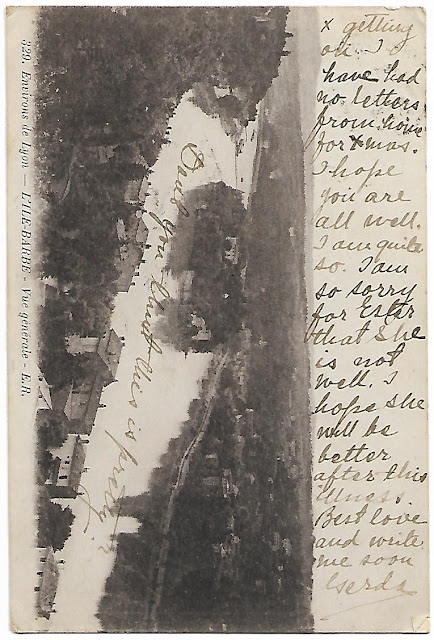
329. Environs de Lyon - L'ILE-BARBE - Vue génerale - E.R.

In the vicinity of Lyon - L'ile Barbe (Barbe Island) 
I närheten av Lyon - L'ile Barbe 

Don't you think this is pretty? 
Visst är detta fint?


To: Mr Gustaf Ekman, Backa, Brålanda, Suède (Sweden)
From: Gerda (Lyon, 14.1.1918)

Ouvert par l'Autorite Militaire
Opened by the Military Authorities


31 av. de Noailles, Lyon
My dear brother, Did you get my card I sent you to Xmas? I have not heard from you for a long time. I am writing this in english because I think you >> will get it quicker and if you can write me a card in english and tell me how Ester is ...


... getting on. I have had no letters from home for Xmas. I hope you are all well. I am quite so. I am so sorry for Ester that she is not well. I hope she will be better after this illness. Best love, and write me soon. / Gerda

Ester was one of Gerda's and Gustaf's older sisters - born 1876, two years older than Gustaf, five years older than Gerda. Like Gerda, she never got married; but unlike her two younger siblings, she did not emigrate with them to America in 1902, but stayed in Sweden. After working as housekeeper at a big estate, and then at a garden center, she ran her own flower shop (in Mullsjö near Jönköping); and later a confectionary. Whatever her health problem was in 1918 (at age 42),  she lived to be 82.  

31 av. de Noailles, Lyon (14.1.1918)
Min käre bror, fick du mitt kort som jag skickade dig till jul? Jag har inte hört något från dig på länge. Jag skriver detta på engelska därför att jag tror du får det snabbare [då]. Och om du kunde skriva ett kort till mig på engelska och tala om hur Ester mår? --- Jag har inte fått några brev hemifrån till jul. Jag hoppas att ni alla mår bra. Med mig är det rätt bra. Jag är ledsen att Ester inte mår bra. Jag hoppas hon ska bli bättre efter den här sjukdomen. Kära hälsningar, och skriv snart. / Gerda  

Ester var en av Gerdas och Gustafs äldre systrar, född 1876,  två år äldre än Gustaf, fem år äldre än Gerda. Liksom Gerda gifte hon sig aldrig, men hon emigrerade inte med de yngre syskonen till Amerika, utan stannade i Sverige. Efter att ha arbetat som hushållerska på en egendom nära Falköping, och sedan på en trädgårdsskola, drev hon sedan under många år en blomsterhandel i Mullsjö, och därefter en konfektyrbutik. Vilka hälsoproblem hon led av 1918 vet jag inte - men hon levde till att bli 82 år gammal.


G.090.02 - Nice / Menton (April, 1918)
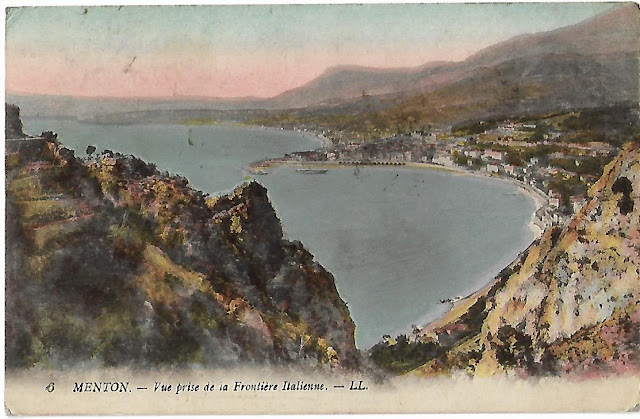


6. MENTON. - Vue prise de la Frontière Italienne. - L.L.

MENTON - View from the Italian border.
MENTON - Vy tagen från italienska gränsen.


To: Mr Gustaf Ekman, Storegården, Fristad, Suède
From: Gerda (Nice, 10.4.1918)
Ouvert par l'Autorite Militaire
Opened by the Military Authorities

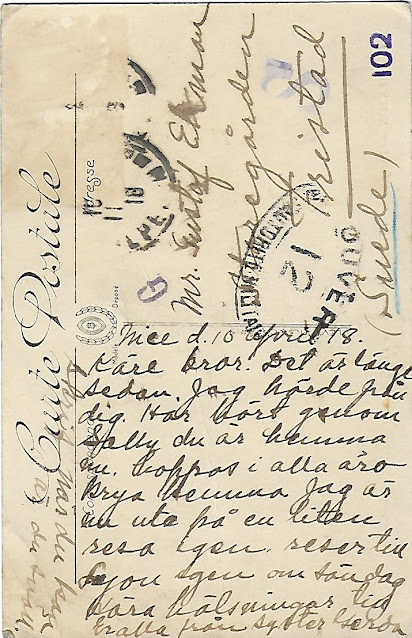
Nice d. 10 april 18
Käre bror! Det är länge sedan jag hörde från dig. Har hört genom Sally du är hemma nu. Hoppas ni alla äro krya hemma. Jag är nu ute på en liten resa igen. Reser till Lyon igen om söndag. Kära hälsningar till er alla från syster Gerda. - Skrif när du kan är du snäll.

Gerdas första kort 1918, skrivet i mitten av januari, sände hon till Gustafs adress i Brålanda, där han bott de senaste fem åren. När hon skriver igen i april, från Nice på franska rivieran, har hon fått veta - inte av Gustaf själv, men av deras yngre halvsyster Sally (min farmor), att han flyttat "hem" till Storegården i Fristad, Västergötland. (Mer om detta längre ner.)

Nice. 10 April 1918
Dear Brother, it's been a long time since I heard from you. I heard from Sally that you are home now. I hope you are all well there. I am now away on a little trip again. Will be going back to Lyon on Sunday. Love to you all from sister Gerda. - Write when you can, please.

Gerda's first card in 1918, written in mid January, was sent to Brålanda in Dalsland, where Gustaf had been living for about five years (since around Christmas 1913). When she writes again in April, from Nice on the Riviera, she has learned, not from Gustaf himself, but from their younger half-sister Sally (my grandmother), that he has moved back "home" to the family farm Storegården at Fristad, in the province of Västergötland. (More about that below.)


G.090.03 - Brides-les-Bains (August, 1918)


1673. BRIDES-les-BAINS et les Glaciers de Vanoise


To: Mr Gustaf Ekman, Storegården, Fristad, Suède (Sweden)
From: Gerda (Brides-les-Bains 13.8.1918)

Ouvert par l'Autorite Militaire
Opened by the Military Authorities

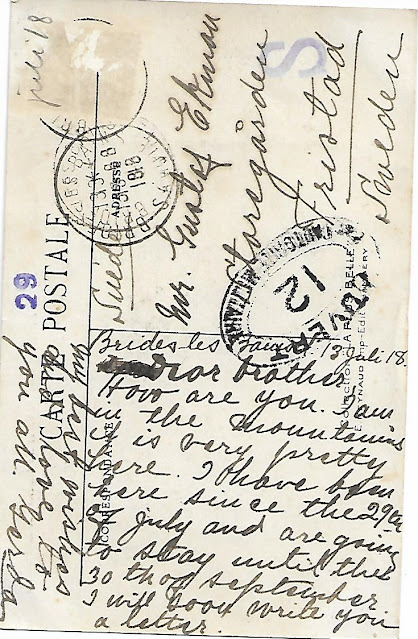
Brides-les-Bains 13 juli '18 [August] *
Dear brother, How are you. I am in the mountains, it is very pretty here. I have been here since the 29th of July * and are going to stay until the 30th of september. I will soon write you a letter. My best wishes and love to you all. / Gerda

* There is some mix-up of dates here. The postmark seems to say 13.8 so I think she arrived 29 July, and wrote the card 13 August. 

Brides-les-Bains 13 juli '18 [augusti] *
Käre bror, hur mår du? Jag är i alperna, det är väldigt vackert här. Jag har varit här sedan 29 juli * och ska stanna till 30 september. Jag ska snart skriva ett brev till dig. Kära hälsningar till er alla. / Gerda

* Något datum måste vara fel här. Poststämpeln ser ut att vara 13.8. Jag tror hon anlände 29 juli, och skrev kortet 13 augusti. 


MEANWHILE IN SWEDEN.... (May 1918)


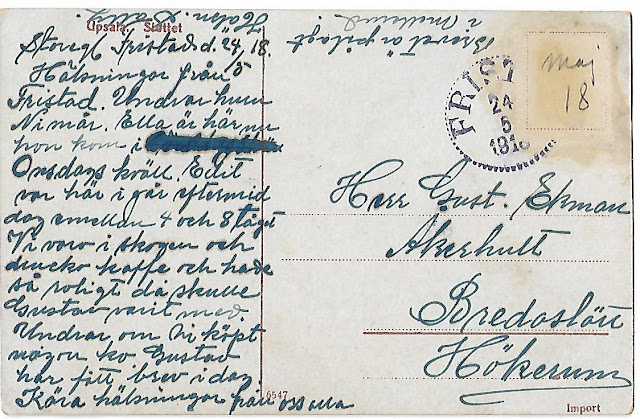
G.091.01 - Uppsala Castle 
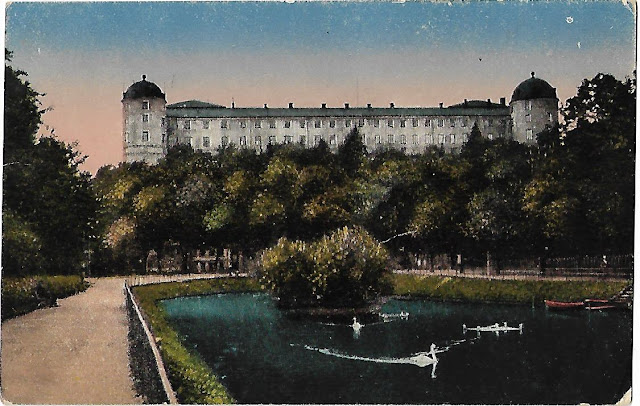
Upsala. Slottet

(The image on the card is not related to the message.)


To: Herr Gust. Ekman, Åkerhult, Bredaslätt, Hökerum
From: Sally (Gustaf's younger half-sister, my grandmother) 
(Fristad 24.5.1918)

Storegd Fristad d. 24/5 '18. 
Hälsningar från Fristad. Undrar huru Ni mår. Ella är här nu, hon kom i onsdags kväll. Edit var här igår eftermiddag emelllan 4 och 8-tåget. Vi voro i skogen och drucko kaffe* och hade så roligt, då skulle Gustav varit med. Undrar om Ni köpt någon ko. Gustav har fått brev idag. Kära hälsningar från oss alla. Hälsn. Sally

Storegården Fristad, 24.5.1918
Greetings from Fristad. I wonder how you are. Ella is here now, she came Wednesday night. Edit was here yesterday afteroon between the 4 pm and 8 pm trains. We were in the woods and had coffee* and had such a good time. You should have been with us. I wonder if you have bought any cow. You have had a letter today. Love from us all, Sally

---

From some Christmas cards from 1917, I conclude that Gustaf moved back to Storegården, Fristad, around Christmas 1917 (after five years at Brålanda in Dalsland, some further 130 km north of Fristad, and before that, one year in Värmland, a bit further north still). He'll be 40 years old in the summer of 1918.

Storegården (name meaning "Big Farm") was the family farm, in 1918 run by the eldest brother Carl (48), living there together with his stepmother Selma (57)  and her three children - a daughter from her first marriage, Hildur (26),  my grandmother Sally (18) and Nils (16). (The father, Samuel, died back in 1907.) 

As for the reason why Gustaf moved back, I can only speculate. Maybe Carl had expressed need of his help? Maybe Gustaf simply was no longer happy with his situation in Brålanda, and missing his family? And/or maybe (as has been vaguely hinted at now and then in his wartime correspondence with Gerda) he did actually eventually win a bit of money in a lottery - not enough to go into farming on his own, but perhaps enough to enter into some kind of partnership with his brother? 

Alas, I can't recall ever hearing any family story told about this. All I have is those mysterious allusions on various wartime postcards, with Gerda repeatedly wishing her brother "luck" connected to the same recurring date, the 15th. And then, in 1917, suddenly a couple of hints that Gustaf seemed to be thinking of moving to a farm of his own. But then the fact that towards the end of 1917, he moved back to the family farm in Fristad instead - and remained living there for many years to come.

But, getting back to May 1918: If Gustaf has moved back - why is Sally writing to him at a different address?? 

The villages Fristad and Hökerum are situated only about 20 km apart. And Sallys question at the end suggests that Gustaf has gone to Hökerum with a purpose: To buy a cow. (Which seems to support the idea of him now taking active part in running the farm.) 

Sally (my grandmother, now 18 years old) seems to have taken over as "main correspondent" at the farm. Back in those days, they used postcards pretty much as we send digital text messages today. So she sends a card just to tell Gustaf that they have had visitors in his absence, and that a letter is waiting for him at home. (I'm so glad she also added the question about the cow, though, as that explains why he's away.) 

The visitors, Ella and Edit, were their nieces, daughters of their oldest sister Emma. Emma, born in 1866, was 44 (!) years older than Sally (and only five years younger than her "stepmother", Sally's mother Selma). I don't have the dates of birth of Ella and Edit, but thinking about it, I realise that they must have been older than Sally, and to her probably would have felt more like older cousins than "nieces". 

- - - 

*/ "We were in the woods and had coffee"
Still in my own childhood (1950s), my grandma Sally loved a "coffee picnic". An illustration that my mother made in 1957, in my first photo album, came to mind for me. I recognise Sally's basket...
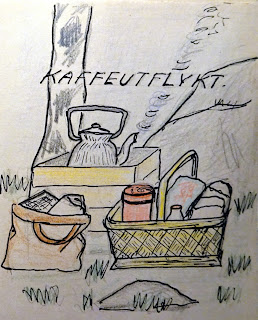
Kaffeutflykt - Coffee Picnic

And in one of Sally's photo albums, I found this photo (below), which she has dated to 1921, and with a note that the occasion was "a break in the work of potato lifting". As the photo is rather blurry, I'm not sure who is who. It could be Gustaf in the middle, thoguh, holding a cup. And possibly Sally on the right. 
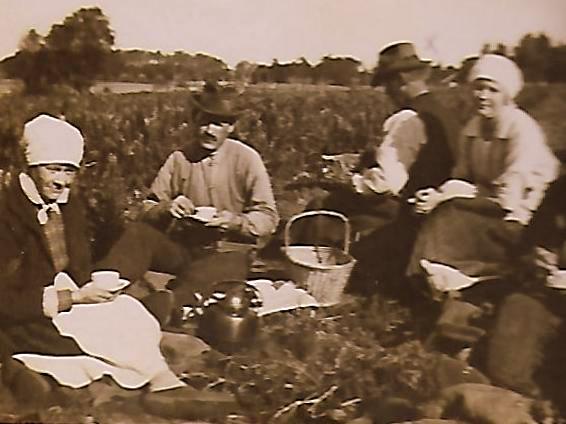
"Paus i potatisupptagning 1921"

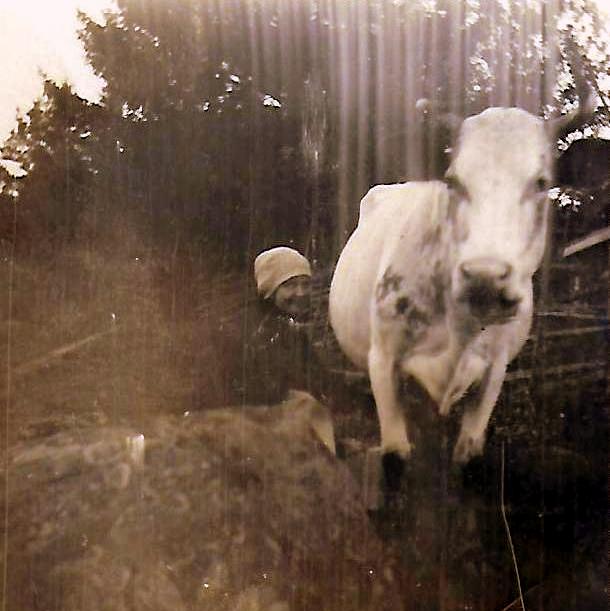
In the same  album, there are also two blurry photos to do with milking cows on the farm. Neither of them has a date attached but my guess is that they are from around the same time. I think it's probably Sally in both photos.

"Inför kvällsmjölkningen" - Going to evening milking


"Kon mjölkas" - Milking the cow

- - -

World War One ended at 11 am on 11 November, 1918.
(This became known as Armistice Day.)

Gerda remained in France until the end of September 1919;
then she returned to Sweden.

(That was not the end of Gerda's travels, though!) 

- - -

I have no more postcards written by Gerda in 1918, nor any from 1919. But according to notes I received back in 2013 from a relative (BW, grandson of Emma), a work certificate, dated 28.9.1919 in Lyon, states that Gerda has been working as Lady's Maid, and is an excellent packer and hairdresser and a neat needlewoman, and her French is good. I also know that after her employment in Lyon ended, she did go back to Sweden - but that this was not the end of her travels. Although I have no  postcards written by Gerda from the next decade (until 1928), I do have some other clues. So I'll try to continue the story, putting together what I have.


"I am away on a little trip again."

- - -

SVENSKA

Av några julkort från 1917 drar jag slutsatsen att Gustaf flyttade tillbaka till Storegården i Fristad omkring jul 1917 (efter fem år i Brålanda, Dalsland, och dessförinnan ett år i Värmland). Sommaren 1918 ska han fylla 40 år.

Storegården var familjejordbruket, vid denna tid skött av äldste brodern Carl (48), som bodde där tillsammans med sin styvmor Selma (57) och hennes tre barn: en dotter från hennes första äktenskap, Hildur (26), min farmor Sally (18) och Nils (16). (Fadern, Samuel, dog redan 1907.)

När det gäller orsaken till att Gustaf flyttade tillbaka, kan jag bara spekulera. Kanske hade Carl uttryckt behov av hjälp? Kanske trivdes Gustaf bara inte längre med sin situation i Brålanda? Eller var det faktiskt så (som antytts då och då under kringsårens korrespondens med Gerda), att han till sist faktiskt vunnit lite pengar på lotteri - dock inte tillräckligt för att flytta till en egen gård trots allt, men kanske tillräckligt för att ingå någon form av partnerskap med brodern?

Tyvärr kan jag inte erinra mig att jag någon gång hört en sådan historia refereras till inom familjen. Allt jag har är de mystiska antydningarna på flera vykort från kringsåren, där Gerda önskar honom tur och lycka till, i anknything till ett upprepat datum: den 15. Och sedan, 1917, antydningar om att han verkar ha planer på att flytta från Brålanda till en egen gård (oklart var). Men sedan istället, kring jul 1917, flyttar tillbaka till Fristad - och blir kvar där. 

Men, för att återvända till Sallys vykort från 1918: Om nu Gustaf flyttat tillbaka till Storegården - varför skriver då Sally ì maj 1918 till honom på en annan adress? Svaret finns i texten. Hökerum ligger bara ett par mil från Fristad, och tydligen är Gustafs ärende där att köpa en ko. (Vilket verkar tyda på att han nu är aktivt involverad i skötseln av Storegården.) 

Sally, 18 år nu, verkar ha tagit över som "förste korrespondent" på gården. Vykort vid den här tiden användes fortfarande ungefär som vi skriver textmeddelanden idag, så hon skriver för att meddela Gustaf att de haft besök under hans frånvaro, och att ett brev också väntar på honom hemma. (Jag är glad att hon även la till frågan om koköpet, eftersom det förklarar varför han är borta!)

Besökarna, Ella och Edit, var döttrar till äldsta systern Emma. Emma, född 1866, var hela 44 år äldre än Sally (och bara fem år yngre än sin "styvmor" Selma). Jag har inte Ellas och Edits födelsedatum, men inser när jag tänker på saken att de måste ha varit äldre än Sally, och måste ha känts mer som äldre kusiner till henne än "systerdöttrar". 

"Vi voro i skogen och drucko kaffe."
Fortfarande i min barndom älskade Sally att göra "kaffeutflykter". Teckningen med kaffekorgen är ritad av min mamma, i mitt första fotoalbum. Fotot nedanför är från ett av Sallys album, och försett med anteckningen "Paus i potatisupptagning 1921". Fotot är lite suddigt, så inte helt lätt att identifiera personerna, men jag tror det kan vara Gustaf i mitten, med kaffekopp, och Sally till höger.

I samma album finns också två foton som hör ihop med kor : "Inför kvällsmjölkningen" och "Kon mjölkas". Antagligen är det Sally på båda bilderna. 

- - -

Första Världskriget upphörde kl 11.00 den 11/11 1918.

Gerda blev kvar i Lyon i Frankrike till slutet av september 1919;
sedan återvände hon till Sverige.

Hon kom dock att göra många fler utlandsresor under sitt liv.

---

Jag har inga fler vykort skrivna av Gerda från 1918, och inte heller 1919 (och ett antal år därefter). Men enligt uppgifter jag fick 2013 av Bengt W, sonson till Emma, finns ett intyg daterat 28.9.1919 i Lyon, som bekräftar att Gerda varit anställd som Lady's Maid (kammarjungfru), och att hon skicklig både på att packa, och som hårfrisörska och sömmerska, och talar bra franska. Jag vet också att hon efter att ha avslutat anställningen i Lyon reste tillbaka till Sverige - men att detta långt ifrån innebar slutet på hennes resande. Även om jag inte har några vykort skrivna av Gerda under de närmast följande åren, så har jag en del andra uppgifter och foton. Och sedan några vykort till, från 1928 och in på 30-talet. Så jag hoppas kunna fortsätta historien genom att lägga pussel med det jag vet.  

2022-02-06

G.085.03 - G.086.01 - "I hope you don't forget your English" (1916) - Sepia Saturday 606

May 1916. Gerda is back in Lyon again, after the trip to the French riviera earlier in the spring (cf. previous post). Within a week, she writes two postcards to her brother Gustaf in Sweden: One in English,  posted in Lyon. The other in Swedish, and posted in Switzerland by a friend. She still obviously does not trust the wartime postal services. But she is also trying to encourage Gustaf not to forget the English he learned during his years in America (1902-11). It's been five years now since they both returned from there to Sweden. In her own employments as lady's maid and travel companion to wealthy ladies, Gerda has found continued use of her English (and has by now probably also learned some French). Gustaf, working on Swedish farms, most likely has not had much chance to practice his English at all since he returned.  

To me, Gerda's postcards written in English prove that she not only learned to speak the language but also to write it quite fluently. Considering she never had any higher education (probably just 6-7 years of school in Sweden), I find that quite impressive. It makes me wonder if she had the opportunity to attend some evening classes during her years in Chicago, or if she just learned from "picking things up" and reading papers etc. 

G.085.03 - Lyon 

399. - LYON.- Perspective des Ponts sur le Rhône - E.R.

To: Herr Gustaf Ekman, Backa, Brålanda, Suède (Sweden)
From: Gerda (Lyon, 24.5.1916)

Lyon d. 24 maj '16
Dear B[rother],  How are you. It is a long time since I heard from you. Perhaps it is my turn to write, I forgot. If so I hope you will forgive me. Best love from Gerda. -  I hope you don't forgot your english. I will send you some papers.  -  When I come home we will speak english all the time but I don't know when yet.

Lyon d. 24 maj '16
Käre bror, hur mår du. Det är länge sedan jag hörde från dig. Kanske är det min tur att skriva, jag minns inte. Om så är hoppas jag du förlåter mig. Kära hälsningar från Gerda. - Jag hoppas du inte glömt din engelska. Jag ska skicka dig några tidningar. -  När jag kommer hem ska vi prata engelska hela tiden, men jag vet inte när än. 


G.086.01 - Nice

66 - NICE-CIMIEZ - HOTEL RIVIERA PALACE
Edition GILETTA. - Nice


To: Mr Gustaf Ekman, Backa, Brålanda, Suède (Schweden)
From: Gerda (written in Lyon 1.6.1916 - posted in Bern, Switzerland 6.6. 1916)

K. bror! Sänder dig de hjärtligaste lyckönskningar på Gustaf-dagen! Hoppas det kommer i tid. Här kan du se hotellet som vi bodde på när vi var ute på resa. Jag märker våra rum X. Jag sänder dig några engelska tidningar, tänkte du tycker om att läsa dem. Kära hälsningar, syster Gerda.  -  Skriv snart  -  Jag har en god vän i Schweiz som sänder detta kort.

Dear Brother, I'm sending you my best wishes for Gustaf-day  [Gustaf's name-day, 6 June]. I hope it will arrive on time. [It obviously didn't.] Here you can see the hotel where we stayed on our trip. I'm marking our rooms with X. I'm sending you some English newspapers, I thought you might like to read them. Love, sister Gerda. -  Write soon  -  I have a friend in Switzerland who will post this card. 

Linking to Sepia Saturday 606 
(same as last week, since no new prompt for this week)


"Perhaps it is my turn to write"


2022-01-29

G.085.01-02 - Greetings from Monte Carlo and Nice (Spring 1916) - Sepia Saturday 606

In March and April 1916, Gerda is writing to her brother Gustaf from Nice on the French Riviera (Côte d'Azur) - the Mediterranean coastline of the southeast corner of France. (Obviously her employer/s is/are still free to travel in the eastern parts of France.) She switches languages between English and Swedish, perhaps partly because she is used to speaking/thinking in English, but it may also be that she's trying to figure out if letters/cards in English will be forwarded faster than if she writes in Swedish (if the post has to pass censorship on the way). She knows that Gustaf understands English well enough, as they both lived in America between 1902-1911. 


G.085.01 - Monte Carlo

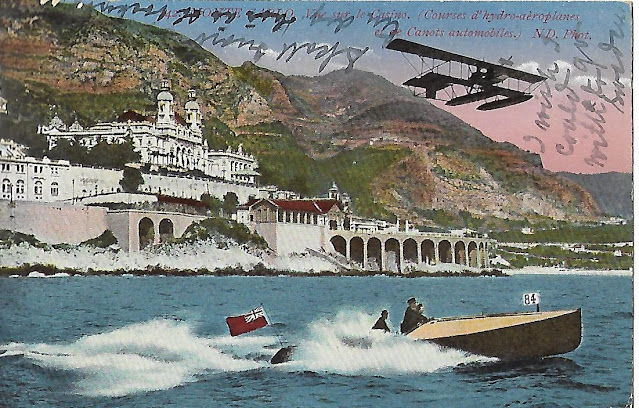
?42. MONTE CARLO. Vue sur le Casino. 
Courses d'hydro-aéroplanes et de Canots automobiles. ND Phot.

Monte Carlo Casino "is a gambling and entertainment complex located in Monaco" [Wikipedia]

This card also features a hydro aeroplane and a motorboat. 

"The first experimenter to succeed in making an aeroplane rise from the surface of the water was the French inventor, M. Fabre, who accomplished this feat with a monoplane of his own invention the last of March, 1910. About a year later Glenn Curtiss, at San Diego, fitted a float to his biplane and made it rise from the water and alight thereon with complete success during the course of his experiments."   https://www.scientificamerican.com/article/the-hydro-aeroplane/ 


To: Mr. Gustaf Ekman, Backa, Brålanda, Suède (Sweden)
From: Gerda (Nice, 8.3.1916)

Nice, March 7.16 - D.B. [Dear Brother] Thank you very much for your letter today. Glad to hear from you that you are well. I am still writing to the Swedish-American soldier. Yes, he is very glad to have found somebody that cares for [him?] a little. Can you read this. Love, Gerda / I will write to you soon. It is so beautiful here. / I wish I could go with to Sweden. *
[* This PS written next to the aeroplane on the front of the card]

Nice, mars 7.16 - K.B. [Käre Broder] Tack så väldigt mycket för ditt brev idag. Glad att höra från dig att du mår bra. Jag skriver fortfarande till den svensk-amerikanske soldaten. Ja, han är glad att ha funnit någon som bryr sig om honom lite. Kan du läsa detta. Kära häls. Gerda / Skall snart skriva till dig. Här är så vackert. / Jag önskar jag kunde åka med till Sverige. *
[*Detta PS skrivet intill flygplanet på bilden.]

It seems that in some context, Gerda has come into contact with a Swedish-American soldier. I've not seen any other references to this among the postcards, so she must have mentioned him in a letter (as Gustaf has obviously asked if she's still in touch with him.) I'm feeling a bit puzzled about where she might have met him. America didn't enter the war until 1917. Were there American soldiers in France even before that? Or was this someone she had met before the war? Somehow it doesn't sound to me like she's referring to an acquaintance going back as far as to her years in America. 

A few more searches, and I find an article entitled Over There, Before 1917. 

"World War I essentially began Aug. 4, 1914, with the German army’s invasion of Belgium. The United States entered the conflict on the side of the Allies (Great Britain, Belgium, France, Italy and Russia) on April 6, 1917. During the intervening 32 months, America remained neutral ­– but many Americans did not. Thousands volunteered for the Allied cause."

Some of them joined the French Foreign Legion. As Americans, they could not swear allegiance to another country, but "in the Foreign Legion, one theoretically swore allegiance only to it, not to France". 

"If anything characterized Americans who joined the Foreign Legion, it was their variety. They had only one common denominator: the desire to fight for France. [---] Some came from wealth, others did not; some were college graduates, others dropouts; some managed to at least graduate high school, and others did not. Some were black, others white. The Foreign Legion was the only military unit of World War I in which Americans of different races were comrades in arms."

And one of them, I suppose, may have been a Swedish American, with a bit of his heart still in Europe - or maybe just feeling he didn't have much left to lose, and no one to care for him? 

A search for "French Foreign Legion Lyon" informs me that there is (now) a French Foreign Legion Recruiting Center in Lyon. I can't find the history, but it seems plausible that if they're there now, they were there back in WW1 as well. 

As for how Gerda might have met him, the photo of her as a Red Cross volunteer comes to mind for me - previously posted here for Sepia Saturday 596. (Copying the photo below as well.) Date and place for the photo unknown, but as I now feel sure that Gerda lived in Lyon for the duration of the war (apart from occasional 'holiday' trips to Lake Geneva and the Riviera!), it seems likely that it was also in Lyon that she sometimes helped out as a Red Cross volunteer. 

It's rather satisfactory when one manages to come up with a theory - even if I'll never know for sure! ;-)


G.085.02 - NICE

34 - NICE - Avenue de la Gare


To: Herr Gustaf Ekman, Backa, Brålanda, Suède
From: Gerda (Nice, 3 April 1916)

Nice d. 2. 4.16 - K.B. [Käre Bror] Det är visst länge sedan jag skrev till dig. Hur har du det, är du ännu kvar på samma plats. Vi äro nu här i härliga södern, 25 gr. varmt i solen i dag. Vi reser nog till Lyon igen om ett par veckor. Kära hälsningar, Gerda. / Jag undrar hur det går med vinsten?

Nice 2.4.16 - D.B. [Dear Brother] I think it's been a while since I last wrote to you. How are you, are you still staying at the same place? We are now here in the lovely south, 25 degrees in the sun today. We'll probably be going back to Lyon again in a couple of weeks. Love, Gerda. / I'm wondering how things are going with the winnings? *

*The Swedish word 'vinsten' could be interpreted either as winnings like from a lottery, or profit from an investment etc. As Gerda  on previous postcards has been wondering about "luck" connected to the 15th of a few different months, I assume that she is still  referring to some kind of lottery.

Compare the postcard from Sally in last week's post, written 27.3.1916. She too was wondering if Gustaf was still in the same place - or "if you have moved to your own farm now in March, or if you have sold your farm".  

Linking to Sepia Saturday 606


"I think it's been a while since I last wrote to you."